Quick Intro
The word action is common in everyday English. People use it in conversation, writing, business communication, and storytelling.
Learning synonyms for action helps you express ideas more clearly. It also improves vocabulary for students, ESL learners, and writers. Using the right alternative word can make your sentence more precise and natural.
Direct Answer
Meaning of action:
Action means doing something or taking steps to achieve a result.
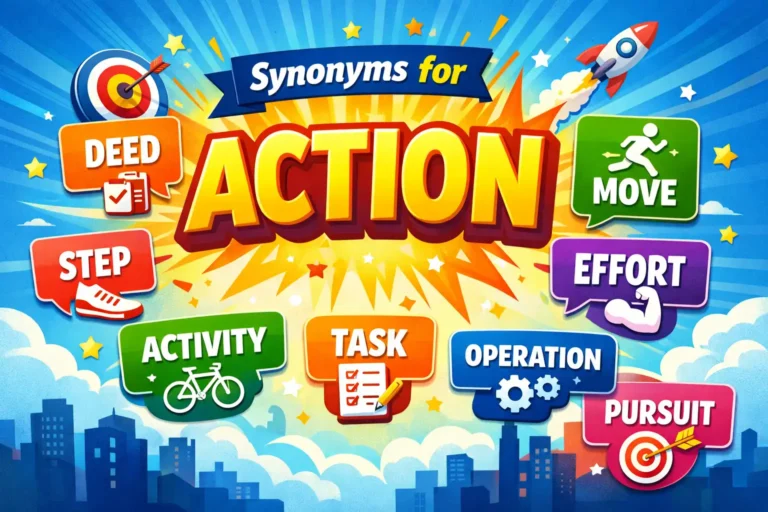
Common synonyms for action include:
- act
- move
- step
- deed
- activity
- operation
- procedure
- initiative
- measure
- effort
- undertaking
- maneuver
Categories of Synonyms
Physical Action
These words describe visible or physical movement or behavior.
Examples include act, move, deed, and maneuver. These terms focus on something someone actually does.
Strategic or Planned Action
Some synonyms describe deliberate steps taken to achieve a goal.
Examples include initiative, measure, operation, and procedure.
Effort or Goal-Oriented Action
These words emphasize trying to achieve something.
Examples include effort, undertaking, and activity.
Synonyms Table
| Word | Simple Meaning | Example Sentence |
| act | something someone does | Her quick act helped solve the problem. |
| move | a step or decision | The company made a smart move in the market. |
| step | one stage in a process | This step improves safety. |
| deed | a notable action | The firefighter performed a brave deed. |
| activity | something people do | Outdoor activity is good for health. |
| operation | a planned action | The rescue operation started early. |
| procedure | a specific method | Follow the correct procedure carefully. |
| initiative | the ability to act first | She showed great initiative at work. |
| measure | an action taken to solve a problem | The government introduced new measures. |
| effort | attempt to do something | His effort improved the results. |
| undertaking | a major task or project | Building the bridge was a big undertaking. |
| maneuver | a skilled movement or tactic | The pilot made a sharp maneuver. |
Master Synonyms List (Grouped by Level)
Beginner / Simple
Act
Meaning: something a person does.
Example: She quickly acted to stop the mistake. (Informal)
Move
Meaning: a decision or step taken in a situation.
Example: His next move surprised everyone. (Informal)
Step
Meaning: a stage in solving a problem.
Example: The first step is understanding the issue.
Deed
Meaning: an action, often important or meaningful.
Example: The volunteer performed a kind deed.
Intermediate
Activity
Meaning: something that people do regularly.
Example: Physical activity keeps the body healthy.
Measure
Meaning: an action taken to fix or control a problem.
Example: New measures improved workplace safety.
Effort
Meaning: trying hard to achieve something.
Example: Her effort helped the team succeed.
Initiative
Meaning: the ability to take action independently.
Example: He took initiative to finish the project early.
Advanced / Formal
Operation
Meaning: a complex or organized action.
Example: The rescue operation saved many lives. (Formal)
Procedure
Meaning: a formal method or system of action.
Example: Hospitals follow strict procedures. (Formal)
Undertaking
Meaning: a serious project or responsibility.
Example: Starting a company is a major undertaking. (Formal)
Maneuver
Meaning: a strategic or skilled movement or action.
Example: The driver made a careful maneuver. (Formal)
Formal vs Informal Synonyms
Some synonyms for action are more suitable in formal writing.
Informal or everyday language
- act
- move
- step
- effort
These are common in conversation and casual writing.
Formal or professional language
- operation
- procedure
- measure
- undertaking
These appear often in business reports, academic writing, or official documents.
Choosing the correct tone helps make communication clearer and more appropriate for the audience.
Real-Life Usage Examples
Conversation
“Your quick action saved the situation.”
Academic Writing
“The government implemented new measures to control pollution.”
Business Writing
“The company took immediate steps to improve customer service.”
Blogging
“Small daily actions can lead to big lifestyle changes.”
Emotional Expression
“His kind deed made everyone feel grateful.”
Similar Words Comparison
Action vs Act
Action is a general term for doing something.
Act usually refers to one specific behavior.
Example:
He took action to fix the problem.
Helping the stranger was a kind act.
Action vs Initiative
Action means doing something.
Initiative emphasizes starting something without being told.
Example:
She took action to complete the task.
She showed initiative by starting early.
Example Sentences
- Quick action prevented a serious accident.
- The manager took measures to reduce costs.
- His brave deed inspired the entire community.
- The team made a strategic move during negotiations.
- Exercise is an important daily activity.
- The rescue operation lasted several hours.
- The company introduced a new safety procedure.
- Her strong effort improved the final result.
- The project became a major undertaking.
- The pilot performed a precise maneuver.
- Taking the first step is often the hardest part.
- She showed great initiative at work.
- The government introduced emergency measures.
- One positive action can change everything.
- Every small effort matters.
Common Mistakes
Using rare or unnatural synonyms
Some learners use uncommon words that native speakers rarely use. Stick to common vocabulary like act, step, or effort.
Choosing the wrong tone
Using procedure in casual conversation may sound unnatural.
Repeating the same synonym
Writers often repeat action or act too many times. Variety improves readability.
Using synonyms without understanding meaning
Not all synonyms mean exactly the same thing. Measure usually refers to policy or problem-solving steps.
Tips / Best Practices
Choose synonyms based on the context. A business report may require formal terms like measure or procedure.
Consider the tone of your writing. Casual writing often uses simple words like step or move.
Pay attention to clarity. The best synonym is the one readers understand easily.
Avoid overusing the same word. Using different synonyms naturally improves writing and prevents keyword stuffing.
When NOT to Use Action
Sometimes action is too vague. In technical writing, a more precise word is better.
Example:
Instead of “take action,” you might say:
- implement a procedure
- introduce a measure
- begin an operation
Choosing a specific word makes writing clearer.
Opposite Words (Antonyms)
Common antonyms for action include:
- inaction
- inactivity
- passivity
- hesitation
- delay
These words describe the absence of action.
FAQs
What does action mean?
Action means doing something or taking steps to achieve a result.
Is action formal or informal?
The word action is neutral and can be used in both formal and informal contexts.
How can I use action in conversation?
Example: “We need to take action before the problem gets worse.”
What is the best synonym for action?
Common alternatives include act, step, effort, measure, and initiative.
Can action be replaced with act?
Sometimes yes. However, act usually refers to one specific behavior.
What synonym works best in business writing?
Words like measure, procedure, and initiative work well in professional contexts.
What synonym is best for daily conversation?
Simple words like step, move, or effort sound natural in conversation.
Is initiative a synonym for action?
Yes, but initiative emphasizes starting something independently.
What is the opposite of action?
Common opposites include inaction, passivity, and inactivity.
Why should I learn synonyms for action?
Learning synonyms improves writing, speaking, and vocabulary clarity.
Conclusion
Understanding synonyms for action helps improve communication. It allows writers and speakers to express ideas with better precision and clarity.
By learning alternatives like act, step, measure, effort, and initiative, you can strengthen both writing and conversation skills.
Try using three new synonyms in your next sentence to expand your vocabulary.

Thomas Walker focuses on practical vocabulary improvement and clear word substitution guides.