Awareness: Meaning + Why Synonyms Matter
The word awareness is common in daily conversation, education, psychology, and professional writing. Learning synonyms helps you express ideas more clearly and avoid repetition. This guide explains simple alternatives you can use with confidence.
Direct Answer
Awareness means knowing or noticing something around you or inside your mind.
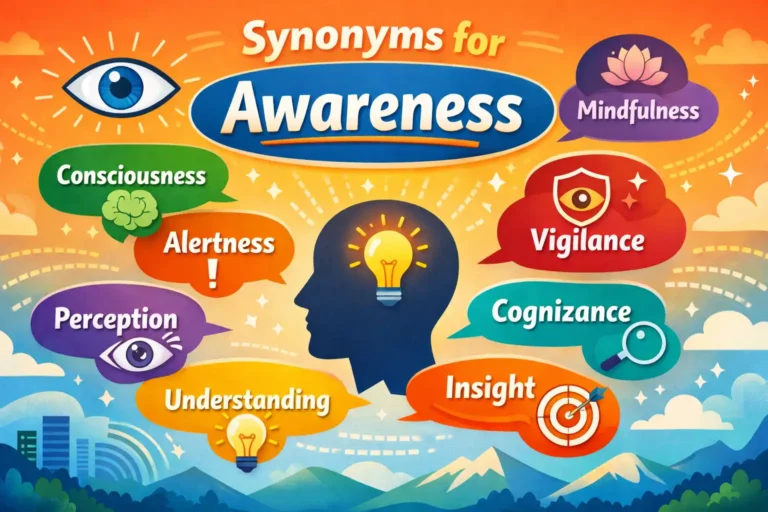
Common synonyms include:
- Knowledge
- Understanding
- Consciousness
- Perception
- Recognition
- Mindfulness
- Insight
- Attentiveness
Meaning of Awareness
Awareness refers to the state of being aware, informed, or conscious of something. It can involve noticing facts, feelings, surroundings, or situations.
Example:
She showed strong awareness of cultural differences during the meeting.
Types of Awareness Synonyms (Cognitive, Situational, Emotional)
Different synonyms highlight different types of awareness.
Cognitive Awareness (Mental Understanding)
Words in this group describe knowing or understanding information clearly.
Sensory or Situational Awareness
These words focus on noticing what is happening around you using observation or attention.
Social or Emotional Awareness
These synonyms relate to understanding emotions, people, or relationships.
Synonyms Table
| Word | Simple Meaning | Example Sentence |
| Familiarity | Knowing something from experience | His familiarity with the system helped solve the issue. |
| Comprehension | Ability to understand | Reading improves comprehension over time. |
| Realization | Becoming aware suddenly | Her realization came after the discussion. |
| Sensitivity | Awareness of feelings or changes | Teachers need sensitivity to student needs. |
| Alertness | Being watchful and attentive | Drivers must maintain alertness on highways. |
| Acuity | Sharpness of perception | Visual acuity is important for pilots. |
| Cognizance | Formal awareness or knowledge | The manager took cognizance of the complaint. |
| Appreciation | Understanding value or importance | Travel builds appreciation of other cultures. |
Master Synonyms List (Grouped by Level)
Beginner / Simple
Attention — focus on something
Example: Please pay attention to the instructions. (Neutral)
Sense — awareness through feeling or perception
Example: He had a strong sense of danger. (Neutral)
Notice — awareness after observing something
Example: I took notice of the change in her tone. (Neutral)
Intermediate
Vigilance — careful watchfulness
Example: Security requires constant vigilance. (Formal)
Perceptiveness — ability to notice details
Example: Her perceptiveness helped identify the problem. (Neutral)
Self-awareness — understanding your own thoughts or feelings
Example: Meditation improves self-awareness. (Neutral)
Advanced / Formal
Discernment — ability to judge or understand clearly
Example: Good leaders show strong discernment. (Formal)
Sentience — capacity to feel or perceive (often scientific)
Example: Scientists study animal sentience. (Formal)
Formal vs Informal Synonyms
Some synonyms sound more professional than others.
- Formal: cognizance, vigilance, discernment, acuity
- Neutral: knowledge, understanding, perception, insight
- Casual: attention, notice, sense
Use formal words in academic or business writing. Use simpler words in conversation.
Real-Life Usage Examples
Conversation
I didn’t have much awareness of the rules before joining.
Academic Writing
Environmental awareness plays a critical role in sustainability education.
Business Writing
Customer awareness of the product increased after the campaign.
Blogging
Building mental health awareness helps reduce stigma.
Emotional Expression
His awareness of her feelings made the conversation easier.
Similar Words Comparison
Awareness vs Knowledge
- Awareness = knowing something exists.
- Knowledge = deeper understanding with information.
Example:
She had awareness of the problem but not enough knowledge to fix it.
Awareness vs Mindfulness
- Awareness = general noticing or knowing.
- Mindfulness = focused attention on the present moment.
Example:
Mindfulness increases emotional awareness.
Example Sentences
- Public campaigns help people understand health risks more clearly.
- Children learn about their surroundings through observation and experience.
- He did not realize the consequences of his actions at first.
- Learning about other cultures improves communication skills.
- The program helped employees recognize workplace hazards.
- She spoke with a clear understanding of the situation.
- Technology has helped society become more informed about climate issues.
- Noticing body language can improve conversations.
- Meditation helps people understand their thoughts and emotions better.
- The training made workers more alert to safety procedures.
- Recognizing your strengths can boost confidence.
- Understanding emotions improves relationships.
- Managing time becomes easier when you pay attention to priorities.
- Good teamwork requires noticing how others feel.
- Personal growth often begins with honest self-reflection.
Common Mistakes
1. Using awareness when knowledge is needed
Wrong: I have full awareness of mathematics.
Better: I have strong knowledge of mathematics.
2. Overusing the same word repeatedly
Use synonyms to improve writing clarity.
3. Confusing awareness with attention
Attention is focus; awareness is understanding or noticing.
4. Using very formal words in casual speech
Avoid words like cognizance in everyday conversation.
Tips / Best Practices
- Choose words based on context (academic vs casual).
- Match the tone to your audience.
- Prefer clarity over complexity.
- Avoid repeating the same word too often.
- Do not force synonyms where the original word works best.
When NOT to Use Awareness
Avoid using awareness when you mean:
- Deep expertise → use knowledge or expertise
- Physical focus → use attention
- Opinion or belief → use view or perspective
Opposite Words (Antonyms)
Common antonyms include:
- Ignorance
- Unawareness
- Inattention
- Blindness
- Indifference
FAQs
What does awareness mean?
It means knowing or noticing something around you or within yourself.
Is awareness formal or informal?
It is neutral and works in both casual and professional contexts.
How can I use awareness in conversation?
Example: I didn’t have much awareness of that issue before.
What is the best synonym for awareness?
It depends on context, but understanding and knowledge are common choices.
Can awareness be replaced with knowledge?
Sometimes, but knowledge usually means deeper information.
Is awareness the same as mindfulness?
No. Mindfulness focuses on present-moment attention.
Can I use awareness in academic writing?
Yes. It is widely accepted in research and formal writing.
What part of speech is awareness?
It is a noun.
Is self-awareness different from awareness?
Yes. Self-awareness refers specifically to understanding yourself.
Why should I learn synonyms for awareness?
They improve writing variety and communication clarity.
Conclusion
Learning synonyms for awareness helps you speak and write more clearly. You can express ideas with better precision, avoid repetition, and communicate confidently in different situations.
Try using three new synonyms in your next sentence to build your vocabulary naturally.

Thomas Walker focuses on practical vocabulary improvement and clear word substitution guides.