Micro Introduction
The word comprehension appears in school, business, and everyday conversations. It describes how well someone understands something. Learning synonyms helps you speak and write more clearly, avoid repetition, and sound more natural in English.
Direct Answer
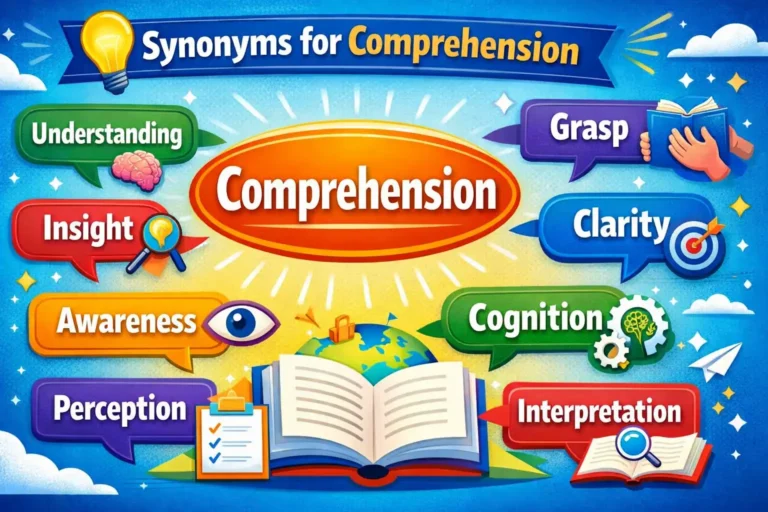
Synonyms for comprehension are words that describe understanding or the ability to understand information, ideas, or situations.
Common synonyms include:
- Understanding
- Grasp
- Awareness
- Insight
- Perception
- Apprehension
Meaning of Comprehension
Comprehension means the ability to understand something clearly or fully.
Example:
Her reading comprehension improved after she practiced daily.
Categories of Synonyms
Synonyms for comprehension can vary slightly depending on context.
Cognitive Understanding
Words that describe mental ability to understand ideas or information.
Awareness and Perception
Words that focus on noticing or recognizing meaning or details.
Interpretation and Judgment
Words that involve deeper thinking, analysis, or evaluation.
Top 10 Synonyms for Comprehension
| Word | Simple Meaning | Example Sentence |
| Understanding | Knowing what something means | Her understanding of grammar improved quickly. |
| Grasp | Ability to understand something | He has a strong grasp of the topic. |
| Awareness | Knowing about something | Awareness of rules prevents mistakes. |
| Insight | Deep understanding | The article gave me insight into the issue. |
| Perception | How you understand or see something | Cultural perception affects communication. |
| Knowledge | Information you understand | She has good knowledge of science. |
| Interpretation | Understanding meaning | His interpretation of the data was accurate. |
| Recognition | Identifying something correctly | Recognition of patterns helps learning. |
| Discernment | Ability to judge well | Leaders need discernment in decisions. |
| Cognition | Mental process of thinking | Sleep improves cognition and focus. |
Master Synonyms List (Grouped by Level)
Beginner / Simple
Knowledge — what you know or understand
Example: She has good knowledge of basic math.
Recognition — knowing something when you see or hear it
Example: His recognition of mistakes helped him improve.
Appreciation — understanding value or importance
Example: I gained appreciation for art after the class.
Intermediate
Interpretation — understanding meaning in your own way
Example: Her interpretation of the story was creative.
Cognition — mental thinking ability
Example: Stress can affect cognition and focus.
Discernment — ability to judge clearly
Example: Managers need discernment when making decisions.
Advanced / Formal
Perceptiveness — strong ability to notice and understand
Example: His perceptiveness impressed the professor. (Formal)
Erudition — deep academic knowledge
Example: The scholar’s erudition was respected worldwide. (Formal)
Acumen — sharp understanding or insight
Example: Her business acumen led to success. (Formal)
Formal vs Informal Synonyms
Some synonyms sound more casual, while others fit professional or academic contexts.
- Informal / Everyday: understanding, knowledge, grasp
- Neutral: awareness, recognition, interpretation
- Formal: cognition, acumen, discernment, erudition
Use simple words in conversation and formal terms in academic or business writing.
Real-Life Usage Examples
Conversation
I finally have a better understanding of the rules now.
Academic Writing
Reading strategies improve student cognition and comprehension skills.
Business Writing
Market awareness helps companies make better decisions.
Blogging
Travel experiences increase cultural appreciation.
Emotional Expression
I gained deeper insight into my feelings after therapy.
Similar Words Comparison
Comprehension vs Understanding
Understanding is more common and informal. Comprehension sounds slightly more academic.
- I have a good understanding of the topic.
- Reading comprehension is important for students.
Comprehension vs Awareness
Awareness focuses on noticing or knowing something exists, not always fully understanding it.
- She has awareness of the problem.
- He has full comprehension of the solution.
Example Sentences
- Her comprehension of the lesson improved after she started taking notes.
- I didn’t realize my comprehension was weak until I took the test.
- Do you think watching videos helps comprehension more than reading?
- Without clear instructions, comprehension becomes difficult for beginners.
- His comprehension isn’t the problem — he just needs more practice.
- Teachers often check comprehension by asking follow-up questions.
- Better sleep can actually improve comprehension and memory.
- If your comprehension feels slow, try breaking information into smaller parts.
- She struggled at first, but her comprehension increased over time.
- Why is reading comprehension harder in a second language?
- Poor lighting affected my comprehension while studying late at night.
- The trainer explained the process again to ensure full comprehension.
- Children develop comprehension skills at different speeds.
- Even with good vocabulary, comprehension may fail without context.
- Don’t worry if your comprehension isn’t perfect yet — improvement takes time.
Common Mistakes
1. Using “Knowledge” Instead of “Comprehension”
Knowledge means information you know, not always understanding.
❌ He has knowledge of the concept.
✔ He has comprehension of the concept.
2. Confusing Awareness with Full Understanding
Awareness is partial understanding.
❌ She has comprehension of the issue (if she only knows about it).
✔ She has awareness of the issue.
3. Overusing Formal Words
Using words like erudition in casual conversation sounds unnatural.
✔ Keep language simple unless context requires formality.
4. Repetition in Writing
Using comprehension too often reduces readability.
✔ Use synonyms to vary vocabulary naturally.
Tips / Best Practices
- Choose words based on tone (formal vs casual).
- Match the context (school, business, conversation).
- Focus on clarity over complexity.
- Avoid overusing one word (no keyword stuffing).
- Use simple synonyms for ESL communication.
When NOT to Use Comprehension
Avoid using comprehension when:
- You mean general knowledge (use knowledge).
- You mean awareness only (use awareness).
- You speak casually (use understanding).
Opposite Words (Antonyms)
Common antonyms include:
- Misunderstanding
- Confusion
- Ignorance
- Incomprehension
- Misinterpretation
FAQs
What does comprehension mean?
Comprehension means the ability to understand something clearly or completely.
Is comprehension formal or informal?
It is neutral but slightly more formal than “understanding.”
How can I use it in conversation?
You can say, “I have better comprehension now.”
What is the best synonym for comprehension?
“Understanding” is the most common and natural synonym.
Can comprehension be replaced with awareness?
Sometimes, but awareness usually means partial understanding.
Is comprehension important for learning English?
Yes. Strong comprehension helps reading, listening, and communication.
What is reading comprehension?
It means understanding written text fully.
What is listening comprehension?
It means understanding spoken language.
Is comprehension the same as knowledge?
Not exactly. Knowledge is information; comprehension is understanding.
How do I improve comprehension?
Practice reading, listening, and asking questions.
Conclusion
Learning synonyms for comprehension helps you communicate more clearly, avoid repetition, and improve both writing and speaking skills. Strong vocabulary also builds confidence in English.
Try using three new synonyms in your next sentence to strengthen your language skills.
Meta Description (140–150 characters):

Thomas Walker focuses on practical vocabulary improvement and clear word substitution guides.