Introduction: Why Learn Family Synonyms?
The word family appears in daily conversation, school writing, and social topics. It describes people connected by blood, marriage, or care. Learning synonyms helps you avoid repetition and sound clearer. It also improves both speaking and writing skills.
Direct Answer: Best Synonyms for Family
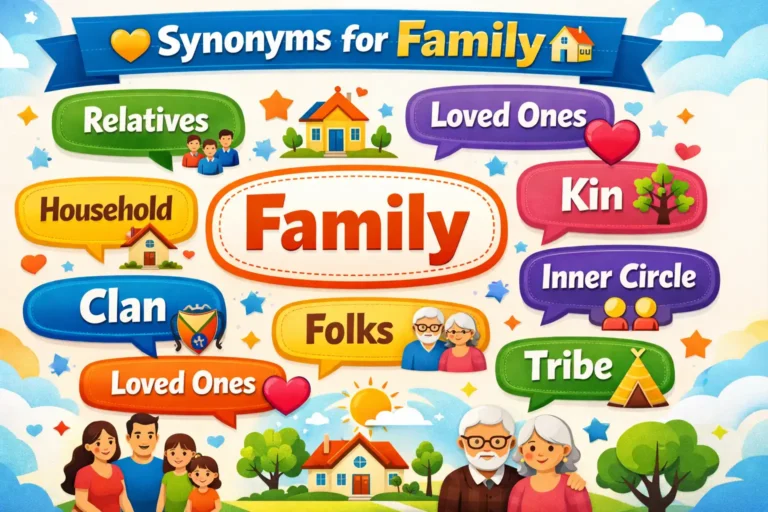
Family means a group of people connected by relationship, care, or shared living. Common synonyms include:
- relatives
- household
- kin
- clan
- lineage
- tribe
- ancestry
Definition of Family (Simple Meaning)
A family is a group of people related by birth, marriage, or emotional bonds who support each other.
Example:
She spends every weekend visiting her family.
Types of Family Synonyms (Close, Extended, Cultural)
Close Family Synonyms (Immediate Family)
These words describe people connected by blood or marriage.
Heritage-Based Synonyms (Ancestry, Lineage)
These refer to ancestry or long family history.
Group-Identity Words (Use Carefully)
These words describe a large shared identity or cultural connection.
Family Synonyms Table (Meaning + Examples)
| Word | Simple Meaning | Example Sentence |
| relatives | people related to you | My relatives live in another city. |
| household | people living in one home | Our household eats dinner together. |
| kin | family members | He invited all his kin to the wedding. |
| clan | large related group | The clan gathers every summer. |
| lineage | family history line | She comes from a long lineage of teachers. |
| tribe | extended people group | The tribe protects its traditions. |
| ancestry | family background | He is proud of his ancestry. |
Master Synonyms List (Easy vs Formal Family Synonyms)
Beginner / Simple
relatives
Simple meaning: family members
Example: I met my relatives at the reunion.
Informal
household
Simple meaning: people living together
Example: The household cleaned the house together.
Neutral
Intermediate
kin
Simple meaning: blood family
Example: She trusts her kin completely.
Neutral
clan
Simple meaning: extended family group
Example: The clan celebrates traditional holidays.
Neutral
Advanced / Formal
lineage
Simple meaning: historical family line
Example: He studies his lineage carefully.
Formal
ancestry
Simple meaning: family origin history
Example: She researches her ancestry online.
Formal
tribe
Simple meaning: large cultural family group
Example: The tribe honors its elders.
Formal
Formal vs Informal Synonyms
Informal synonyms like relatives work in conversation. Neutral words like household fit everyday writing. Formal words like lineage or ancestry appear in academic or historical contexts. Choose based on audience and tone.
Real-Life Usage Examples
Conversation: I’m visiting my relatives this weekend.
Academic Writing: The study examines family lineage patterns.
Business Writing: Our company supports household well-being.
Blogging: Family traditions shape our identity.
Emotional Expression: My kin always support me.
Similar Words Comparison
Family vs Relatives
Family is emotional and broad.
Relatives focuses only on blood or legal connections.
Example:
My family supports me emotionally.
My relatives live far away.
Family vs Household
Family includes emotional bonds.
Household means people sharing a home.
Example:
Her family lives across the country.
Her household includes roommates.
Example Sentences (Grouped Mini-Sections)
Daily Conversation
- “I’m having dinner with my family tonight.”
- “Most of my relatives live out of state.”
- “My household splits the bills and chores.”
School / Academic Writing
- “Researchers examined kin networks in rural communities.”
- “The report traces the author’s lineage over five generations.”
- “Many students explore their ancestry through public records.”
Culture / Community Context
- “The clan meets each year to celebrate shared traditions.”
- “The tribe protects its language and customs through teaching.”
Emotional / Supportive Context
- “When I felt stuck, my family encouraged me to keep going.”
- “In hard times, kin can provide stability and practical help.”
Work / Formal Communication
- “The policy supports employees with family caregiving duties.”
- “The program offers resources for diverse households.”
Common Mistakes (Including a “clan” Cultural Sensitivity Note)
- Using “tribe” or “clan” casually as slang.
Saying “my friend clan” or “my tribe” can feel disrespectful, especially when discussing Indigenous or ethnic groups. Use these terms mainly for real cultural, historical, or family-structure contexts. - Assuming “clan” always means “close friends.”
Clan usually means a large extended family group, often with a shared ancestor and cultural traditions. If you mean friends, use “group,” “circle,” or “community” instead. - Mixing up “household” and “family.”
A household is about living together, not relationship. Roommates can be a household but not a family. - Using very formal words in casual speech.
Lineage and ancestry can sound too serious in everyday conversation. They fit best in academic, historical, or legal contexts. - Repeating one synonym in the same paragraph.
If you already used family, don’t swap in relatives three lines later unless the meaning changes. Choose one term that matches the exact point you’re making.
Tips / Best Practices (Specific Rules + Mini Checklist)
Practical Rules You Can Follow
- Rule 1: Decide what you mean first (relationship, home, or history).
- Relationship: family, relatives, kin
- Home/living unit: household
- History/roots: ancestry, lineage
- Large extended group: clan (use carefully), tribe (use carefully)
- Relationship: family, relatives, kin
- Rule 2: Match formality to the setting.
- Casual: family, relatives
- Neutral: household, kin
- Formal/academic: ancestry, lineage
- Casual: family, relatives
- Rule 3: Don’t “upgrade” the word if it changes the meaning.
- “My household loves me” sounds odd (household = living unit, not emotion).
- “My lineage is coming over” is incorrect (lineage = history, not visitors).
- “My household loves me” sounds odd (household = living unit, not emotion).
- Rule 4: Use “clan/tribe” only when it’s accurate—not as slang.
If you mean friends, use group, circle, community instead. - Rule 5: Control repetition with a simple pattern.
Use one main word per paragraph, then a pronoun (“they,” “we”) or a clear noun (“my parents,” “my cousins”) to avoid overusing synonyms.
When NOT to Use Family
Avoid using family when you only mean people who live together without emotional or legal ties. In formal or technical writing, household or residents may be more accurate and neutral.
Example:
“The survey measures income by household, not by family.”
Opposite Words (Antonyms)
Antonyms for family describe people with no personal or social connection to you. These words are useful when you want to emphasize distance, independence, or lack of relationship.
- stranger
- outsider
- unrelated person
- individual
When to Use Antonyms
Use these antonyms when you want to highlight contrast. For example, in writing about trust, belonging, or social boundaries, you may compare family with strangers or outsiders to show emotional difference.
Example:
“She treats close friends like family, not like strangers.”
FAQs
What does family mean?
A group connected by birth, marriage, or emotional bonds.
Is family formal or informal?
It is neutral and works in casual, professional, and academic contexts.
How can I use it in conversation?
Use it to describe close relationships, shared support, or people you live with.
What is the best synonym for family?
Relatives is the closest everyday substitute in most situations.
Can family be replaced with household?
Yes, but only when talking about shared living, not emotional connection.
What is a formal word for family in academic writing?
Formal alternatives include lineage and ancestry, especially when discussing history or genealogy.
What synonym for family should I use in an essay?
Use kin or relatives for general essays. Use lineage or ancestry only if you are discussing heritage or historical background.
Conclusion
Learning synonyms for family helps you write with precision and speak more naturally. The most useful everyday alternatives are relatives, household, and kin, while lineage and ancestry work best in formal or historical contexts. Choosing the right word improves clarity and tone.
Now strengthen your vocabulary in practice: write one short paragraph and replace family with at least three correct synonyms from this guide. Then read it aloud and check if the meaning still feels natural. That’s how real vocabulary growth happens.

Thomas Walker focuses on practical vocabulary improvement and clear word substitution guides.