Micro Introduction
The word knowledge appears in daily conversations, school writing, business communication, and online content. Learning synonyms helps you express ideas more clearly and avoid repetition. This guide explains simple alternatives with examples you can use immediately.
Direct Answer
Knowledge means information, understanding, or skills gained through learning or experience.
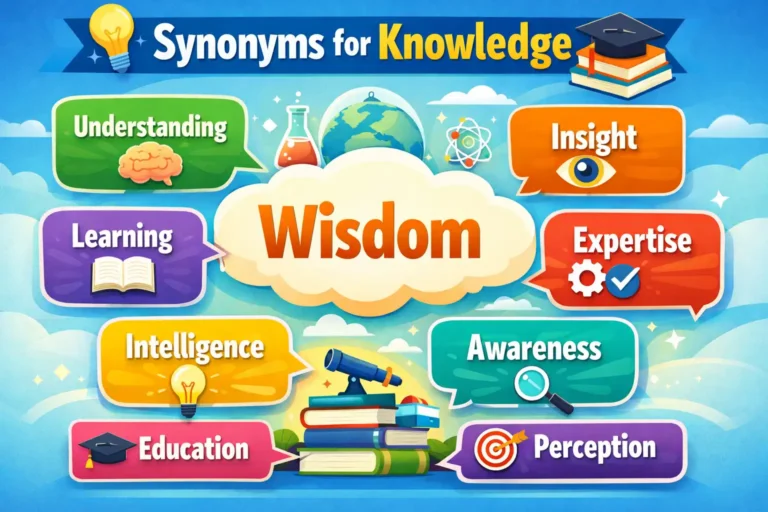
Common synonyms include:
- Information
- Understanding
- Awareness
- Learning
- Education
- Expertise
- Wisdom
- Insight
- Experience
- Familiarity
- Comprehension
- Know-how
What “Knowledge” Means (Simple Definition + Usage)
Knowledge refers to facts, skills, or understanding that someone gains through study, observation, or experience.
Example:
She has strong knowledge of computer programming.
Categories of Synonyms
Different synonyms highlight different types of knowledge.
1. Factual Knowledge
These words focus on information or learned facts.
Examples: information, education, learning.
2. Practical Knowledge
These words emphasize skills gained through experience.
Examples: experience, know-how, proficiency.
3. Deep Understanding
These words describe intellectual depth or wisdom.
Examples: insight, wisdom, comprehension.
Synonyms Table
| Word | Simple Meaning | Example Sentence |
| Information | Facts or data | I need more information about the topic. |
| Understanding | Clear mental grasp | His understanding of math improved. |
| Awareness | Knowing something exists | Public awareness is increasing. |
| Learning | Knowledge gained by study | Learning takes time and practice. |
| Education | Formal teaching | Education changes lives. |
| Expertise | High skill level | She has expertise in design. |
| Wisdom | Good judgment from experience | His wisdom helped the team. |
| Insight | Deep understanding | The book gives insight into culture. |
| Experience | Knowledge from doing | Experience builds confidence. |
| Familiarity | Knowing something well | Familiarity with tools helps. |
| Comprehension | Ability to understand | Reading improves comprehension. |
| Know-how | Practical skill | He has the know-how to fix it. |
| Proficiency | High ability | Language proficiency is important. |
| Scholarship | Academic knowledge | She earned a scholarship award. |
| Erudition | Deep academic learning | The professor showed erudition. |
Master Synonyms List (Grouped by Level)
Beginner / Simple
Information — facts you know
Example: I received useful information from the teacher. (Neutral)
Understanding — clear knowledge of something
Example: She has good understanding of the lesson. (Neutral)
Learning — knowledge gained from study
Example: Learning English takes practice. (Neutral)
Experience — knowledge from doing
Example: His experience helped solve the problem. (Neutral)
Familiarity — knowing something well
Example: Familiarity with the software is helpful. (Neutral)
Intermediate
Awareness — knowing something exists
Example: Public awareness about health is growing. (Neutral)
Education — knowledge from school or study
Example: A good education opens opportunities. (Neutral)
Expertise — advanced skill or knowledge
Example: Her expertise impressed the client. (Formal)
Insight — deep understanding
Example: The article gave me new insight. (Neutral)
Comprehension — ability to understand
Example: Reading improves comprehension skills. (Formal)
Know-how — practical skill
Example: He has the know-how to repair machines. (Informal)
Advanced / Formal
Wisdom — knowledge with good judgment
Example: Her wisdom guided the decision. (Formal)
Proficiency — high level of skill
Example: Language proficiency requires practice. (Formal)
Scholarship — academic achievement
Example: His scholarship earned recognition. (Formal)
Erudition — deep scholarly knowledge
Example: The lecture showed remarkable erudition. (Very formal)
Formal vs Informal Synonyms
Some synonyms sound more professional than others.
- Informal: know-how, learning, experience
- Neutral: understanding, information, awareness
- Formal: expertise, proficiency, erudition, scholarship
Use formal words in academic or business writing. Use simpler words in conversation.
Real-Life Usage Examples
Conversation:
I don’t have much experience with cooking.
Academic Writing:
The research improves our understanding of climate change.
Business Writing:
We value employees with technical expertise.
Blogging:
This guide shares practical know-how for beginners.
Emotional Expression:
Her life wisdom inspires me.
Similar Words Comparison
Knowledge vs Information
- Knowledge = information plus understanding or experience.
- Information = raw facts only.
Example:
I have the information, but not enough knowledge to decide.
Knowledge vs Wisdom
- Knowledge = facts or skills learned.
- Wisdom = good judgment using knowledge.
Example:
He has knowledge, but she has wisdom.
Example Sentences
- His technical knowledge is impressive.
- She gained valuable experience during the internship.
- Reading books increases understanding.
- The course improved my language proficiency.
- Awareness of safety rules is important.
- Her expertise helped the project succeed.
- Education creates opportunities for growth.
- The teacher shared useful insight.
- Familiarity with tools saves time.
- Wisdom comes with age and reflection.
- Learning never stops in life.
- Comprehension improves with practice.
- The manager values practical know-how.
- Scholarship requires dedication.
- Experience teaches lessons you cannot learn from books.
Common Mistakes
- Using “knowledge” when “information” is better
If you mean facts only, use information. - Confusing “wisdom” with “knowledge”
Wisdom includes judgment, not just facts. - Overusing formal words
Words like erudition sound unnatural in casual speech. - Using synonyms without context
Always check if the meaning fits your sentence. - Repeating the same word
Use synonyms to improve writing variety.
Tips / Best Practices
- Choose words based on tone (formal vs casual).
- Match the synonym to the context (school, business, conversation).
- Focus on clarity, not complexity.
- Avoid overusing any keyword.
- Use simple synonyms for ESL communication.
When NOT to Use Knowledge
Avoid knowledge when:
- You mean only data or facts → use information.
- You describe skill ability → use skill or expertise.
- You talk about awareness of a situation → use awareness.
Opposite Words (Antonyms)
- Ignorance
- Unawareness
- Misunderstanding
- Inexperience
- Illiteracy
- Naivety
FAQs
1. What does knowledge mean?
Knowledge means information or skills gained through learning or experience.
2. Is knowledge formal or informal?
It is neutral and works in both formal and casual contexts.
3. How can I use knowledge in conversation?
Example: I have some knowledge about computers.
4. What is the best synonym for knowledge?
It depends on context. Understanding and information are common choices.
5. Can knowledge be replaced with experience?
Yes, when referring to skills learned through practice.
6. Is wisdom the same as knowledge?
No. Wisdom includes judgment and life experience.
7. What synonym is best for academic writing?
Expertise, comprehension, or proficiency work well.
8. What synonym is easiest for beginners?
Information and understanding are simple choices.
9. Can I use know-how in professional writing?
It is better for casual or conversational contexts.
10. Why should I learn synonyms for knowledge?
They improve clarity, vocabulary range, and writing quality.
Conclusion
Learning synonyms for knowledge helps you speak and write more clearly. You can choose words that match your tone, context, and audience. This skill improves communication in school, work, and daily life.
Try using three new synonyms in your next sentence to build confidence and fluency.

Thomas Walker focuses on practical vocabulary improvement and clear word substitution guides.