Quick Intro: Why “Movement” Gets Repeated
The word movement appears in daily speech, academic writing, fitness topics, and storytelling. Learning synonyms helps you express ideas more clearly and avoid repetition. This guide explains simple alternatives with examples you can use right away.
Direct Answer
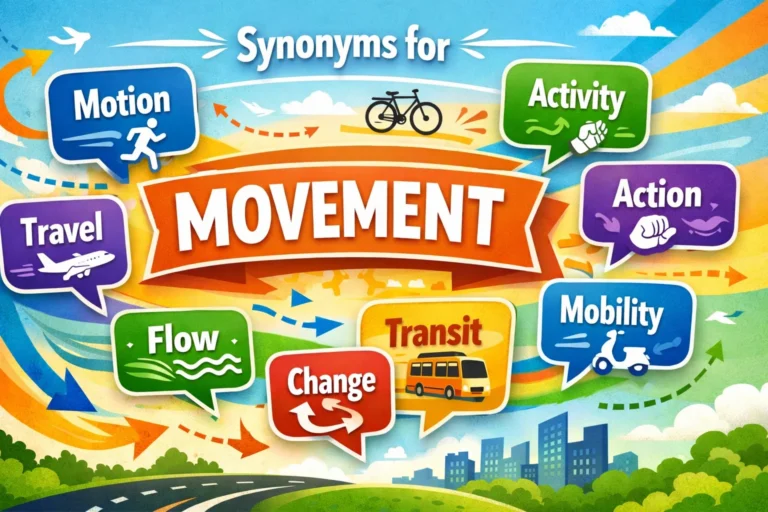
Movement means a change in position, place, or activity. Common synonyms include words that describe motion, action, or progress.
Common synonyms for movement:
- Motion
- Move
- Action
- Activity
- Mobility
- Locomotion
- Travel
- Shift
- Transfer
- Displacement
- Migration
- Progression
- Maneuver
- Gesture
- Flow
Meaning of Movement
Movement refers to the act of changing position, location, or state. It can describe physical motion, body language, social trends, or progress over time.
Example:
The dancer’s movement was smooth and controlled.
Categories of Synonyms
Different synonyms describe different types of movement.
Physical Motion
Words that describe bodies or objects changing position in space.
Examples: motion, locomotion, maneuver.
Change of Position or Direction
Words that focus on shifting from one place to another.
Examples: shift, transfer, displacement.
Progress or Activity
Words that describe development, action, or ongoing processes.
Examples: activity, progression, flow.
Synonyms Table
| Word | Simple Meaning | Example Sentence |
| Motion | Physical movement | The car is in motion. |
| Move | Change position | Please move closer. |
| Action | Doing something | The movie has nonstop action. |
| Activity | Something happening | There is a lot of activity today. |
| Mobility | Ability to move | Exercise improves mobility. |
| Locomotion | Movement from place to place | Animals use legs for locomotion. |
| Travel | Movement over distance | Air travel is fast. |
| Shift | Small change in position | There was a shift in focus. |
| Transfer | Move from one place to another | She transferred the files. |
| Displacement | Movement from original place | Floods caused displacement. |
| Migration | Movement of groups | Birds begin migration in winter. |
| Progression | Gradual movement forward | The disease shows progression. |
| Maneuver | Planned movement | The pilot made a sharp maneuver. |
| Gesture | Body movement expressing meaning | He made a friendly gesture. |
| Flow | Smooth movement | The river has steady flow. |
Master Synonyms List (Grouped by Level)
Beginner / Simple
Move
Simple meaning: change position
Example: She moved the chair near the window.
Usage: Neutral, everyday
Action
Simple meaning: doing something
Example: The teacher encouraged action instead of waiting.
Usage: Neutral
Activity
Simple meaning: something happening
Example: Morning activity starts early here.
Usage: Neutral
Travel
Simple meaning: movement over distance
Example: They traveled across the country.
Usage: Neutral
Shift
Simple meaning: small change
Example: There was a shift in his attitude.
Usage: Neutral
Intermediate
Motion
Simple meaning: physical movement
Example: The wheels stayed in motion all night.
Usage: Neutral
Mobility
Simple meaning: ability to move freely
Example: Yoga improves joint mobility.
Usage: Neutral
Transfer
Simple meaning: move between places
Example: The company transferred him to another office.
Usage: Neutral / Formal
Flow
Simple meaning: smooth movement
Example: Traffic flow improved after repairs.
Usage: Neutral
Gesture
Simple meaning: body movement showing meaning
Example: She made a kind gesture to help him.
Usage: Neutral
Advanced / Formal
Locomotion
Simple meaning: movement from place to place
Example: Scientists study animal locomotion patterns.
Usage: Formal
Displacement
Simple meaning: forced movement from place
Example: War caused mass displacement of people.
Usage: Formal
Migration
Simple meaning: group movement to new area
Example: Climate affects bird migration.
Usage: Formal / Academic
Progression
Simple meaning: gradual forward movement
Example: The illness showed rapid progression.
Usage: Formal
Maneuver
Simple meaning: skilled or planned movement
Example: The driver performed a difficult maneuver.
Usage: Semi-formal
Formal vs Informal Synonyms
Some synonyms sound more casual, while others fit professional writing.
- Informal / Everyday: move, activity, action, shift
- Neutral: motion, travel, flow, gesture
- Formal / Academic: locomotion, displacement, migration, progression
Choose based on your audience. Academic papers prefer formal terms, while conversations use simple ones.
Real-Life Usage Examples
Conversation:
I noticed a sudden movement behind the door.
Academic Writing:
Researchers analyzed animal movement patterns.
Business Writing:
There was strong market movement this quarter.
Blogging:
Daily movement helps reduce stress and improve health.
Emotional Expression:
Her small movement showed nervousness.
Similar Words Comparison
Movement vs Motion
Both refer to physical change in position.
Movement is broader and more common.
Motion often sounds more technical or scientific.
Example:
The machine is in motion.
The dancer’s movement is graceful.
Movement vs Activity
Movement focuses on physical motion.
Activity refers to events or actions happening.
Example:
Physical movement improves health.
There is a lot of activity in the office today.
Example Sentences
- Regular movement keeps your body healthy.
- The cat made a quick movement toward the toy.
- Political movement can change society.
- Her movement was slow after the injury.
- Exercise increases joint movement.
- I saw movement in the distance.
- The robot’s movement looked natural.
- Market movement surprised investors.
- The coach corrected his arm movement.
- There was sudden movement in the crowd.
- Gentle movement helps reduce stiffness.
- Eye movement can show emotions.
- The camera detected motion movement at night.
- Yoga improves body movement and balance.
- Small movement can create big results.
Common Mistakes
1. Using Formal Words in Casual Speech
Saying “locomotion” in daily conversation sounds unnatural. Use “movement” or “motion” instead.
2. Confusing Activity with Movement
Activity does not always mean physical motion. It can mean events or tasks.
3. Overusing One Word
Repeating “movement” many times makes writing boring. Use synonyms carefully.
4. Choosing Incorrect Context
Migration refers to groups, not individual small motions.
Tips / Best Practices
- Match the tone: Formal writing needs formal synonyms.
- Check context: Physical motion vs progress meaning.
- Keep clarity first: Choose familiar words when possible.
- Avoid overuse: Do not replace every instance unnecessarily.
- Think audience: ESL learners benefit from simple vocabulary.
Better Choices Than “Movement” in These Cases
The word movement is broad, but it is not always the most accurate choice. In some contexts, a more specific word sounds clearer and more natural.
Use a different word when you mean:
- Business or market changes → use growth, change, trend, fluctuation
❌ Market movement was strong this year.
✅ Market growth was strong this year. - Emotional reactions → use reaction, response, feeling
❌ Her movement showed anger.
✅ Her reaction showed anger. - Decisions or opinions changing → use shift, change, adjustment
❌ There was movement in his opinion.
✅ There was a shift in his opinion. - Progress or improvement → use progress, development, improvement
❌ The project shows movement.
✅ The project shows progress.
Choosing a more precise word helps your writing sound natural and professional.
Opposite Words (Antonyms)
Antonyms for movement describe a lack of motion, activity, or change in position.
- Stillness
- Rest
- Stability
- Immobility
- Inactivity
- Standstill
FAQs
What does movement mean?
It means changing position, location, or state.
Is movement formal or informal?
It is neutral and works in both casual and formal contexts.
How can I use movement in conversation?
Example: “I saw movement outside the window.”
What is the best synonym for movement?
Motion is the closest and most common synonym.
Can movement be replaced with activity?
Sometimes, but only when referring to events or actions, not physical motion.
Conclusion
Learning synonyms for movement improves both writing and speaking. It helps you avoid repetition and choose words that match your tone and context. Strong vocabulary also makes communication clearer and more professional.
Try using three new synonyms in your next sentence to build confidence.

Thomas Walker focuses on practical vocabulary improvement and clear word substitution guides.