Micro Introduction
The word running appears in daily speech, sports, writing, and business contexts. Learning synonyms helps you sound more natural and precise. It also improves clarity when you describe speed, movement, or activity.
Direct Answer
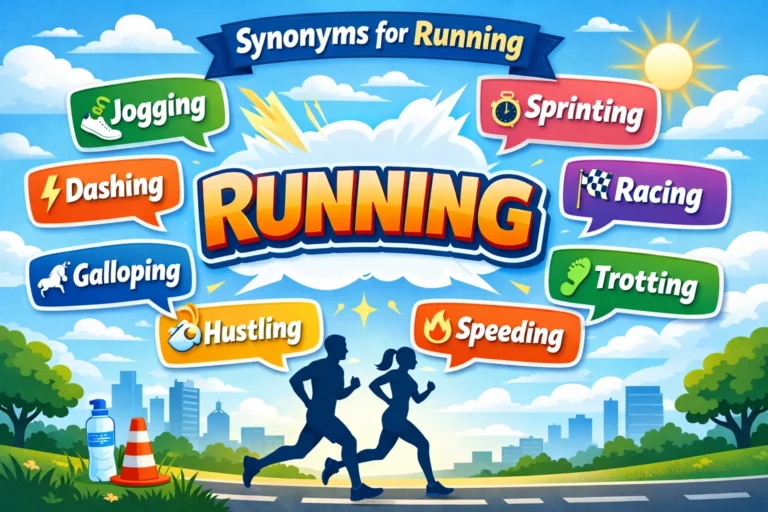
Common synonyms for running include words that describe moving quickly on foot or operating something.
- jog
- sprint
- dash
- race
- hurry
- rush
- bolt
- flee
Meaning of Running
Running means moving quickly using your legs so that both feet leave the ground at times. It can also mean operating or managing something.
Example: She is running in the park every morning.
Types of “Running” Meanings (Movement, Operating, Flow)
1. Physical Movement
These synonyms describe moving fast using your body, often in sports or daily activity.
2. Managing or Operating
Some synonyms relate to controlling, organizing, or operating systems, businesses, or machines.
3. Flow or Continuous Motion
These words describe liquids, processes, or things moving continuously rather than people moving on foot.
Movement Synonyms Table (Running = moving fast on foot)
| Word | Simple Meaning | Example Sentence |
| jog | run slowly for exercise | I jog every morning. |
| sprint | run very fast for a short time | He sprinted to the finish line. |
| dash | run quickly for a short distance | She dashed across the road. |
| race | run fast in a competition | They raced each other at school. |
| hurry | move fast because of time | We hurried to catch the bus. |
| rush | go quickly, often with stress | She rushed out of the office. |
| bolt | run away suddenly | The dog bolted toward the gate. |
| flee | run away to escape danger | The villagers fled the storm. |
| dart | move suddenly and quickly | The cat darted under the chair. |
| charge | run forward with force | The player charged toward the ball. |
| scamper | run quickly with small steps | The kids scampered inside. |
| scurry | run quickly with short steps | Mice scurried along the wall. |
Master Synonyms List (Grouped by Level)
Beginner / Simple
Scurry — move quickly with small steps
Example: The mouse scurried across the floor. (Neutral)
Scoot — move quickly in a playful or informal way
Example: The child scooted toward the door. (Informal)
Zip — move very fast
Example: The car zipped past us. (Informal)
Intermediate
Gallop — run very fast like a horse
Example: The horse galloped across the field. (Neutral)
Trot — run at a steady, light pace
Example: The dog trotted beside me. (Neutral)
Scamper — run quickly with excitement or fear
Example: The kids scampered into the playground. (Neutral)
Dart — move suddenly and quickly
Example: She darted across the street. (Neutral)
Charge — run forward with force
Example: The player charged toward the goal. (Neutral)
Bound — run with long energetic steps
Example: The deer bounded over the fence. (Neutral)
Advanced / Formal
Hasten — move quickly or speed up an action
Example: We must hasten our preparations. (Formal)
Abscond — run away secretly, often to escape
Example: The thief absconded with the money. (Formal)
Formal vs Informal Synonyms
Use informal synonyms like scoot or zip in conversations or casual writing.
neutral words like dart or gallop in most situations.
formal words like hasten or abscond in academic, legal, or professional contexts.
Choosing the right tone makes your communication sound natural and appropriate.
Real-Life Usage Examples
Conversation (Daily Life)
“I saw a man running to catch the train this morning.”
School / Student Context
“The teacher told us to stop running in the hallway.”
Fitness & Health
“I started running three times a week to improve my stamina.”
Workplace / Business
“She is running the meeting while the manager is away.”
Travel Situation
“We were running through the airport because our flight was boarding.”
Technology Context
“My computer has been running slowly since yesterday.”
Parenting / Family
“The kids were running around the garden after dinner.”
Emergency Situation
“People were running toward the exit when the alarm sounded.”
Emotional Expression
“My heart was running fast before the exam.”
Time Pressure
“I’m running late, so I’ll call you later.”
Sports Context
“He spends hours running on the track to prepare for competitions.”
Daily Routine
“She goes running every morning before work.”
Similar Words Comparison
Running vs Jogging
Running usually means faster movement or exercise.
Jogging means slower, steady movement for fitness.
Example:
- I am running to the store because I’m late.
- I am jogging for exercise.
Running vs Sprinting
Running is general movement at any speed.
Sprinting means running at maximum speed for a short time.
Example:
- He is running in the park.
- He is sprinting in the race.
Example Sentences (Grouped by Meaning)
1. Movement (Physical Action)
- She enjoys running in the park after work.
- The child came running when he heard his name.
- He was running to catch the last bus home.
- The dog kept running along the beach happily.
2. Operating / Managing Something
- She is running her own online business now.
- The company has been running successfully for years.
- He is running the project while the manager is on leave.
3. Flow / Continuous Movement
- Water is running from the kitchen tap.
- Tears were running down her face during the movie.
- Sweat was running down his forehead after exercise.
4. Idioms and Common Expressions
- I’m running late for my appointment.
- Time is running out, so we need to decide soon.
- My phone battery is running low.
Common Mistakes
1. Using the Wrong Speed Word
Learners sometimes confuse slow and fast words.
Example mistake: saying jog when you mean very fast movement.
2. Using Formal Words in Casual Speech
Words like abscond sound unnatural in daily conversation.
3. Confusing Physical and Non-Physical Meanings
“Running a company” does not mean moving physically.
4. Overusing One Word
Repeating running too often reduces writing quality. Use variety instead.
Tips / Best Practices for Choosing the Right Synonym
Choosing the correct synonym for running depends on context, speed, and purpose. Use these tips to sound natural and clear.
- Think about the situation first (exercise, emergency, business, flow of liquid).
- Match the formality level to your audience (conversation vs academic writing).
- Choose words your listener already understands — clarity is more important than complexity.
- Avoid repeating the same word too often in writing. Variety improves readability.
3 Decision Rules (Speed + Tone + Meaning)
1. Speed Rule — How fast is the movement?
Speed helps you pick the most accurate word.
- Slow → jog
- Normal → run
- Very fast → sprint, dash
Example:
“He was sprinting to catch the train.” (very fast, urgent)
2. Tone Rule — How formal is the situation?
Your environment determines vocabulary choice.
- Casual conversation → run, rush
- Neutral writing → jog, dash
- Formal writing → hasten, flee
Example:
“The suspect fled the scene.” (formal/news tone)
3. Meaning Rule — Physical or Non-Physical?
First decide what type of meaning you need.
- Physical movement → run, sprint, jog
- Managing something → operate, manage
- Flow or process → flow, stream, circulate
Example:
“She is running the company.” (not physical movement)
💡 Quick Tip:
If you are unsure, use run. It is safe, natural, and widely understood in English.
When NOT to Use Running
Do not use running when:
- Movement is slow (use walking instead).
- The action is stationary (like standing or sitting).
- You mean emotional excitement rather than physical movement without context.
Choosing precise vocabulary prevents confusion.
Opposite Words (Antonyms)
The opposite of running depends on the meaning you use.
1. Movement (Physical Action)
These words describe not moving or moving slowly.
- walking
- standing
- stopping
- resting
- remain
- stay
Example:
He stopped running and decided to walk instead.
2. Stopping or Interrupting Activity
These antonyms apply when an action or process pauses.
- pause
- halt
- stop
- cease
Example:
The event will halt if the weather gets worse.
3. Machines / Systems (Operating Meaning)
When running means operating or functioning, the opposite refers to inactivity.
- idle
- shut down
- inactive
- stopped
Example:
The engine is idle because the car is not moving.
💡 Tip for Learners:
Always choose the antonym based on the meaning of running in your sentence. Physical movement and machine operation use different opposites.
FAQs
What does running mean?
Running means moving quickly using your legs so both feet leave the ground at times. It can also mean operating or managing something.
Is running formal or informal?
The word running is neutral. It works in both formal and informal situations depending on context.
How can I use running in conversation?
Example: “I was running to catch the bus this morning.”
It is common in daily speech when talking about movement or urgency.
What is the best synonym for running?
The best synonym depends on meaning. Jog works for exercise, sprint for speed, and dash for short, quick movement.
Can running be replaced with jogging?
Yes, but only when you mean slow or moderate exercise. Jogging is not as fast or intense as running.
What is the best synonym for running in IELTS writing?
For IELTS, use precise vocabulary based on context. Good choices include sprint, dash, flee, or hasten. Avoid informal words like zip or scoot in academic writing.
What is the difference between dash and sprint?
Sprint means running at maximum speed, usually in sports.
Dash means running quickly for a short distance, often suddenly or urgently.
Example:
He sprinted in the race.
She dashed across the street.
Is sprint faster than running?
Yes. Sprinting means running at your fastest possible speed, while running can be any pace.
Can running mean managing something?
Yes. For example: “She is running a business.” Here it means managing or operating, not physical movement.
What synonym should I use in professional writing?
Use neutral or formal words like operate, manage, administer, or hasten, depending on meaning and context.
Conclusion
Learning synonyms for running improves both speaking and writing. You can describe movement more clearly and avoid repetition. This skill also helps ESL learners sound more natural and confident.
Try using three new synonyms in your next sentence to build stronger vocabulary.

Thomas Walker focuses on practical vocabulary improvement and clear word substitution guides.