Quick Intro: What “Soon” Means
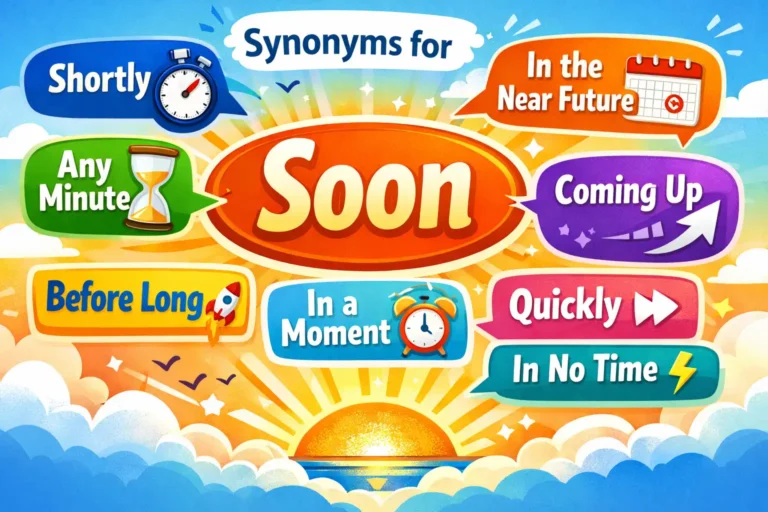
The word soon appears in daily speech, emails, and writing. It helps describe time that is close in the future. Learning synonyms for soon improves clarity and prevents repetition. It also makes your English sound more natural.
Direct Meaning + Best Synonyms
Soon means in a short time or in the near future.Soon means something will happen after a short time, not far in the future.
Example:
We will leave soon.
Common synonyms include:
- shortly
- quickly
- promptly
- immediately
- before long
- in a moment
- presently
- right away
Synonyms by Timing + Tone
Immediate Action
These synonyms describe actions that must happen with no delay. They often appear in commands, instructions, or emergency situations. Using them can sound strong or urgent, so choose carefully.
⚠️ Warning: Words in this category often imply urgency or authority. They may sound like an order rather than a polite request.
Examples:
- Come here immediately. (strong command)
- Send the report right away. (urgent instruction)
- The nurse responded promptly. (professional urgency)
Use these words when speed truly matters. Avoid them in casual situations unless you want to stress importance.
Near Future
These synonyms describe events expected after a short wait, but not instantly. They suggest something will happen soon, yet allow breathing room. The time feel can range from a few minutes to a few hours, depending on context.
Examples:
- I’ll call you in a moment. (usually minutes)
- The train will arrive shortly. (minutes, maybe a short delay)
- We’ll finish this before long. (could be hours, flexible timing)
These words soften urgency. They sound calmer and more natural in everyday conversation.
Formal Timing
These synonyms appear more often in professional or formal writing. They describe planned timing rather than urgency. Some words in this group carry regional meaning differences, especially in US vs UK English.
⚠️ Dialect note: The word presently can be confusing.
- In American English, it usually means soon.
- In British English, it can mean now or currently.
Examples:
- The session will begin presently. (US: soon / UK: now)
- The manager responded promptly. (formal, efficient timing)
- The ceremony will start shortly. (formal near-future tone)
Because of this difference, avoid presently in international writing unless the timing is clear from context.
Synonyms Table
Synonyms of Soon Table
| Word | Simple Meaning | Tone | Typical Context | Example Sentence |
| shortly | after a short time | neutral / polite | announcements, schedules | The meeting will start shortly. |
| quickly | in a fast way | neutral | general action, everyday speech | Please respond quickly. |
| promptly | without delay | formal / professional | business, service, reports | She promptly answered the email. |
| immediately | at once | strong / urgent | commands, emergencies | Come here immediately. |
| before long | after a little time | calm / narrative | storytelling, writing | We will arrive before long. |
| in a moment | very soon | casual / friendly | conversation | I will help you in a moment. |
| presently | soon (US) / now (UK) | formal | formal speech, announcements | The doctor will see you presently. |
| right away | instantly | informal / urgent | casual requests, instructions | Start your work right away. |
Master Synonyms List (Grouped by Level)
Instead of re-listing the same synonyms, use this section to practice choosing the best word for tone and urgency.
Beginner / Simple (best for speaking/texting)
Rule: Best for everyday chat, texting, and friendly messages.
Exercise A — Choose 1 word to complete each sentence: (shortly / right away / in a moment)
- “I’m busy—I’ll call you ____.”
- “Can you reply ____? I’m outside.”
- “The bus should arrive ____.”
Answer key (suggested): 1) in a moment 2) right away 3) shortly
Intermediate (timing vs speed)
Key contrast: quickly ≠ soon
- soon = timing (near future)
- quickly = speed (fast action)
Exercise B — Decide which fits better (soon or quickly):
- “She will come ____.” (timing)
- “She walked ____.” (speed)
- “The update will launch ____.” (timing)
- “Please finish ____.” (speed)
Answer key: 1) soon 2) quickly 3) soon 4) quickly
Bonus nuance: “before long” is timing-focused like soon, but softer and less urgent.
Advanced / Formal (formal/command tone, not “formal-only”)
These words often sound official, urgent, or directive. They can fit formal writing, but the bigger feature is authority + urgency.
Exercise C — Rewrite each sentence in a more professional/urgent tone:
- “Please send it soon.” → Use promptly
- “Come here soon.” → Use immediately
- “I will reply soon.” → Use promptly or shortly (choose tone)
Suggested rewrites:
- “Please send it promptly.”
- “Come here immediately.”
- “I will respond shortly.” / “I will respond promptly.”
Formal vs Informal Synonyms (With Email Subjects + Examples)
Informal (friendly, everyday)
Good for texting, casual DMs, and quick notes: right away, in a moment, soon.
Text-style examples:
- “I’ll be there in a moment.”
- “Call me right away when you’re free.”
Formal / Professional (clear, polite, sometimes urgent)
Good for workplace emails and service messages: shortly, promptly, immediately (use carefully), presently (very formal/less common in US business email).
Email subject lines (choose based on urgency):
- Subject: Quick Update — Reply Needed Today
- Subject: Action Required: Please Respond Promptly
- Subject: Urgent: Immediate Attention Needed
Email examples:
- “Thank you for your message. We will respond shortly.” (professional, calm)
- “Please review and reply promptly so we can proceed.” (firm, professional)
- “If there is a security issue, contact us immediately.” (high urgency / directive tone)
Politeness tip: If “immediately” feels too harsh, soften it:
- “Please respond as soon as possible.” (polite urgency)
- “At your earliest convenience” (polite, but not urgent)
If you want, I can also convert the table into a mini “tone map” (Casual → Neutral → Command) so readers pick faster without repeating definitions.
Real-Life Usage Examples
Conversation:
I’ll call you shortly.
This fits casual speech because shortly sounds natural and polite. It suggests a small delay without urgency.
Academic Writing:
The results will be published shortly.
Academic writing prefers neutral timing words. Shortly is precise without sounding emotional or informal.
Business Writing:
We will respond promptly to your request.
Promptly signals professionalism and efficiency. It reassures the reader that action will happen without unnecessary delay.
Blogging:
New features are coming soon.
Blog writing often uses friendly, simple timing words. Soon keeps the tone relaxed and accessible for readers.
Customer Service:
Your order will arrive before long.
Before long feels reassuring and positive. It suggests waiting, but not for an uncomfortable amount of time.
Urgent Instruction:
Please contact support immediately.
Immediately is used when delay is unacceptable. It communicates urgency and importance very clearly.
Friendly Reassurance:
I’ll help you in a moment.
This phrase softens urgency. It sounds warm and human, perfect for polite everyday interaction.
Professional Announcement:
The meeting will begin presently.
Presently is more formal. It appears in announcements or official communication where tone matters.
Emotional Expression:
I hope things improve soon.
Soon works well for emotional language because it expresses hope without sounding technical or formal.
Quick Action Situation:
Finish this quickly so we can leave.
Quickly focuses on speed, not just timing. It fits when the action itself must happen fast.
Similar Words Comparison
Soon vs In a Bit vs Shortly
Soon is neutral and flexible. It means the near future but does not specify exactly when. It works in both speech and writing.
Example: I’ll call you soon.
This sounds natural and open-ended.
In a bit is informal and conversational. It suggests a short wait, but it is casual and friendly. It is best for speaking, not formal writing.
Example: I’ll be ready in a bit.
This feels relaxed and personal.
Shortly is more structured and slightly formal. It is common in announcements, customer service, and professional writing.
Example: The event will start shortly.
This sounds organized and official.
👉 Key difference:
Soon = general future
In a bit = casual speech
Shortly = polite or professional tone
Soon vs Presently
Both words refer to the near future, but the tone is very different.
Soon is modern, neutral, and used everywhere. It fits everyday conversation and writing.
Example: She will arrive soon.
Presently sounds formal and traditional. It appears in announcements, hospitality settings, or formal speech. In American English, it may sound old-fashioned in casual talk.
Example: The manager will see you presently.
👉 Nuance:
Use presently when you want a formal or official tone.
Use soon for everyday natural English.
Example Sentences
Neutral / Everyday Speech
These sentences show natural daily conversation. The tone is relaxed and flexible.
- I’ll see you soon.
- Dinner will be ready shortly.
- I’ll help you in a moment.
- We’ll talk again before long.
- She’ll arrive soon.
Email / Professional Tone
These examples fit polite writing and workplace communication.
- We will respond promptly to your message.
- The report will be available shortly.
- Our team will contact you soon.
- The meeting will begin presently.
Urgent / Immediate Action
These sentences show situations that require speed or priority.
- Please reply immediately.
- Call me right away.
- Finish this quickly so we can leave.
- The doctor must see her immediately.
Emotional / Personal Expression
These sentences express hope or feelings about the near future.
- I hope things improve soon.
- I’ll feel better soon.
Common Mistakes
1. Using immediately when delay is acceptable
- Immediately means zero delay. Many learners use it when they really mean soon.
- ❌ Incorrect: I’ll finish the report immediately. (but you need 2 hours)
✅ Correct: I’ll finish the report soon.
2. Repeating soon too often
- Using the same word again and again makes writing sound weak.
- ❌ Incorrect: I’ll call you soon. We’ll meet soon. I’ll text you soon.
✅ Correct: I’ll call you shortly. We’ll meet before long. I’ll text you in a moment.
3. Using formal words in casual speech
- Some synonyms sound too formal for everyday conversation.
- ❌ Incorrect: I’ll see you presently, bro.
✅ Correct: I’ll see you in a bit.
4. Using informal phrases in professional emails
- Casual phrases can sound unprofessional in business writing.
- ❌ Incorrect: I’ll send the file in a bit.
✅ Correct: I’ll send the file shortly.
5. Using vague timing in important instructions
- Soon it is unclear when exact timing matters.
- ❌ Incorrect: The delivery will arrive soon.
✅ Correct: The delivery will arrive at 3 PM.
Tips / Best Practices: Specific Rules + Mini Checklist
7 Practical Rules (Use These Every Time)
- Decide if you mean “no delay” or “small delay.”
- No delay → immediately, right away
- Small delay → soon, shortly, in a moment, before long
- Pick the tone first, then the word.
- Casual speech → in a bit, in a moment, right away
- Neutral → soon, shortly, before long
- Professional → promptly, shortly
- Very formal/old-fashioned tone → presently
- Use “quickly” for speed, not just time.
- Timing: We’ll leave soon.
- Speed: Finish quickly.
- Use “promptly” when you want to sound reliable.
It means “without delay” in a professional way. Great for customer service and emails. - Avoid “soon” when the reader needs a schedule.
If someone needs planning info, give a time: today, by 5 PM, within 24 hours. - Don’t mix formal timing words with slang.
Keep style consistent. Formal + casual together can sound unnatural. - Rotate synonyms to avoid repetition, but don’t overdo it.
Use one timing word per sentence unless you need emphasis.
When NOT to Use Soon
Do not use soon when exact timing matters. In schedules or instructions, use specific times instead of vague language.
Opposite Words (Antonyms)
These words describe timing that is far from the present or delayed.
- later
- eventually
- much later
- afterward
- never
Eventually — nuance:
Eventually means something will happen in the future, but after a long delay or many steps. It is the opposite feeling of soon, which suggests closeness in time.
Example:
We didn’t agree at first, but we eventually found a solution.
👉 Difference:
Soon = near future
Eventually = distant or delayed future
FAQs
What does soon mean?
It means in the near future, after a short time.
Is soon formal or informal?
It is neutral and works in both casual and professional contexts.
How can I use it in conversation?
You can say: “I’ll see you soon.”
What is the best synonym for soon?
Shortly is the closest neutral synonym for most situations.
Can soon be replaced immediately?
Only if there is no delay at all.
What is the difference between soon and shortly?
They are very similar, but shortly sounds slightly more formal and is common in announcements or emails.
Is “in a bit” the same as soon?
It has a similar meaning, but in a bit is informal and best for casual conversation, not business writing.
When should I avoid using soon?
Avoid it when exact timing is required, like schedules or instructions. Use a specific time instead.
Conclusion
Learning synonyms for soon improves both writing and speaking. It adds variety and clarity to your language. Using the right word helps you sound natural and precise.
Try using 3 new synonyms in your next sentence.

Thomas Walker focuses on practical vocabulary improvement and clear word substitution guides.