Why Learn Synonyms for “Thinking”?
The word thinking appears in daily conversation, school writing, and professional communication. Learning synonyms helps you sound clearer and more precise. It also improves vocabulary for ESL learners and writers.
Direct Answer
Thinking means using your mind to understand, decide, or consider ideas.
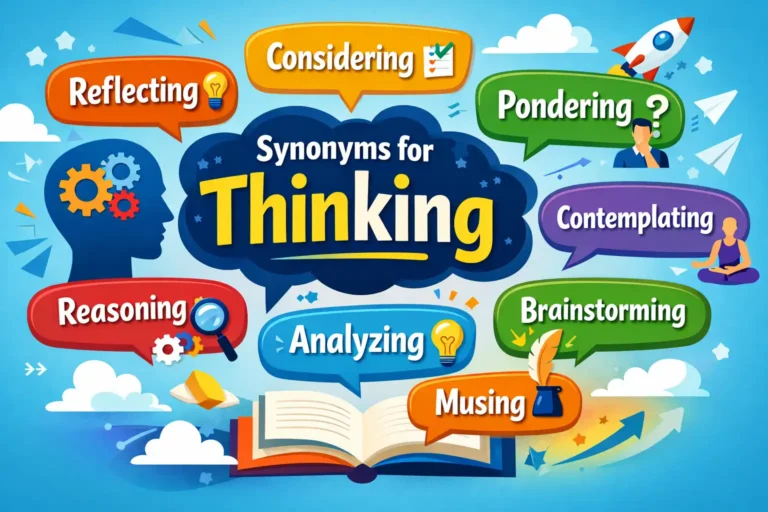
Common synonyms include:
- consider
- reflect
- ponder
- contemplate
- analyze
- reason
- deliberate
- imagine
- believe
- suppose
Meaning of Thinking
Thinking is the mental process of using your brain to form ideas, make decisions, or understand information.
Example:
She is thinking about her future career.
Categories of Synonyms
Cognitive Process
These words focus on understanding information or solving problems mentally.
Deep Reflection
These synonyms describe careful or serious thought over time.
Planning and Decision
These words relate to choosing actions or forming opinions.
Related Words (Not Always Synonyms)
| Word | Simple Meaning | Example Sentence |
| Review | Look at something carefully | I need to review my notes before the test. |
| Examine | Study closely | The scientist examined the results. |
| Plan | Decide steps ahead | We plan our trip early. |
| Judge | Form an opinion | Try not to judge too quickly. |
| Weigh | Consider carefully | She weighed the options. |
| Question | Think with doubt | He questioned the decision. |
| Decide | Choose after thinking | They decided to move. |
| Focus | Pay attention mentally | Please focus on the task. |
Master Synonyms List (Grouped by Level)
Beginner / Simple
Wonder — think with curiosity
Example: I wonder if it will rain today. (Neutral)
Guess — think without certainty
Example: I guess he is busy. (Informal)
Figure — understand or solve mentally
Example: I am trying to figure the problem out. (Informal)
Assume — think something is true without proof
Example: Don’t assume everyone agrees. (Neutral)
Reckon — believe or think (casual use)
Example: I reckon it will work. (Informal)
Intermediate
Evaluate — judge value or importance
Example: We must evaluate the risks. (Formal)
Assess — measure or judge carefully
Example: Teachers assess student progress. (Formal)
Infer — reach a conclusion from evidence
Example: You can infer meaning from context. (Formal)
Deduce — logically conclude
Example: Detectives deduce facts from clues. (Formal)
Speculate — think about possibilities
Example: Experts speculate about the future. (Neutral)
Process — mentally deal with information
Example: It takes time to process new ideas. (Neutral)
Advanced / Formal
Ruminate — think deeply for a long time
Example: He ruminated on the decision overnight. (Formal)
Cogitate — think carefully (formal style)
Example: Philosophers cogitate about existence. (Formal)
Envisage — imagine a future situation
Example: She envisages a better world. (Formal)
Conceptualize — form an idea mentally
Example: Scientists conceptualize theories. (Formal)
Theorize — create explanations or ideas
Example: Researchers theorize about causes. (Formal)
Formal vs Informal Synonyms
Some synonyms work better in casual conversation, while others fit academic or professional writing.
- Informal: guess, figure, reckon
- Neutral: wonder, assume, speculate
- Formal: evaluate, assess, infer, conceptualize
Choose based on context. For example, use evaluate in reports but guess in conversation.
Real-Life Usage Examples
Conversation:
I’m considering changing jobs this year.
Academic Writing:
Researchers are analyzing new solutions to climate challenges.
Business Writing:
We are weighing several options before making a decision.
Blogging:
Many people are reflecting on healthier lifestyle choices today.
Emotional Expression:
She has been pondering her childhood memories lately.
Similar Words Comparison
Thinking vs Pondering
Thinking is general mental activity. Pondering suggests slow and careful thought.
- I am thinking about dinner.
- I am pondering a life decision.
Thinking vs Analyzing
Thinking is broad. Analyzing focuses on studying details or structure.
- He is thinking about the problem.
- He is analyzing the data carefully.
Example Sentences
- She spent the evening considering her career options.
- I need time to reflect before making a final decision.
- He carefully analyzed the problem before responding.
- We are weighing the risks and benefits of the proposal.
- They paused to deliberate on the best solution.
- I often wonder about the future of technology.
- The manager assessed the situation quickly.
- She imagined a different path for her life.
- He inferred the meaning from the context clues.
- I am still figuring out what went wrong.
Common Mistakes
1. Using formal synonyms in casual talk
Saying “I am conceptualizing dinner” sounds unnatural. Use simple words in daily speech.
2. Confusing similar meanings
Infer and assume are different. Infer uses evidence; assume does not.
3. Overusing one synonym
Repeating the same word reduces clarity. Vary vocabulary naturally.
4. Choosing complex words unnecessarily
Simple language is often better for ESL communication.
5. Ignoring context
Some words fit emotional situations, while others fit logical analysis.
Tips / Best Practices
Choosing the right synonym for thinking depends on context, tone, and clarity. A small word change can make your sentence sound more natural, professional, or precise.
Quick Rules
Rule 1: Match the situation
Use simple words for daily conversation and precise words for academic or professional writing.
Rule 2: Focus on meaning depth
If the thought is careful or serious, choose deeper words like deliberate or ponder instead of basic ones.
Mini Rewrites (Before → Better)
1. Casual Situation
❌ I am thinking about your idea.
✅ I am considering your idea.
2. Professional Context
❌ We are thinking about the risks.
✅ We are evaluating the risks.
3. Emotional Reflection
❌ She was thinking about her past.
✅ She was reflecting on her past.
Extra Best Practices
- Choose synonyms based on tone (formal vs casual).
- Consider the context (decision, emotion, analysis).
- Avoid repeating the same word multiple times.
- Use natural vocabulary that native speakers commonly use.
- Do not overuse synonyms just for variety — clarity always comes first.
When NOT to Use Thinking
Do not use thinking when you actually mean knowing, deciding, or performing an action. In many cases, a more precise verb sounds more natural to native speakers.
Wrong vs Right Examples
1. When you mean “decide”
❌ I’m thinking to quit my job tomorrow.
✅ I’ve decided to quit my job tomorrow.
2. When you mean “plan”
❌ We are thinking a trip next month.
✅ We are planning a trip next month.
3. When certainty already exists
❌ I’m thinking he is the manager.
✅ I know he is the manager.
✅ I believe he is the manager. (if not 100% sure)
4. When referring to physical actions
❌ She is thinking the door open.
✅ She is opening the door.
5. When making requests
❌ I am thinking you should call him.
✅ I think you should call him.
✅ I suggest you call him. (more formal)
6. When expressing opinions in formal writing
❌ The company is thinking to expand globally.
✅ The company plans to expand globally.
✅ The company intends to expand globally.
Key Tip
Use thinking mainly for mental processes, not actions or confirmed decisions. If the sentence involves certainty, planning, or movement, choose a more specific verb.
Opposite Words (Antonyms)
The opposite of thinking usually relates to a lack of careful thought, attention, or awareness rather than action itself.
Core Antonyms
Mindlessness — acting without awareness or attention
Example: His mistake came from pure mindlessness.
Thoughtlessness — lack of consideration for consequences or others
Example: Her comment showed thoughtlessness.
Disregard — ignoring something intentionally
Example: He showed disregard for the rules.
Nuance Explained
- Mindlessness focuses on absence of mental awareness.
- Thoughtlessness often includes emotional or social carelessness.
- Disregard suggests choosing to ignore information or advice.
These words oppose thinking because they describe situations where mental effort, reflection, or consideration is missing.
FAQs
What does thinking mean?
It means using your mind to understand, decide, or form ideas.
Is thinking formal or informal?
It is neutral and works in both casual and formal situations.
How can I use thinking in conversation?
You can say, “I’m thinking about your idea.”
What is the best synonym for thinking?
It depends on context. Consider and reflect are common choices.
Can thinking be replaced with analyzing?
Yes, but only when you mean detailed examination.
Is thinking a verb or noun?
It can be both, depending on sentence structure.
What synonym is best for academic writing?
Words like evaluate or assess work well.
What synonym is best for emotional situations?
Words like reflect or wonder fit better.
Why should I learn synonyms?
They improve clarity, vocabulary, and communication skills.
Is thinking the same as imagining?
Not exactly. Imagining focuses on mental pictures or creativity.
What is the difference between “think of” and “think about”?
Think of usually means remembering or creating an idea quickly. Think about means considering something more carefully or for a longer time.
Example: I thought of a solution. / I’m thinking about your suggestion.
What is the difference between ponder and contemplate?
Both mean deep thinking, but ponder is slightly more common and neutral. Contemplate sounds more formal and often relates to serious decisions or philosophical ideas.
What are good synonyms for thinking in academic writing?
Strong academic alternatives include analyze, evaluate, assess, infer, conceptualize, and theorize. These words sound more precise and professional in essays or research papers.
Conclusion
Learning synonyms for thinking helps you communicate more clearly in speaking and writing. It also improves academic vocabulary and professional expression. A richer vocabulary makes your language more natural and confident.
Try using three new synonyms in your next sentence to build stronger English skills.

Thomas Walker focuses on practical vocabulary improvement and clear word substitution guides.