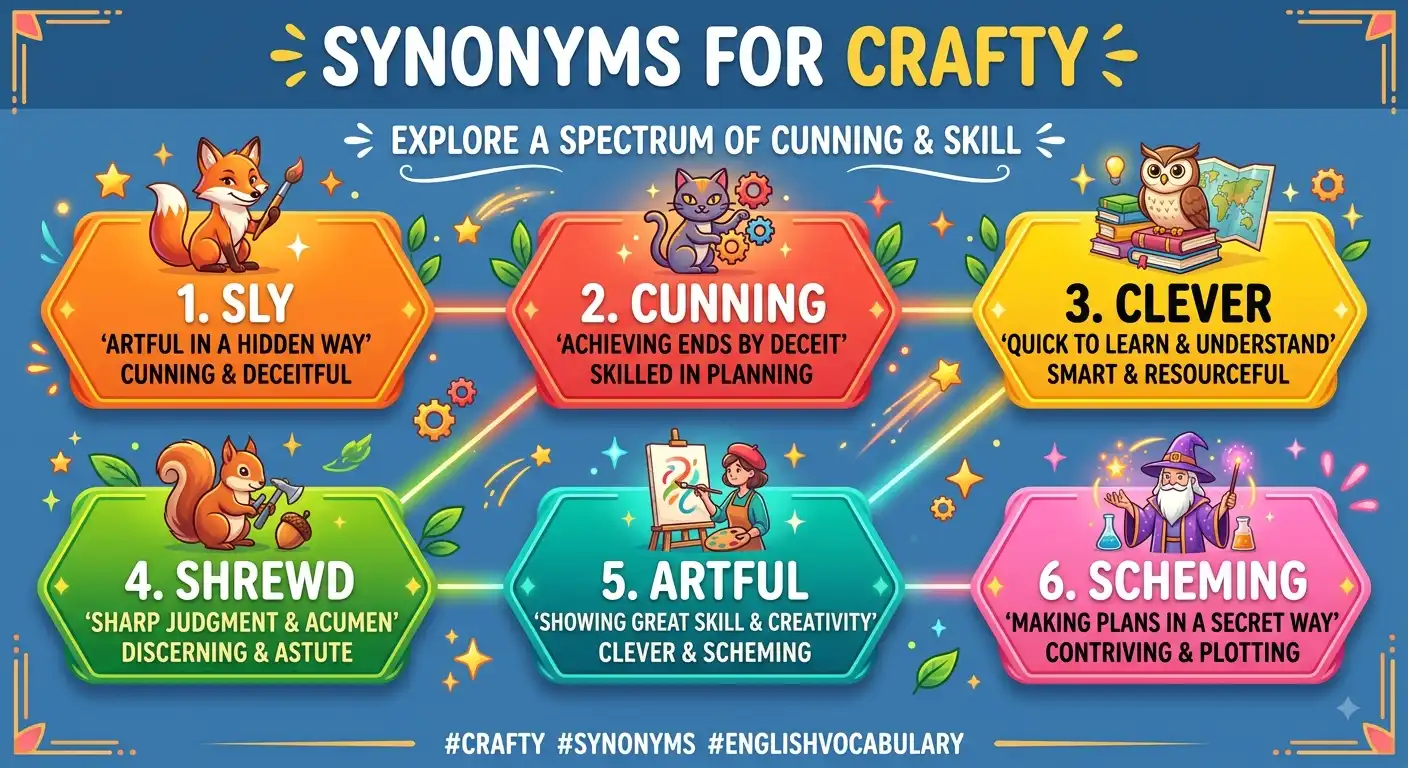
Finding the right synonyms for crafty can completely transform how you express cleverness, skill, and resourcefulness in your writing. When you search for synonyms for crafty, you are looking for alternative words that describe someone clever at achieving things, often through indirect or subtle methods. Knowing various synonyms for crafty helps you avoid repetitive language and paint a vivid picture for your readers. Imagine trying to describe a clever plan in a story, but using the same basic adjective over and over. It gets boring fast! Instead, upgrading your vocabulary lets you distinguish between harmless cleverness and sly deception.
“Words are our most inexhaustible source of magic.” — J.K. Rowling
“The right word may be effective, but no word was ever as effective as a rightly timed pause.” — Mark Twain
At its core, being crafty simply means being good at making or figuring things out using clever tricks or practical skills. Think of a child who builds an intricate treehouse out of discarded cardboard boxes and duct tape, or a baker who ingeniously substitutes missing ingredients to save a recipe. That is the essence of being crafty in everyday life.
This rich vocabulary is exceptionally useful for students writing creative essays, bloggers crafting engaging hooks, content writers optimizing descriptions, and daily English users looking to spice up their conversations.
“Cleverness is not wisdom.” — Euripides
Connotative Meaning of Crafty
- Positive Connotation: Highlights resourcefulness, hands-on creativity, quick-wittedness, and clever problem-solving.
- Negative Connotation: Implies cunning, slyness, trickery, or hidden manipulation with dishonest intentions.
Etymology of Crafty
- Originates from the Old English word cræftig, meaning strong, skillful, or artful.
- Evolved from cræft, denoting physical strength, power, skill, or trade.
- Shifted over centuries from denoting skilled craftsmanship to mental cunning and clever trickery.
Pronunciation of Crafty
- US IPA: /ˈkræf.ti/
- UK IPA: /ˈkrɑːf.ti/
Syllables
- Craf-ty (2 syllables)
Affixation Pattern
- Base root noun/verb: Craft
- Suffix: -y (adjective-forming suffix meaning “characterized by” or “inclined to”)
Comparison Table: Navigating Crafty Synonyms
| Keyword | Meaning | Usage Type | Context |
| Cunning | Showing skill in achieving ends through deceit. | Formal / Serious | Mystery novels, serious journalism |
| Clever | Quick to understand, learn, and devise ideas. | Casual / Positive | Daily conversations, school essays |
| Sly | Having or showing a deceitful nature. | Casual / Descriptive | Fiction writing, character sketches |
| Wily | Skilled at gaining an advantage, especially deceitfully. | Professional / Literary | Historical narratives, storytelling |
| Artful | Clever or skillful, especially in a cunning way. | Formal / Artistic | Professional critiques, literature |
1. Cunning
Pronunciation: US /ˈkʌn.ɪŋ/ | UK /ˈkʌn.ɪŋ/ Meaning: Showing skill in achieving things through clever deception or secret plans. Examples:
- The villain hatched a cunning escape plan from prison.
- She used a cunning strategy to win the chess tournament.
2. Sly
Pronunciation: US /slaɪ/ | UK /slaɪ/ Meaning: Acting in a secret way to get what you want without people noticing. Examples:
- The cat gave a sly look before stealing the treat.
- He made a sly remark about the missing keys.
3. Wily
Pronunciation: US /ˈwaɪ.li/ | UK /ˈwaɪ.li/ Meaning: Clever at getting an advantage, often through smart tricks. Examples:
- The wily detective solved the cold case in days.
- A wily fox outsmarted the farm dogs.
4. Artful
Pronunciation: US /ˈɑːrt.fəl/ | UK /ˈɑːrt.fəl/ Meaning: Clever and skillful, sometimes using indirect methods. Examples:
- Her artful speech persuaded the entire committee.
- The thief made an artful escape into the crowd.
5. Shrewd
Pronunciation: US /ʃruːd/ | UK /ʃruːd/ Meaning: Having good judgment and quick practical cleverness. Examples:
- He made a shrewd investment in local real estate.
- She is a shrewd businesswoman who spots great deals.
6. Foxy
Pronunciation: US /ˈfɑːk.si/ | UK /ˈfɒk.si/ Meaning: Cunning, clever, and alert like a fox. Examples:
- That foxy negotiator closed the deal effortlessly.
- He played a foxy game during the board meeting.
7. Astute
Pronunciation: US /əˈstuːt/ | UK /əˈstuːt/ Meaning: Able to accurately assess situations and turn them to one’s advantage. Examples:
- Her astute observations caught the flaw immediately.
- An astute investor never rushes into bad trades.
8. Slick
Pronunciation: US /slɪk/ | UK /slɪk/ Meaning: Done with great smoothness and clever efficiency. Examples:
- The team delivered a slick presentation to investors.
- He used a slick trick to fix the broken lock.
9. Ingenious
Pronunciation: US /ɪnˈdʒiːn.jəs/ | UK /ɪnˈdʒiːn.jəs/ Meaning: Clever, original, and inventive in solving problems. Examples:
- She designed an ingenious device to water plants.
- That is an ingenious solution to our traffic problem.
10. Devious
Pronunciation: US /ˈdiː.vi.əs/ | UK /ˈdiː.vi.əs/ Meaning: Showing a skillful use of underhanded tactics to achieve goals. Examples:
- The villain had a devious plot to steal the crown.
- Avoid his devious shortcuts if you want success.
11. Subtle
Pronunciation: US /ˈsʌt.əl/ | UK /ˈsʌt.əl/ Meaning: So delicate or precise as to be difficult to analyze or describe. Examples:
- He dropped a subtle hint about his surprise birthday.
- The painting features subtle shades of blue and green.
12. Smart
Pronunciation: US /smɑːrt/ | UK /smɑːt/ Meaning: Having or showing a quick-witted intelligence. Examples:
- Wearing a smart suit boosted his interview confidence.
- That was a smart move in the final game.
13. Sharp
Pronunciation: US /ʃɑːrp/ | UK /ʃɑːp/ Meaning: Quick to notice, understand, or respond. Examples:
- She has a sharp mind for solving complex math.
- Watch out for his sharp replies during debates.
14. Acute
Pronunciation: US /əˈkjuːt/ | UK /əˈkjuːt/ Meaning: Having or showing a perceptive understanding or insight. Examples:
- He has an acute sense of hearing in the dark.
- Her acute awareness helped avoid a major accident.
15. Brainy
Pronunciation: US /ˈbreɪ.ni/ | UK /ˈbreɪ.ni/ Meaning: Having or showing intelligence. Examples:
- The brainy student aced every physics test.
- She joined a brainy club for young programmers.
16. Clever
Pronunciation: US /ˈklev.ər/ | UK /ˈklev.ər/ Meaning: Quick at learning, understanding, and devising solutions. Examples:
- The clever dog opened the pantry door alone.
- He came up with a clever way to save money.
17. Resourceful
Pronunciation: US /rɪˈzɔːrs.fəl/ | UK /rɪˈzɔːs.fəl/ Meaning: Able to act effectively and imaginatively, especially in difficult situations. Examples:
- Being resourceful allowed her to fix the broken car.
- Resourceful campers can survive anywhere in nature.
18. Inventive
Pronunciation: US /ɪnˈven.tɪv/ | UK /ɪnˈven.tɪv/ Meaning: Having the ability to create or design new things creatively. Examples:
- The inventive chef created a brand new flavor profile.
- Children are naturally inventive when playing games.
19. Creative
Pronunciation: US /kriˈeɪ.tɪv/ | UK /kriˈeɪ.tɪv/ Meaning: Relating to or involving the imagination or original ideas. Examples:
- She wrote a creative poem about the autumn wind.
- Creative writing brings stories to vibrant life.
20. Imaginative
Pronunciation: US /ɪˈmædʒ.ə.nə.tɪv/ | UK /ɪˈmædʒ.ɪ.nə.tɪv/ Meaning: Having or showing creativity or inventive skill. Examples:
- The imaginative child built a castle from pillows.
- He pitched an imaginative campaign to the brand.
21. Constructive
Pronunciation: US /kənˈstrʌk.tɪv/ | UK /kənˈstrʌk.tɪv/ Meaning: Serving a useful and positive purpose; tending to build up. Examples:
- Her teacher gave constructive feedback on the essay.
- We had a constructive meeting about project goals.
22. Adaptable
Pronunciation: US /əˈdæp.tə.bəl/ | UK /əˈdæp.tə.bəl/ Meaning: Able to adjust to new conditions or situations easily. Examples:
- Plants must be adaptable to survive harsh winters.
- An adaptable worker thrives in any fast-paced office.
23. Versatile
Pronunciation: US /ˈvɜːr.sə.təl/ | UK /ˈvɜː.sə.taɪl/ Meaning: Able to adapt or be adapted to many different functions or activities. Examples:
- This versatile tool cuts wood and metal easily.
- She is a versatile actress starring in comedy and drama.
24. Capable
Pronunciation: US /ˈkeɪ.pə.bəl/ | UK /ˈkeɪ.pə.bəl/ Meaning: Having the ability, fitness, or quality necessary to do something. Examples:
- He is a capable leader for our team project.
- She is fully capable of managing the budget alone.
25. Competent
Pronunciation: US /ˈkɑːm.pə.tənt/ | UK /ˈkɒm.pɪ.tənt/ Meaning: Having the necessary ability or skills to do something successfully. Examples:
- The competent mechanic fixed the brakes quickly.
- She is a competent writer who meets every deadline.
26. Proficient
Pronunciation: US /prəˈfɪʃ.ənt/ | UK /prəˈfɪʃ.ənt/ Meaning: Competent or skilled in doing or using something. Examples:
- He became proficient in Spanish after living abroad.
- She is proficient at using advanced software tools.
27. Adept
Pronunciation: US /əˈdept/ | UK /əˈdept/ Meaning: Very skilled or proficient at something. Examples:
- He is adept at fixing computers and electronics.
- She proved adept at handling difficult customers.
28. Skilful
Pronunciation: US /ˈskɪl.fəl/ | UK /ˈskɪl.fəl/ Meaning: Having or showing skill. Examples:
- The skilful pianist played the sonata beautifully.
- It takes a skilful carpenter to build fine cabinets.
29. Expert
Pronunciation: US /ˈek.spɜːrt/ | UK /ˈek.spɜːt/ Meaning: Having authoritative knowledge or skill in a particular area. Examples:
- She is an expert in ancient Roman history.
- Call an expert plumber to fix the leak safely.
30. Masterly
Pronunciation: US /ˈmæs.tɚ.li/ | UK /ˈmɑː.stə.li/ Meaning: Done with great skill and understanding. Examples:
- The artist delivered a masterly portrait on canvas.
- He showed masterly control during the tennis match.
31. Slick
Pronunciation: US /slɪk/ | UK /slɪk/ Meaning: Operating with smooth and clever execution. Examples:
- They created a slick mobile application interface.
- His slick driving avoided a sudden accident.
32. Smooth
Pronunciation: US /smuːð/ | UK /smuːð/ Meaning: Having a continuous and even surface or flowing method. Examples:
- The dancer made smooth movements across the stage.
- He gave a smooth explanation for the delay.
33. Subtle
Pronunciation: US /ˈsʌt.əl/ | UK /ˈsʌt.əl/ Meaning: Delicate or indirect in handling situations. Examples:
- She used subtle persuasion to change his mind.
- There was a subtle shift in the market trends.
34. Guileful
Pronunciation: US /ˈɡaɪl.fəl/ | UK /ˈɡaɪl.fəl/ Meaning: Sly or cunning through intelligent deceit. Examples:
- The guileful merchant tricked the tourist into paying extra.
- Her guileful tactics won her the card game.
35. Deceitful
Pronunciation: US /dɪˈsiːt.fəl/ | UK /dɪˈsiːt.fəl/ Meaning: Guilty of or involving deception to mislead others. Examples:
- Do not trust his deceitful promises about money.
- The contract contained deceitful hidden clauses.
36. Tricky
Pronunciation: US /ˈtrɪk.i/ | UK /ˈtrɪk.i/ Meaning: Requiring care and cleverness because of difficulty. Examples:
- Solving this math puzzle is quite tricky.
- He navigated a tricky situation with grace.
37. Slippery
Pronunciation: US /ˈslɪp.ɚ.i/ | UK /ˈslɪp.ər.i/ Meaning: Difficult to hold onto or elusive in character. Examples:
- The politician gave a slippery answer to the press.
- Fish are notoriously slippery when caught.
38. Foxy
Pronunciation: US /ˈfɑːk.si/ | UK /ˈfɒk.si/ Meaning: Cunning and crafty in behavior. Examples:
- That foxy merchant always finds a loophole.
- She made a foxy move in negotiations.
39. Slyboots
Pronunciation: US /ˈslaɪ.buːts/ | UK /ˈslaɪ.buːts/ Meaning: A playful term for someone who is sly or crafty. Examples:
- You kept that secret quiet, you old slyboots!
- The slyboots smiled after winning the prize.
40. Machiavellian
Pronunciation: US /ˌmɑː.ki.əˈvel.i.ən/ | UK /ˌmæk.i.əˈvel.i.ən/ Meaning: Cunning, scheming, and unscrupulous, especially in politics. Examples:
- He used Machiavellian tactics to rise in power.
- The corporate drama felt like a Machiavellian play.
41. Calculating
Pronunciation: US /ˈkæl.kjəˌleɪ.tɪŋ/ | UK /ˈkæl.kjəˌleɪ.tɪŋ/ Meaning: Acting shrewdly and selfishly to achieve an end. Examples:
- She made a calculating decision to switch teams.
- His calculating nature makes him a tough opponent.
42. Scheming
Pronunciation: US /ˈskiː.mɪŋ/ | UK /ˈskiː.mɪŋ/ Meaning: Involved in making secret and clever plans. Examples:
- The scheming villains plotted their next move.
- She caught her coworkers scheming behind her desk.
43. Designing
Pronunciation: US /dɪˈzaɪ.nɪŋ/ | UK /dɪˈzaɪ.nɪŋ/ Meaning: Calculating and deceitful; scheming. Examples:
- Beware of his designing motives in this partnership.
- She saw through his designing flattery immediately.
44. Intriguing
Pronunciation: US /ɪnˈtriː.ɡɪŋ/ | UK /ɪnˈtriː.ɡɪŋ/ Meaning: Arousing curiosity or interest through cleverness. Examples:
- The book features an intriguing plot twist.
- She shared an intriguing idea for the startup.
45. Designing
Pronunciation: US /dɪˈzaɪ.nɪŋ/ | UK /dɪˈzaɪ.nɪŋ/ Meaning: Secretly planning something clever or self-serving. Examples:
- He had designing plans for the company stock.
- Her designing attitude put everyone on edge.
46. Slick
Pronunciation: US /slɪk/ | UK /slɪk/ Meaning: Cleverly executed with minimal effort. Examples:
- They pulled off a slick marketing stunt.
- His slick demeanor hid his nervous anxiety.
47. Shifty
Pronunciation: US /ˈʃɪf.ti/ | UK /ˈʃɪf.ti/ Meaning: Tending to evade, deceive, or avoid direct answers. Examples:
- He gave me a shifty look across the room.
- I distrusted his shifty explanation for being late.
48. Dodgy
Pronunciation: US /ˈdɑː.dʒi/ | UK /ˈdɒdʒ.i/ Meaning: Dishonest or unreliable; clever in a suspicious way. Examples:
- He bought a car from a dodgy salesman.
- That website looks a bit dodgy to me.
49. Sharp-witted
Pronunciation: US /ˈʃɑːrpˌwɪt.ɪd/ | UK /ˈʃɑːpˌwɪt.ɪd/ Meaning: Quick to understand and clever in response. Examples:
- The sharp-witted host handled the heckler brilliantly.
- She is a sharp-witted conversationalist.
50. Quick-witted
Pronunciation: US /ˈkwɪkˌwɪt.ɪd/ | UK /ˈkwɪkˌwɪt.ɪd/ Meaning: Showing or characterized by an ability to think quickly. Examples:
- His quick-witted reply saved the presentation.
- She is quick-witted enough to solve any riddle.
Antonyms of Crafty
- Honest
- Naive
- Artless
- Direct
- Open
- Guileless
- Candid
- Sincere
- Simple
- Straightforward
Prototype Meaning and Categorization of Crafty
- Category: Descriptive Adjective / Personal Attribute
- Prototype Model: A person or plan that exhibits clever ingenuity, manual dexterity, or clever mental maneuvering to achieve a specific goal. It spans across two distinct branches: positive resourcefulness (building things smartly) and negative cunning (tricking people cleverly).
Frequently Asked Questions (FAQ)
What does crafty mean in plain English?
Crafty means being clever at achieving what you want, often by using clever tricks, practical skills, or creative resourcefulness.
Is crafty a positive or negative word?
It depends on context! It can mean creative and resourceful (positive), or sly and deceitful (negative).
How can I use synonyms for crafty in writing?
Use synonyms like wily, astute, or ingenious to add variety, tone, and depth to your character descriptions and essays.
What is the difference between crafty and cunning?
While both involve cleverness, cunning almost always implies deception or harmful trickery, whereas crafty can simply mean skillfully resourceful.
Can crafty be used to describe inanimate objects?
Usually, it describes people, minds, or plans, but it can metaphorically describe a device or mechanism built with clever ingenuity.
Conclusion
Learning and mastering synonyms for crafty is one of the most effective ways to elevate your writing, blogging, speaking, and daily communication. When you expand your vocabulary beyond basic words, you gain the precise tools needed to capture nuance, mood, and tone. Whether you want to describe a brilliant inventor or a sneaky character in a fiction story, having the right alternative word makes all the difference.
“To use words well is to paint pictures in the minds of your audience.” — Anonymous
We encourage you to actively practice these words in your daily emails, academic essays, and casual conversations. Notice how replacing a generic adjective with something like astute or ingenious instantly sharpens your message. Keep experimenting with new words, stay curious, and watch your linguistic confidence grow day by day!
“Language is the dress of thought.” — Samuel Johnson

Thomas Walker is a professional English consultant and content strategist with over eleven years of experience working with technology companies, business writers, and content teams who need precise, modern vocabulary guidance (Biography).