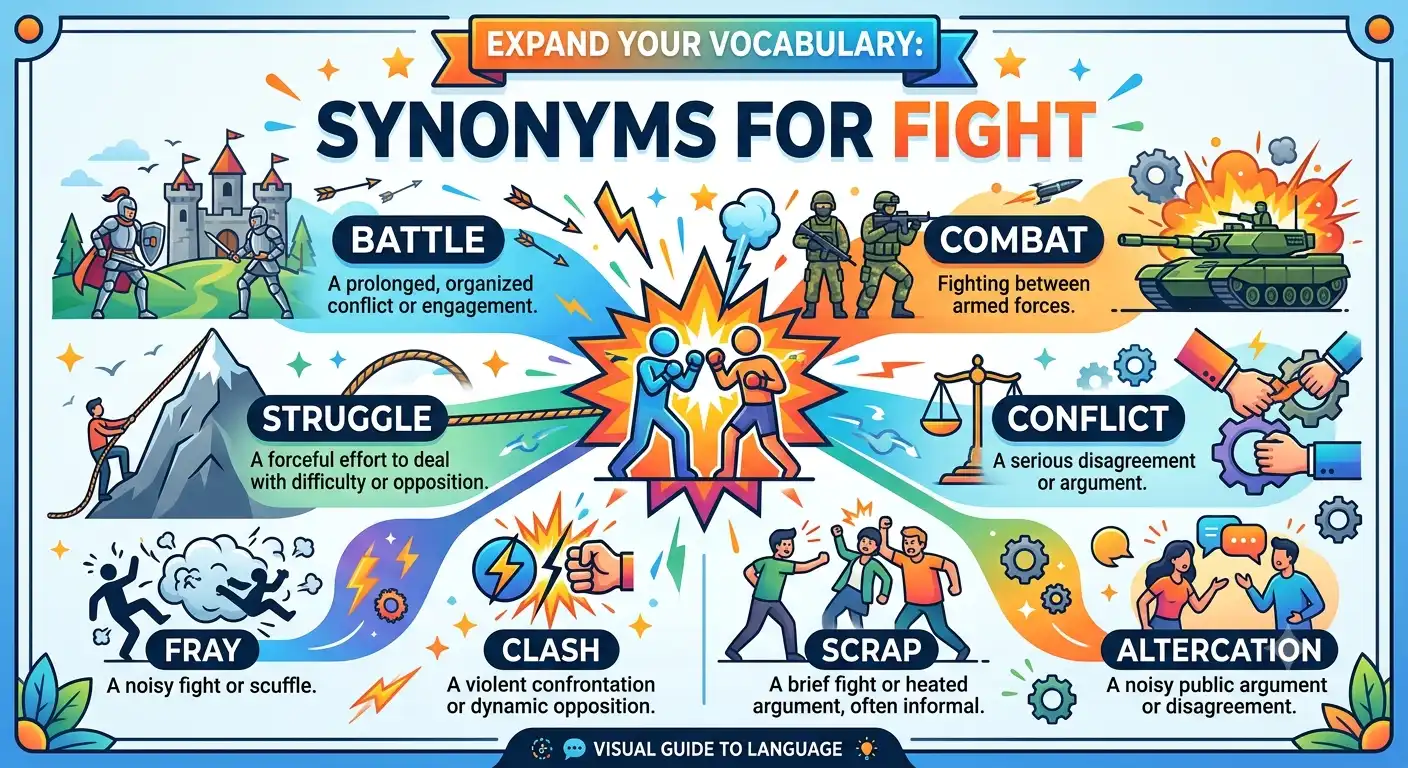
Learning the right synonyms for fight is an outstanding way to elevate your speaking and writing. When you understand different synonyms for fight, you can express conflict and determination with absolute clarity. Using strong synonyms for fight helps you describe how you stand up for what is right, handle a tough argument, or win an athletic contest.
Imagine two chess players sitting across a wooden board in a quiet room. They do not share a single spoken word, yet a fierce battle rages between them with every moving piece on the board. This silent clash shows why choosing the right word matters so much. In very simple English, a “fight” means to use physical force or strong words to defeat an opponent, a difficult situation, or a bad habit.
“The hardest fight is the one you have with yourself.” — Unknown
“To fight for what is right is the highest honor.” — Unknown
Expanding your range of expression is incredibly helpful for several groups of writers:
- For students: It helps you describe historical battles, literary struggles, and personal achievements in essays without repeating the same basic words.
- For bloggers: It keeps your readers completely hooked with exciting, active, and highly relatable action words.
- For content writers: It boosts your search engine rankings by using natural variety that algorithms love.
- For daily English users: It helps you share your personal stories, hard days, and proud achievements with absolute clarity.
Connotative Meaning of Fight
The word “fight” carries a very active and emotional connotation of strength, resistance, and survival. It can suggest a negative situation, like a painful physical battle or an angry verbal argument. However, it also suggests positive traits, like showing courage, refusing to give up, and working hard to protect someone you love. It represents the active choice to face a challenge directly.
Etymology of Fight
- Fight (Root): Formed from the Old English word feohtan (meaning “to fight” or “to strive”).
- Origin: Derived from the West Germanic root, similar to the Dutch word vechten and the German word fechten.
- Evolution: Used since before the 12th century to mean “physical combat between enemies,” which later grew to include verbal arguments, sports matches, and mental struggles.
Linguistic Profile of Fight
- US Pronunciation (IPA): /faɪt/
- UK Pronunciation (IPA): /faɪt/
- Syllables: 1 syllable (fight)
- Affixation Pattern: A strong Germanic base verb that takes the irregular past tense fought and past participle fought.
Comparison of Key Synonyms
To help you choose the right word instantly, here is a simple comparison of key synonyms:
| Keyword | Meaning | Usage Type | Context |
|---|---|---|---|
| Battle | A long and organized fight between armies or big ideas. | Literary & Emotional | Historical wars, chronic illnesses, social movements |
| Clash | A sudden, loud fight or disagreement between two sides. | Casual & Professional | Sports rivalries, office debates, colors |
| Struggle | A long, hard effort to overcome a difficult obstacle. | Emotional & Casual | Family budgets, mental health, deep grief |
| Dispute | A formal disagreement or argument over a specific rule. | Professional & Academic | Business contracts, border lines, legal matters |
| Brawl | A wild, noisy, and unorganized physical fight in public. | Casual & Emotional | Street fights, tavern arguments, rough games |
| Spar | To practice boxing or exchange light arguments for fun. | Casual & Professional | Gym workouts, friendly debates, verbal practice |
50 Synonyms for Fight
Here is your ultimate list of 50 synonyms to describe victory, arguments, and physical struggles.
1. Battle
- Pronunciation: US /ˈbæt̬.əl/ | UK /ˈbæt.əl/
- Meaning: This means a long and organized fight between two sides.
- Examples:
- The brave soldiers won the battle on the hill.
- She won her long battle against the illness.
2. Clash
- Pronunciation: US /klæʃ/ | UK /klæʃ/
- Meaning: This means a sudden fight or disagreement between two different groups.
- Examples:
- The two soccer teams clash on the field tonight.
- My ideas clash with my brother’s ideas.
3. Struggle
- Pronunciation: US /ˈstrʌɡ.əl/ | UK /ˈstrʌɡ.əl/
- Meaning: This means to work very hard to get through a difficult problem.
- Examples:
- The small business had to struggle to survive the winter.
- He had to struggle to open the rusted door.
4. Combat
- Pronunciation: US /ˈkɑːm.bæt/ | UK /ˈbɒm.bæt/
- Meaning: This means physical fighting between enemies in a war.
- Examples:
- The pilots were trained for direct aerial combat.
- We must combat climate change by planting more trees.
5. Conflict
- Pronunciation: US /ˈkɑːn.flɪkt/ | UK /ˈkɒn.flɪkt/
- Meaning: This means a serious disagreement or argument that lasts a long time.
- Examples:
- The manager helped resolve the conflict between the workers.
- Their different goals caused a minor conflict in the group.
6. Dispute
- Pronunciation: US /dɪˈspjuːt/ | UK /dɪˈspjuːt/
- Meaning: This means an official argument about facts, rules, or property.
- Examples:
- The neighbors resolved their dispute over the fence.
- There is no dispute that she is the best runner.
7. Brawl
- Pronunciation: US /brɑːl/ | UK /brɔːl/
- Meaning: This means a loud, messy, and wild fight in a public place.
- Examples:
- The police arrived to stop a noisy brawl outside the store.
- A sudden brawl started during the hockey game.
8. Scuffle
- Pronunciation: US /ˈskʌf.əl/ | UK /ˈskʌf.əl/
- Meaning: This means a short, light physical fight that is not very serious.
- Examples:
- There was a brief scuffle in the school yard today.
- The guard got into a quick scuffle with the thief.
9. Quarrel
- Pronunciation: US /ˈkwɔːr.əl/ | UK /ˈkwɒr.əl/
- Meaning: This means an angry argument between people who usually get along.
- Examples:
- The sisters had a silly quarrel about who should clean.
- I do not want to quarrel with you over dinner.
10. Argue
- Pronunciation: US /ˈɑːrɡ.juː/ | UK /ˈɑːɡ.juː/
- Meaning: This means to speak angrily to someone because you disagree with them.
- Examples:
- They always argue about which movie to watch.
- Please do not argue with the referee’s decision.
11. Feud
- Pronunciation: US /fjuːd/ | UK /fjuːd/
- Meaning: This means an angry disagreement between families or groups that lasts for years.
- Examples:
- The bitter feud between the two families finally ended.
- They have been in a silent feud since high school.
12. Oppose
- Pronunciation: US /əˈpoʊz/ | UK /əˈpəʊz/
- Meaning: This means to speak or act against a plan or idea.
- Examples:
- Many local citizens oppose the new highway plan.
- She chose to oppose the decision during the meeting.
13. Resist
- Pronunciation: US /rɪˈzɪst/ | UK /rɪˈzɪst/
- Meaning: This means to fight against something or refuse to accept it.
- Examples:
- It is hard to resist eating fresh chocolate cookies.
- The small army tried to resist the enemy advance.
14. Withstand
- Pronunciation: US /wɪðˈstænd/ | UK /wɪðˈstænd/
- Meaning: This means to remain strong and undamaged by a powerful force.
- Examples:
- The old brick house can withstand strong winds.
- She managed to withstand the pressure from her boss.
15. Contend
- Pronunciation: US /kənˈtend/ | UK /kənˈtend/
- Meaning: This means to compete with someone to achieve a major goal.
- Examples:
- Three great runners will contend for the gold medal.
- We must contend with many difficulties on this project.
16. Encounter
- Pronunciation: US /ɪnˈkaʊn.t̬ɚ/ | UK /ɪnˈkaʊn.tər/
- Meaning: This means a sudden or unexpected meeting with an enemy or obstacle.
- Examples:
- The hikers had a scary encounter with a wild bear.
- Our team had a brief encounter with the rival players.
17. Skirmish
- Pronunciation: US /ˈskɝː.mɪʃ/ | UK /ˈskɜː.mɪʃ/
- Meaning: This means a short, unplanned fight between small groups of soldiers.
- Examples:
- A light skirmish took place near the border line.
- The politicians had a minor verbal skirmish on television.
18. Tussle
- Pronunciation: US /ˈtʌs.əl/ | UK /ˈtʌs.əl/
- Meaning: This means a quick, energetic physical struggle or a light fight.
- Examples:
- The two dogs had a playful tussle in the grass.
- He lost his hat during the tussle in the crowd.
19. Altercation
- Pronunciation: US /ˌɑːl.tɚˈkeɪ.ʃən/ | UK /ˌɒl.təˈkeɪ.ʃən/
- Meaning: This means a noisy argument in public that might attract attention.
- Examples:
- The driver got into an altercation with the traffic officer.
- An altercation broke out in the restaurant lobby.
20. Squabble
- Pronunciation: US /ˈskwɑː.bəl/ | UK /ˈskwɒb.əl/
- Meaning: This means a noisy argument about something that is not important.
- Examples:
- The children squabble over who gets the largest toy.
- Let us not squabble over a few cents.
21. Spar
- Pronunciation: US /spɑːr/ | UK /spɑː/
- Meaning: This means to practice boxing or argue in a friendly way.
- Examples:
- The two boxers will spar for three rounds today.
- The lawyers like to spar with each other in court.
22. Grapple
- Pronunciation: US /ˈɡræp.əl/ | UK /ˈɡræp.əl/
- Meaning: This means to hold onto someone and fight with them physically.
- Examples:
- The security guards had to grapple with the intruder.
- She had to grapple with a very hard math problem.
23. Duel
- Pronunciation: US /ˈduː.əl/ | UK /ˈdʒuː.əl/
- Meaning: This means a formal fight between two people with weapons to settle an honor dispute.
- Examples:
- The two knights agreed to a duel at sunrise.
- The chess match felt like a silent mental duel.
“The ultimate measure of a man is not where he stands in moments of comfort and convenience, but where he stands at times of challenge and controversy.” — Martin Luther King Jr.
24. Wrangle
- Pronunciation: US /ˈræŋ.ɡəl/ | UK /ˈræŋ.ɡəl/
- Meaning: This means to have a noisy and complicated argument that lasts a long time.
- Examples:
- The lawyers had to wrangle over the details of the contract.
- We had to wrangle with the company to get a refund.
25. Challenge
- Pronunciation: US /ˈtʃæl.ɪndʒ/ | UK /ˈtʃæl.ɪndʒ/
- Meaning: This means an invitation to compete in a fight, game, or test.
- Examples:
- I accept your challenge to a race around the block.
- Climbing the steep mountain was a massive physical challenge.
26. Defy
- Pronunciation: US /dɪˈfaɪ/ | UK /dɪˈfaɪ/
- Meaning: This means to refuse to obey a person, rule, or force.
- Examples:
- She decided to defy the bad weather and go for a run.
- The brave citizen chose to defy the unfair local law.
27. Confront
- Pronunciation: US /kənˈfrʌnt/ | UK /kənˈfrʌnt/
- Meaning: This means to face a person or problem directly and with courage.
- Examples:
- You must confront your fears if you want to grow.
- He chose to confront his coworker about the stolen project.
28. Tackle
- Pronunciation: US /ˈtæk.əl/ | UK /ˈtæk.əl/
- Meaning: This means to grab someone to throw them down, or to deal with a hard problem.
- Examples:
- The defender ran fast to tackle the football player.
- We need to tackle this dirty room before mom comes home.
29. War
- Pronunciation: US /wɔːr/ | UK /wɔː/
- Meaning: This means an armed fight between different nations, groups, or major ideas.
- Examples:
- The two countries were at war for five years.
- The doctors are fighting a war against the dangerous virus.
30. Rumpus
- Pronunciation: US /ˈrʌm.pəs/ | UK /ˈrʌm.pəs/
- Meaning: This means a noisy disturbance, fight, or argument.
- Examples:
- The loud party next door caused a major rumpus.
- The children made a rumpus in the living room.
31. Row
- Pronunciation: US /raʊ/ | UK /raʊ/
- Meaning: This means a noisy and very angry argument between people.
- Examples:
- My parents had a loud row about the car keys.
- He walked out of the house after a bitter row.
32. Fracas
- Pronunciation: US /ˈfreɪ.kəs/ | UK /ˈfræk.ɑː/
- Meaning: This means a noisy, disorderly fight or argument in a crowd.
- Examples:
- The police were called to settle a fracas in the park.
- A sudden fracas broke out among the excited fans.
33. Affray
- Pronunciation: US /əˈfreɪ/ | UK /əˈfreɪ/
- Meaning: This means a noisy fight in a public place that frightens other people.
- Examples:
- The young men were charged with starting a public affray.
- A loud affray near the bank caused the shops to close.
34. Melee
- Pronunciation: US /ˈmeɪ.leɪ/ | UK /ˈmeɪ.leɪ/
- Meaning: This means a large, confused fight involving a crowd of people.
- Examples:
- Several people lost their shoes in the wild melee.
- The peaceful protest turned into a confusing melee.
35. Scrap
- Pronunciation: US /skræp/ | UK /skræp/
- Meaning: This is a casual term for a short, playful, or minor physical fight.
- Examples:
- The schoolboys got into a small scrap over a pencil.
- Our dog loves to have a quick scrap with the neighbor’s dog.
36. Assault
- Pronunciation: US /əˈsɑːlt/ | UK /əˈsɔːlt/
- Meaning: This means a violent physical attack on a person or building.
- Examples:
- The soldiers planned a night assault on the enemy camp.
- He was arrested for a physical assault outside the shop.
37. Attack
- Pronunciation: US /əˈtæk/ | UK /əˈtæk/
- Meaning: This means to try to hurt, damage, or defeat someone with physical force or words.
- Examples:
- The wild wolves will attack if they feel threatened.
- The newspaper article was a direct attack on the mayor.
38. Campaign
- Pronunciation: US /kæmˈpeɪn/ | UK /kæmˈpeɪn/
- Meaning: This means a series of planned actions to achieve a social or political goal.
- Examples:
- She organized a campaign to clean up the local river.
- The army launched a new campaign in the desert.
39. Crusade
- Pronunciation: US /kruːˈseɪd/ | UK /kruːˈseɪd/
- Meaning: This means a long and determined effort to change something for the better.
- Examples:
- The teacher led a personal crusade to improve child literacy.
- They started a green crusade against plastic bags.
40. Drive
- Pronunciation: US /draɪv/ | UK /draɪv/
- Meaning: This means an organized effort by a group of people to achieve a goal.
- Examples:
- Our school started a food drive to help poor families.
- The company has a strong drive to increase sales.
41. Endeavor
- Pronunciation: US /ɪnˈdev.ɚ/ | UK /ɪnˈdev.ər/
- Meaning: This means a serious and determined effort to do something new.
- Examples:
- Writing a long book is a difficult creative endeavor.
- We wish you good luck in your new business endeavor.
42. Hassle
- Pronunciation: US /ˈhæs.əl/ | UK /ˈhæs.əl/
- Meaning: This is a casual word for a situation that causes a lot of trouble or arguments.
- Examples:
- Getting a visa can be a major hassle for travelers.
- I do not want to hassle you about your homework.
43. Bicker
- Pronunciation: US /ˈbɪk.ɚ/ | UK /ˈbɪk.ər/
- Meaning: This means to argue in a childish way about small things.
- Examples:
- The kids continue to bicker about who sits near the window.
- It is tiring to listen to them bicker all afternoon.
44. Contest
- Pronunciation: US /ˈkɑːn.test/ | UK /ˈbɒn.test/
- Meaning: This means a competition to see who is the best in a sport or activity.
- Examples:
- She entered a spelling contest at the library.
- The election was a very close contest between two leaders.
45. Rivalry
- Pronunciation: US /ˈraɪ.vəl.ri/ | UK /ˈraɪ.vəl.ri/
- Meaning: This means a long struggle between people who want the same success.
- Examples:
- There is a friendly rivalry between the two schools.
- The siblings have a strong rivalry in sports.
46. Match
- Pronunciation: US /mætʃ/ | UK /mætʃ/
- Meaning: This means a sports game where two people or teams compete.
- Examples:
- I watched an exciting tennis match yesterday.
- They will play a friendly chess match tomorrow.
47. Bout
- Pronunciation: US /baʊt/ | UK /baʊt/
- Meaning: This means a short period of intense activity, like a boxing match or an illness.
- Examples:
- The boxer won his final bout with a powerful punch.
- She is resting after a short bout of the flu.
48. Strive
- Pronunciation: US /straɪv/ | UK /straɪv/
- Meaning: This means to make a very great effort to achieve something.
- Examples:
- We must strive to do our best in school every day.
- The company will strive to make safer products.
49. Stand
- Pronunciation: US /stænd/ | UK /stænd/
- Meaning: This means an active effort to defend yourself or your opinions.
- Examples:
- You must take a stand against bullying in school.
- The small group made a final stand against the invaders.
50. Counter
- Pronunciation: US /ˈkaʊn.t̬ɚ/ | UK /ˈkaʊn.tər/
- Meaning: This means to take action to defend yourself against an attack or argument.
- Examples:
- The champion managed to counter the blow with his shield.
- She used solid facts to counter his false statement.
Antonyms of Fight
To understand “fight” fully, it is helpful to look at its direct opposites. In communication and daily life, these words represent peace, agreement, and giving up:
- Surrender: To stop fighting an opponent and admit that you have lost.
- Peace: A state of quiet where there is no war or fighting.
- Agree: To have the same opinion or say yes to a plan.
- Yield: To stop resisting and let someone else have their way.
- Acquiesce: To accept something quietly without arguing, even if you do not like it.
Prototype Meaning and Categorization of Synonyms for Fight
The fifty synonyms for fight can be easily divided into four main categories:
- The Warriors (Physical Combat): Words like battle, combat, war, assault, and melee that describe serious, physical, and historical conflicts between groups.
- The Debaters (Verbal Disagreement): Terms like dispute, argue, quarrel, altercation, and squabble that focus on spoken conflict, arguments, and words.
- The Resisters (Mental and Social Effort): Words like struggle, resist, withstand, strive, and defy that show inner strength, effort, and standing up to bad conditions.
- The Competitors (Sports and Games): Phrases like spar, contest, match, bout, and tackle that look at organized, rule-based sports fighting or friendly practice.
FAQ about Synonyms for Fight
1. What is the difference between “fight” and “battle”?
A fight is a general term for any conflict, whether it is physical, verbal, or mental. A battle is usually a much larger, more organized, and longer conflict, such as a military campaign or a long-term fight against a serious disease.
2. Can I use “scrap” in formal business writing?
No, scrap is a highly casual and informal synonym. It is perfect for describing a light, friendly playground scuffle or a pet play-fight, but you should avoid it in professional emails or academic essays.
3. What is a professional synonym for fight?
In a corporate or legal environment, words like dispute (as in “dispute resolution”), contend (as in “contend with market changes”), or counter (as in “counter a rival’s offer”) sound much more polished and professional.
4. Is “altercation” a physical fight?
An altercation can include mild pushing, but it is primarily a loud, angry, and public verbal argument that draws attention from bystanders.
5. How does choosing the right synonym for fight improve my SEO?
Using diverse words stops search engines from flagging your content for repeating the word “fight” too many times. Variety keeps human readers on your page longer, which boosts your rankings.
6. What is the correct pronunciation of “fight”?
In both US and UK English, it is pronounced as /faɪt/. It contains exactly one syllable and features a long “i” sound.
Conclusion
Expanding your vocabulary with fifty unique synonyms for fight is a powerful way to make your communication much more engaging. When you select the exact word that fits your situation, your writing gains immediate emotional depth and impact. Rather than repeating the same common verbs, bloggers can craft highly active articles, students can write persuasive historical essays, and business professionals can make their marketing messages clear and professional. Using active vocabulary keeps your readers curious and ensures that your unique voice sounds completely authentic.
We encourage you to practice using these terms as you write your school papers, draft work emails, or chat with your friends. By paying attention to the small differences in these words, you can match your tone to your specific audience perfectly. Do not be afraid to experiment with new terms in your next conversation. With regular practice, choosing the right synonym will become completely natural, helping you share your thoughts, challenges, and successes with confidence. Every time you swap a dull word for a dynamic one, you take a big step forward as a writer. Your voice will sound brighter, and your ideas will carry much more weight. Keep exploring the beauty of the English language, and watch how quickly your sentences begin to shine.
“Do not go gentle into that good night… Rage, rage against the dying of the light.” — Dylan Thomas
“In the middle of difficulty lies opportunity.” — Albert Einstein

Thomas Walker is a professional English consultant and content strategist with over eleven years of experience working with technology companies, business writers, and content teams who need precise, modern vocabulary guidance (Biography).