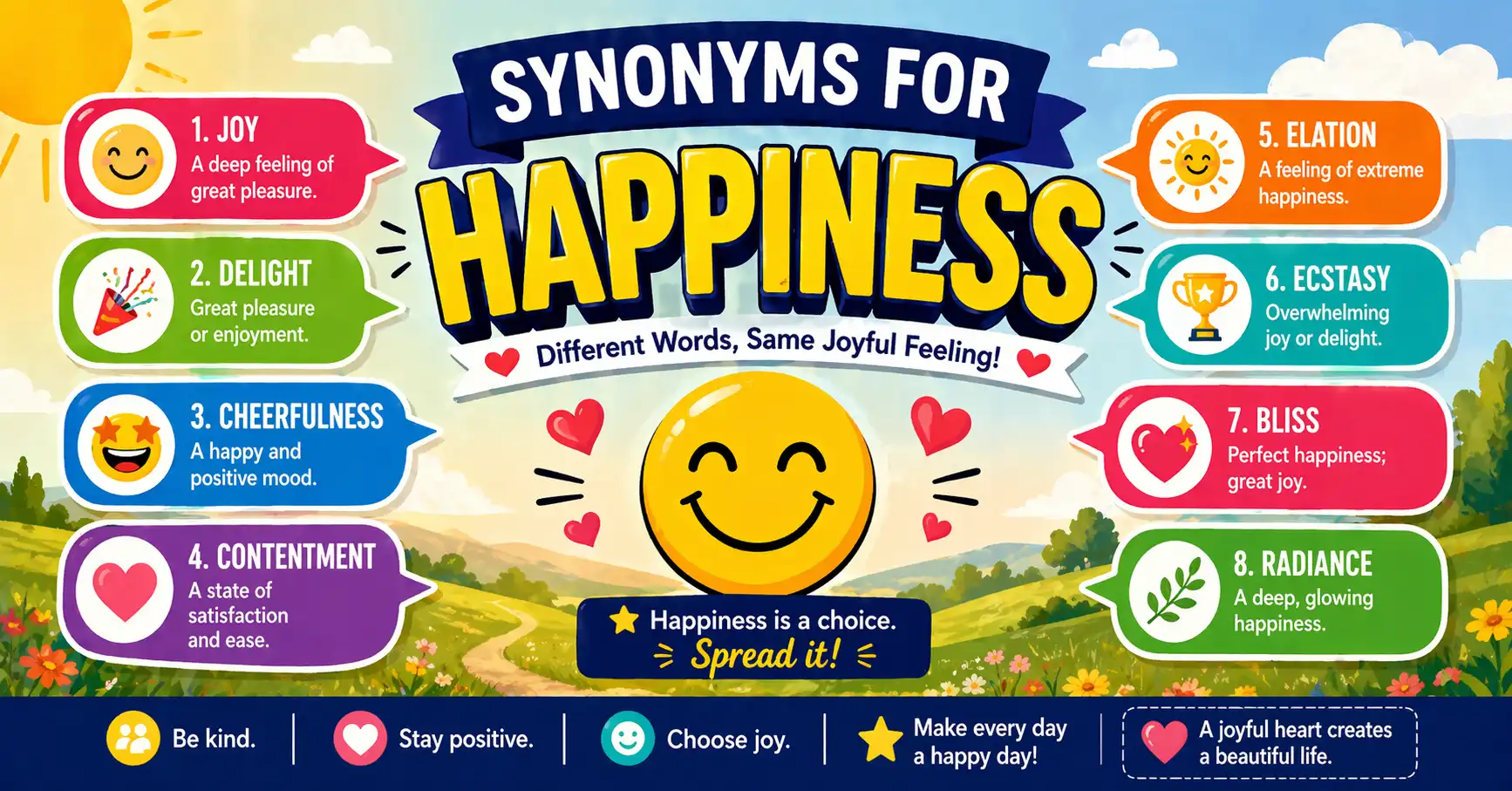
When you seek the perfect synonyms for happiness, you open up a world of beautiful emotional expression. Learning these synonyms for happiness allows you to describe positive experiences with absolute clarity. Using diverse synonyms for happiness ensures your essays, stories, and letters sound dynamic and deeply engaging.
Imagine walking into a surprise party thrown by your closest friends. Your heart swells, a massive smile spreads across your face, and you feel an incredible rush of warmth. To capture this special moment in writing, you need more than just the word “happy.” Choosing a term like “jubilation” or “pure bliss” paints an instant, colorful picture for your reader.
In very simple English, synonyms for happiness are different words that mean feeling glad, smiling a lot, and enjoying your life. These terms are highly useful for many different people:
- For students: Knowing these words helps you write descriptive essays that earn high marks.
- For bloggers: Using energetic words keeps your readers hooked and feeling uplifted.
- For content writers: Including diverse vocabulary naturally boosts your search engine rankings on Google.
- For daily English users: It helps you share your positive feelings clearly with friends and family.
“Happiness is not something ready-made. It comes from your own actions.” — Dalai Lama
“For every minute you are angry you lose sixty seconds of happiness.” — Ralph Waldo Emerson
Connotative Meaning of Synonyms for Happiness
The search for synonyms for happiness carries connotations of light, warmth, fulfillment, and emotional safety. Rather than just indicating a simple smile, these words evoke a sense of deep personal satisfaction, shared joy, and positive energy. When you use them, you invite your reader to feel the exact type of good feeling you are describing.
Etymology of Happiness
- Happiness (Root): Derived from the Middle English word hap, which means luck, chance, or good fortune.
- Suffix “-ness”: An Old English suffix used to turn adjectives into nouns, meaning the state or condition of.
- Evolution: Shifted in the 16th century from meaning “good fortune” to representing an emotional state of joy and satisfaction.
Linguistic Profile of Happiness
- US Pronunciation (IPA): /ˈhæp.i.nəs/
- UK Pronunciation (IPA): /ˈhæp.i.nəs/
- Syllables: 3 syllables (hap-pi-ness)
- Affixation Pattern: Root word happy combined with the noun-forming suffix -ness.
Comparison of Key Synonyms
To help you find the perfect term instantly, here is a simple comparison of key synonyms:
| Keyword | Meaning | Usage Type | Context |
|---|---|---|---|
| Joy | A strong, sudden feeling of great pleasure. | Emotional | Family gatherings, personal achievements, celebrations |
| Bliss | Complete and perfect happiness, often quiet. | Emotional | Peaceful moments, vacations, spiritual experiences |
| Glee | A lively, playful feeling of delight or mischief. | Casual | Games, childhood memories, lighthearted fun |
| Contentment | A peaceful feeling of being satisfied with what you have. | Formal & Casual | Daily reflection, quiet afternoons, life satisfaction |
| Elation | A proud, excited feeling of happiness after a success. | Professional & Formal | Graduation, job promotions, winning a game |
| Ecstasy | An intense, overwhelming state of joy. | Emotional | Artistic triumphs, peak life experiences |
| Cheer | A bright, friendly feeling that brings hope. | Casual | Festive holidays, supporting a friend, community events |
“The most important thing is to enjoy your life—to be happy—it’s all that matters.” — Audrey Hepburn
50 Synonyms for Happiness
Here is your ultimate list of 50 synonyms to describe positive emotions, joyful spaces, and peaceful states of mind.
1. Joy
- Pronunciation: US /dʒɔɪ/ | UK /dʒɔɪ/
- Meaning: This is a very strong feeling of being happy.
- Examples:
- Her face filled with joy when she saw the puppy.
- We danced with pure joy in the rain.
2. Bliss
- Pronunciation: US /blɪs/ | UK /blɪs/
- Meaning: This is a state of complete and perfect peace.
- Examples:
- Floating on the quiet lake was pure bliss.
- Reading a book by the fireplace brings me bliss.
3. Glee
- Pronunciation: US /ɡliː/ | UK /ɡliː/
- Meaning: This is a lively, playful feeling of delight.
- Examples:
- The kids opened their presents with loud glee.
- He laughed with glee when he won the race.
4. Contentment
- Pronunciation: US /kənˈtent.mənt/ | UK /kənˈtent.mənt/
- Meaning: This is a quiet feeling of being happy with what you have.
- Examples:
- She sighed with contentment after eating a warm meal.
- True contentment comes from loving your family.
5. Elation
- Pronunciation: US /iˈleɪ.ʃən/ | UK /iˈleɪ.ʃən/
- Meaning: This is a proud, excited feeling after a great success.
- Examples:
- We felt pure elation when we passed the test.
- The team shared a moment of elation after winning the game.
6. Ecstasy
- Pronunciation: US /ˈek.stə.si/ | UK /ˈek.stə.si/
- Meaning: This is an intense, overwhelming feeling of joy.
- Examples:
- The crowd was in ecstasy during the beautiful concert.
- She closed her eyes in ecstasy as she tasted the cake.
7. Delight
- Pronunciation: US /dɪˈlaɪt/ | UK /dɪˈlaɪt/
- Meaning: This is a strong feeling of pleasure and satisfaction.
- Examples:
- The magic show brought great delight to the children.
- He smiled with delight when his friend arrived.
8. Pleasure
- Pronunciation: US /ˈpleʒ.ɚ/ | UK /ˈpleʒ.ə/
- Meaning: This is an enjoyable feeling you get from doing something you like.
- Examples:
- It is a pleasure to meet you today.
- She takes great pleasure in gardening every weekend.
9. Cheerfulness
- Pronunciation: US /ˈtʃɪr.fəl.nəs/ | UK /ˈtʃɪə.fəl.nəs/
- Meaning: This is a bright, friendly, and optimistic attitude.
- Examples:
- Her natural cheerfulness made everyone in the room smile.
- He started the morning with great cheerfulness.
10. Jubilation
- Pronunciation: US /ˌdʒuː.bəˈleɪ.ʃən/ | UK /ˌdʒuː.bɪˈleɪ.ʃən/
- Meaning: This is a loud, active celebration of a big victory.
- Examples:
- The streets filled with jubilation when the war ended.
- Fans roared in jubilation as the final goal was scored.
11. Euphoria
- Pronunciation: US /juːˈfɔːr.i.ə/ | UK /juːˈfɔː.ri.ə/
- Meaning: This is a very strong, exciting feeling of well-being.
- Examples:
- Running across the finish line gave him a wave of euphoria.
- A feeling of euphoria filled the room after the successful launch.
12. Felicity
- Pronunciation: US /fəˈlɪs.ə.t̬i/ | UK /fəˈlɪs.ə.ti/
- Meaning: This is a formal word for great happiness and good fortune.
- Examples:
- Their long marriage was a beautiful picture of domestic felicity.
- He wished the young couple a lifetime of felicity.
13. Rapture
- Pronunciation: US /ˈræp.tʃɚ/ | UK /ˈræp.tʃə/
- Meaning: This is an extreme feeling of joy, love, and wonder.
- Examples:
- The artist looked at the sunset with quiet rapture.
- She listened to the sweet music in total rapture.
14. Gladness
- Pronunciation: US /ˈɡlæd.nəs/ | UK /ˈɡlæd.nəs/
- Meaning: This is a simple, pleasant feeling of being pleased.
- Examples:
- My heart filled with gladness when I saw your letter.
- He expressed his gladness for the lovely gifts.
15. Merriment
- Pronunciation: US /ˈmer.ɪ.mənt/ | UK /ˈmer.ɪ.mənt/
- Meaning: This is a fun, noisy, and cheerful activity with friends.
- Examples:
- The cozy cabin was filled with laughter and merriment.
- Holiday parties always bring plenty of merriment.
16. Exuberance
- Pronunciation: US /ɪɡˈzuː.bɚ.əns/ | UK /ɪɡˈzjuː.bər.əns/
- Meaning: This is an energetic, bouncing feeling of joy and life.
- Examples:
- The young dog showed its exuberance by jumping up and down.
- We love her youthful exuberance and bright ideas.
17. Jollity
- Pronunciation: US /ˈdʒɑː.lə.t̬i/ | UK /ˈdʒɒl.ə.ti/
- Meaning: This is a lively, friendly quality of being happy and festive.
- Examples:
- The winter festival was full of food, games, and jollity.
- He was a man of great humor and constant jollity.
18. Beatitude
- Pronunciation: US /biˈæt̬.ə.tuːd/ | UK /biˈæt.ɪ.tjuːd/
- Meaning: This is a state of holy, blessed, or supreme happiness.
- Examples:
- The saintly man lived a quiet life of gentle beatitude.
- She felt a deep beatitude while meditating in the temple.
19. Satisfaction
- Pronunciation: US /ˌsæt̬.ɪsˈfæk.ʃən/ | UK /ˌsæt.ɪsˈfæk.ʃən/
- Meaning: This is the good feeling you get when you finish a job well.
- Examples:
- Cleaning the entire house gave her a sense of satisfaction.
- He looked at his completed woodwork with deep satisfaction.
20. Serenity
- Pronunciation: US /səˈren.ə.t̬i/ | UK /səˈren.ə.ti/
- Meaning: This is a calm, peaceful state of mind with no worries.
- Examples:
- Walking through the forest brought a deep serenity to his soul.
- I love the quiet serenity of the beach in the morning.
21. Peace
- Pronunciation: US /piːs/ | UK /piːs/
- Meaning: This is a quiet, steady state of safety and happiness.
- Examples:
- He finally found peace after moving to the countryside.
- We sat in perfect peace under the shady oak tree.
22. Mirth
- Pronunciation: US /mɝːθ/ | UK /mɜːθ/
- Meaning: This is happiness accompanied by laughter and jokes.
- Examples:
- The funny clown filled the tent with mirth.
- His clever jokes caused a lot of mirth at the dinner table.
23. Gaiety
- Pronunciation: US /ˈɡeɪ.ə.t̬i/ | UK /ˈeɪ.ə.ti/
- Meaning: This is a bright, cheerful, and colorful atmosphere.
- Examples:
- The colorful balloons added to the gaiety of the party.
- She loved the music, dancing, and general gaiety of the wedding.
24. Cheer
- Pronunciation: US /tʃɪr/ | UK /tʃɪə/
- Meaning: This is a bright feeling of hope and comfort.
- Examples:
- The cheerful nurse brought a lot of cheer to the sick patients.
- Let us spread holiday cheer to our neighbors this week.
25. Lightheartedness
- Pronunciation: US /ˌlaɪtˈhɑːr.t̬ɪd.nəs/ | UK /ˌlaɪtˈhɑː.tɪd.nəs/
- Meaning: This is a carefree feeling with no heavy worries.
- Examples:
- School vacations always bring a sense of lightheartedness.
- They joked around with a playful lightheartedness.
26. Optimism
- Pronunciation: US /ˈɑːp.tə.mɪ.zəm/ | UK /ˈɒp.tɪ.mɪ.zəm/
- Meaning: This is a happy belief that good things will happen in the future.
- Examples:
- She faced the difficult challenge with bright optimism.
- His natural optimism kept him happy even on bad days.
27. High Spirits
- Pronunciation: US /haɪ ˈspɪr.ɪts/ | UK /haɪ ˈspɪr.ɪts/
- Meaning: This is a lively state of being energetic, happy, and active.
- Examples:
- The children were in high spirits on their way to the zoo.
- A good night of sleep left him in high spirits.
28. Buoyancy
- Pronunciation: US /ˈbɔɪ.ən.si/ | UK /ˈbɔɪ.ən.si/
- Meaning: This is an upbeat ability to bounce back quickly from sad times.
- Examples:
- Her emotional buoyancy helped her smile through the storm.
- He has a wonderful buoyancy that keeps his mind cheerful.
29. Radiance
- Pronunciation: US /ˈreɪ.di.əns/ | UK /ˈreɪ.di.əns/
- Meaning: This is a bright, glowing happiness that shows on your face.
- Examples:
- The bride had a beautiful radiance as she walked down the hall.
- His inner radiance warmed everyone who met him.
30. Warmth
- Pronunciation: US /wɔːrmθ/ | UK /wɔːmθ/
- Meaning: This is a friendly, loving, and comfortable feeling.
- Examples:
- We welcomed the new neighbors with open arms and true warmth.
- She remembered her grandmother’s house with deep warmth.
31. Playfulness
- Pronunciation: US /ˈpleɪ.fəl.nəs/ | UK /ˈpleɪ.fəl.nəs/
- Meaning: This is a fun-loving, active, and humorous mood.
- Examples:
- The puppy chased its tail with silly playfulness.
- Adding some playfulness to your work makes the day go faster.
32. Exultation
- Pronunciation: US /ˌeɡ.zʌlˈteɪ.ʃən/ | UK /ˌek.sʌlˈteɪ.ʃən/
- Meaning: This is a triumphant feeling of extreme joy.
- Examples:
- The climber stood on top of the mountain in pure exultation.
- Cheers of exultation filled the room when the results were shown.
33. Triumph
- Pronunciation: US /ˈtraɪ.əmf/ | UK /ˈtraɪ.ʌmf/
- Meaning: This is the happy feeling of winning a difficult battle.
- Examples:
- She smiled in triumph as she crossed the finish line.
- Learning to walk again was a massive personal triumph.
34. Gratification
- Pronunciation: US /ˌgræt̬.ə.fəˈkeɪ.ʃən/ | UK /ˌgræt.ɪ.fɪˈkeɪ.ʃən/
- Meaning: This is a pleased feeling you get when your wishes come true.
- Examples:
- Helping the poor gave her a deep sense of gratification.
- He wanted instant gratification instead of waiting for his turn.
35. Comfort
- Pronunciation: US /ˈkʌm.fɚt/ | UK /ˈkʌm.fət/
- Meaning: This is a cozy, pleasant feeling of being relaxed and safe.
- Examples:
- The soft blanket gave the sleepy child a lot of comfort.
- I find great comfort in drinking warm tea on a rainy day.
36. Well-being
- Pronunciation: US /ˌwelˈbiː.ɪŋ/ | UK /ˌwelˈbiː.ɪŋ/
- Meaning: This is a healthy, happy state of body and mind.
- Examples:
- Exercise and good food are important for your well-being.
- The company cares about the physical well-being of its workers.
37. Prosperity
- Pronunciation: US /prɑːˈsper.ə.t̬i/ | UK /prɒˈsper.ə.ti/
- Meaning: This is a successful state of having enough money and safety.
- Examples:
- The peaceful country enjoyed many years of growth and prosperity.
- We wish you a future filled with health and prosperity.
38. Blessedness
- Pronunciation: US /ˈbles.ɪd.nəs/ | UK /ˈbles.ɪd.nəs/
- Meaning: This is a deep state of being favored, happy, and holy.
- Examples:
- They lived a quiet, rural life of peaceful blessedness.
- He thanked the heavens for the blessedness of his family.
39. Good Humor
- Pronunciation: US /ɡʊd ˈhjuː.mɚ/ | UK /ɡʊd ˈhjuː.mər/
- Meaning: This is a friendly, pleasant, and easygoing state of mind.
- Examples:
- He kept his good humor even when the car broke down.
- The teacher’s constant good humor made the classroom fun.
40. Joviality
- Pronunciation: US /ˌdʒoʊ.viˈæl.ə.t̬i/ | UK /ˌdʒəʊ.viˈæl.ə.ti/
- Meaning: This is a very jolly, friendly, and lively behavior.
- Examples:
- The holiday dinner was filled with stories and loud joviality.
- His natural joviality made him the life of every party.
41. Festivity
- Pronunciation: US /fesˈtɪv.ə.t̬i/ | UK /fesˈtɪv.ə.ti/
- Meaning: This is the happy, active atmosphere of a holiday or celebration.
- Examples:
- The colorful street lights added to the holiday festivity.
- We joined the neighborhood festivity with a basket of cookies.
42. Vivacity
- Pronunciation: US /vɪˈvæs.ə.t̬i/ | UK /vɪˈvæs.ə.ti/
- Meaning: This is a lively, high-energy, and attractive happiness.
- Examples:
- Her natural vivacity made her a wonderful stage actress.
- He spoke about his favorite books with great vivacity.
43. Alacrity
- Pronunciation: US /əˈlæk.rə.t̬i/ | UK /əˈlæk.rə.ti/
- Meaning: This is a quick, cheerful eagerness to do a task.
- Examples:
- She accepted the job offer with great alacrity.
- The helpful boy cleaned his room with surprising alacrity.
44. Eagerness
- Pronunciation: US /ˈiː.ɡɚ.nəs/ | UK /ˈiː.ɡə.nəs/
- Meaning: This is a happy, excited feeling of wanting to do something.
- Examples:
- The kids showed their eagerness to swim by running to the pool.
- His eagerness to learn new things impressed his boss.
45. Enthusiasm
- Pronunciation: US /ɪnˈθuː.zi.æz.əm/ | UK /ɪnˈθjuː.zi.æz.əm/
- Meaning: This is a very strong, active interest in a subject or hobby.
- Examples:
- She plays soccer with incredible energy and enthusiasm.
- His wild enthusiasm for space made him study science.
46. Zest
- Pronunciation: US /zest/ | UK /zest/
- Meaning: This is an exciting, eager enjoyment of life or activity.
- Examples:
- Travel gave him a fresh zest for living.
- She approaches every single day with a wonderful zest.
47. Zeal
- Pronunciation: US /ziːl/ | UK /ziːl/
- Meaning: This is a strong, passionate desire to support a cause or goal.
- Examples:
- The young volunteers worked with amazing zeal to clean the park.
- He pursued his artistic dreams with great zeal.
48. Sanguineness
- Pronunciation: US /ˈsæŋ.ɡwɪn.nəs/ | UK /ˈsæŋ.ɡwɪn.nəs/
- Meaning: This is a cheerful, confident outlook even in tough times.
- Examples:
- Her natural sanguineness made her believe everything would be fine.
- He faced the medical report with calm sanguineness.
49. Gratefulness
- Pronunciation: US /ˈɡreɪt.fəl.nəs/ | UK /ˈɡreɪt.fəl.nəs/
- Meaning: This is a warm, happy feeling of thanking someone for their help.
- Examples:
- Her heart was filled with gratefulness for her kind friends.
- He expressed his deep gratefulness with a handwritten card.
50. Liveliness
- Pronunciation: US /ˈlaɪv.li.nəs/ | UK /ˈlaɪv.li.nəs/
- Meaning: This is an active, energetic, and exciting quality.
- Examples:
- The lively puppy brought a fresh liveliness to our quiet home.
- We loved the cheerful liveliness of the local market.
Antonyms of Happiness
To truly master the context of happiness, it is helpful to look at its direct opposites. In communication, these words show a total lack of structured positive energy or emotional well-being:
- Sadness: A state of feeling unhappy, sorrowful, or down.
- Grief: Deep, painful mental suffering caused by a major loss.
- Melancholy: A quiet, long-lasting state of sadness or serious thought.
- Despair: A complete loss of hope that things will ever get better.
- Misery: A very poor, painful, or highly uncomfortable state of life.
Prototype Meaning and Categorization of Synonyms for Happiness
At its core, happiness is about safety, pleasure, high energy, and satisfaction. The diverse synonyms for happiness generally fall into four clean categories:
- Deep & Lasting Peace (The Quiet): Words like contentment, serenity, peace, blessedness, and well-being that focus on long-term balance.
- High-Energy Excitement (The Intense): Words like joy, elation, ecstasy, euphoria, and exultation for peak moments.
- Social & Playful Fun (The Social): Words like glee, merriment, jollity, mirth, and festivity for shared laughter.
- Warm & Bright Outlooks (The Attitude): Words like cheerfulness, optimism, radiance, warmth, and sanguineness for daily life.
FAQ about Synonyms for Happiness
1. What is the strongest synonym for happiness?
The strongest synonyms are ecstasy and euphoria, which represent intense, overwhelming peaks of joy.
2. How does “bliss” differ from “happiness”?
While happiness can be loud and active, bliss is usually a very quiet, silent, and perfect state of peace.
3. Can “peace” be used as a synonym for happiness?
Yes. In quiet contexts, peace represents the ultimate form of sustainable, worry-free happiness.
4. Why do professional writers avoid repeating the word “happy”?
Repeating the same basic word makes text sound dry. Using terms like contentment or radiance keeps readers engaged.
5. Is “euphoria” used in everyday conversations?
Yes, but usually to describe extreme moments, like winning a championship or achieving a major life dream.
6. What is a good formal synonym to use in a cover letter?
Using satisfaction or alacrity shows a highly professional, eager, and positive attitude to a hiring manager.
Conclusion
Expanding your active vocabulary with these fifty synonyms for happiness is a massive step toward writing success. When you learn to match the exact feeling word to your text, your work gains instant clarity, power, and authority. Instead of repeating simple terms, bloggers can write inspiring articles, students can build flawless essays, and writers can make their work stand out on search engines.
We highly encourage you to practice these terms as you write your school essays, draft professional emails, or chat with your friends. By carefully selecting the perfect synonym, you bring fresh energy to your writing and make your professional voice truly unforgettable.
“Happiness is a warm puppy.” — Charles M. Schulz
“The only way to find true happiness is to risk being completely open.” — Chuck Palahniuk

Thomas Walker is a professional English consultant and content strategist with over eleven years of experience working with technology companies, business writers, and content teams who need precise, modern vocabulary guidance (Biography).