
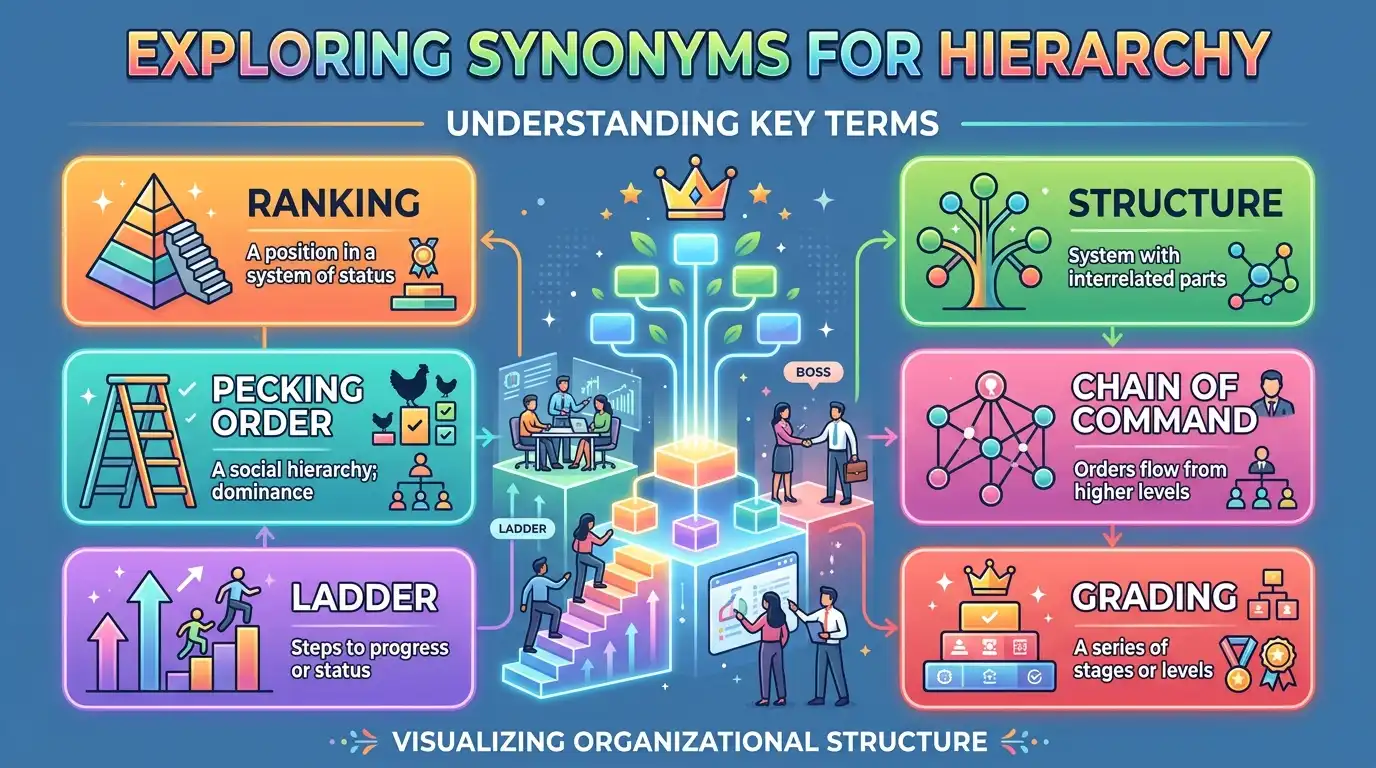
Finding the right synonyms for hierarchy helps you express power structures, corporate ladders, and ranked systems clearly. When you learn synonyms for hierarchy, your writing becomes richer and far more precise for any context. Exploring varied synonyms for hierarchy gives you the exact word to describe everything from a bird’s pecking order to a corporate chain of command.
Imagine stepping into a fast-growing company on your very first day. You notice how messages pass from interns to managers, and finally to executive directors. Every group has an organized order where people hold different levels of responsibility. Understanding this structured setup helps you navigate workplace discussions, write sharp reports, and express ideas with confidence.
A hierarchy is simply a system where people or things are ranked one above the other. In plain terms, it means putting things in order from highest to lowest.
This vocabulary word is immensely helpful across many fields:
- Students can use these terms to write stronger academic essays and social studies papers.
- Bloggers can vary their language to keep readers engaged and improve content flow.
- Content writers can choose precise words to fit specific tone guidelines and SEO targets.
- Daily English users can explain workplace dynamics and social structures without repeating the same word.
“Order is the shape upon which beauty depends.” – Pearl S. Buck
“Words are, in my not-so-humble opinion, our most inexhaustible source of magic.” – J.K. Rowling
Linguistic Overview of “Hierarchy”
Connotative Meaning
The word hierarchy often carries a neutral to formal connotation. Neutral when describing scientific classifications or organizational charts; formal or slightly negative when implying rigid control, bureaucratic delay, or unequal social status.
Etymology
- Origin: Derived from Late Greek hierarkhia (“rule of a high priest”).
- Roots: hieros (meaning “sacred”) + archein (meaning “to rule”).
- Middle English / French: Passed through Old French (hiérarchie) into Middle English in the 14th century, initially referring to angelic orders.
Pronunciation
- US IPA: /ˈhaɪ.ə.rɑːr.ki/
- UK IPA: /ˈhaɪə.rɑː.ki/
Syllables & Affixation
- Syllables: 4 syllables (hi-er-ar-chy)
- Root Word: Hierarchy
- Suffix: -y (noun-forming suffix)
- Related Forms: Hierarchical (adjective), Hierarchically (adverb), Hierarch (noun)
Comparison Table: Key Synonyms for Hierarchy
| Keyword | Meaning | Usage Type | Context |
| Hierarchy | A ranked system from top to bottom | Formal / Professional | Corporate, academic, social |
| Chain of command | Line of authority in an organization | Professional / Military | Workplace, military, management |
| Pecking order | Informal social status or rank | Casual / Expressive | Social groups, animals, teams |
| Echelon | A level or rank in an organization | Formal / Professional | Business, politics, military |
| Gradation | A series of subtle successive stages | Technical / Academic | Art, design, nature, ranking |
| Stratification | Division into distinct social classes | Academic / Scientific | Sociology, geology, research |
| Pyramid | Structure shaped like a triangle with layers | Visual / Functional | Business models, food chains |
| Tier | One of a series of rows or levels | General / Neutral | Subscriptions, gaming, systems |
50 Synonyms for Hierarchy
1. Chain of Command
- Pronunciation: US: /tʃeɪn ʌv kəˈmænd/ | UK: /tʃeɪn ɒv kəˈmɑːnd/
- Meaning: Line of authority from top leaders to workers.
- Examples:
- Speak to your boss to respect the chain of command.
- The army relies on a strict chain of command.
2. Pecking Order
- Pronunciation: US: /ˈpek.ɪŋ ˌɔːr.dɚ/ | UK: /ˈpek.ɪŋ ˌɔː.də/
- Meaning: The informal rank of importance within a group.
- Examples:
- New birds quickly learn the flock pecking order.
- Office staff soon discover the unofficial pecking order.
3. Echelon
- Pronunciation: US: /ˈeʃ.ə.lɑːn/ | UK: /ˈeʃ.ə.lɒn/
- Meaning: A specific level or rank in an organization.
- Examples:
- She joined the top echelon of the firm.
- High echelons of government met today.
4. Tier
- Pronunciation: US: /tɪr/ | UK: /tɪə/
- Meaning: One layer in a system with many levels.
- Examples:
- Premium users enjoy the top tier features.
- The stadium has a three tier seating plan.
5. Stratification
- Pronunciation: US: /ˌstræt̬.ə.fəˈkeɪ.ʃən/ | UK: /ˌstræt.ɪ.fɪˈkeɪ.ʃən/
- Meaning: Division into different social or official layers.
- Examples:
- Social stratification affects economic growth.
- Rocks display clear natural stratification.
6. Ranking
- Pronunciation: US: /ˈræŋ.kɪŋ/ | UK: /ˈræŋ.kɪŋ/
- Meaning: A position on a list from best to worst.
- Examples:
- His global chess ranking rose this month.
- The school earned a high national ranking.
7. Scale
- Pronunciation: US: /skeɪl/ | UK: /skeɪl/
- Meaning: A set of levels used to measure things.
- Examples:
- Workers earn wages on a fixed scale.
- The team measured success on a ten point scale.
8. Gradation
- Pronunciation: US: /ɡræˈdeɪ.ʃən/ | UK: /ɡrəˈdeɪ.ʃən/
- Meaning: A gradual change through small steps or stages.
- Examples:
- The paint shows a smooth color gradation.
- Salary steps follow a clear step gradation.
9. Ladder
- Pronunciation: US: /ˈlæd.ɚ/ | UK: /ˈlæd.ə/
- Meaning: A series of stages to move up in work.
- Examples:
- He climbed the corporate ladder quickly.
- Hard work helps you move up the career ladder.
10. Pyramid
- Pronunciation: US: /ˈpɪr.ə.mɪd/ | UK: /ˈpɪr.ə.mɪd/
- Meaning: A system with few leaders at the top and many at the base.
- Examples:
- Management forms a broad pyramid structure.
- The food pyramid shows ideal eating habits.
11. Order
- Pronunciation: US: /ˈɔːr.dɚ/ | UK: /ˈɔː.də/
- Meaning: The organized arrangement of people or objects.
- Examples:
- Keep your files in alphabetical order.
- The social order shifted after the election.
12. Structure
- Pronunciation: US: /ˈstrʌk.tʃɚ/ | UK: /ˈstrʌk.tʃə/
- Meaning: The way parts connect to form a whole.
- Examples:
- Our company has a clear management structure.
- The article follows a logical paragraph structure.
13. System
- Pronunciation: US: /ˈsɪs.təm/ | UK: /ˈsɪs.təm/
- Meaning: A group of related parts working together.
- Examples:
- The grading system rewards daily effort.
- Train routes form an efficient transport system.
14. Organization
- Pronunciation: US: /ˌɔːr.ɡən.əˈzeɪ.ʃən/ | UK: /ˌɔː.ɡən.aɪˈzeɪ.ʃən/
- Meaning: An ordered group formed for a specific purpose.
- Examples:
- She leads a non profit organization.
- Good file organization saves time.
15. Level
- Pronunciation: US: /ˈlev.əl/ | UK: /ˈlev.əl/
- Meaning: A specific height or rank in a scale.
- Examples:
- Pass this level to win the game.
- Entry level jobs teach basic skills.
16. Command Structure
- Pronunciation: US: /kəˈmænd ˈstrʌk.tʃɚ/ | UK: /kəˈmɑːnd ˈstrʌk.tʃə/
- Meaning: The system of authority in military or executive groups.
- Examples:
- The crisis team established a command structure.
- Officers follow a unified command structure.
17. Power Structure
- Pronunciation: US: /ˈpaʊ.ɚ ˈstrʌk.tʃɚ/ | UK: /ˈpaʊ.ə ˈstrʌk.tʃə/
- Meaning: The way control is distributed among people.
- Examples:
- Wealthy families held the local power structure.
- Digital tools altered the old power structure.
18. Class System
- Pronunciation: US: /klæs ˈsɪs.təm/ | UK: /klɑːs ˈsɪs.təm/
- Meaning: Division of society into status groups.
- Examples:
- History lessons cover the ancient class system.
- Education helps break down rigid class system barriers.
19. Caste System
- Pronunciation: US: /kæst ˈsɪs.təm/ | UK: /kɑːst ˈsɪs.təm/
- Meaning: A strict social system based on inherited rank.
- Examples:
- Laws prohibited discrimination under the caste system.
- Scholars study the historical caste system.
20. Status System
- Pronunciation: US: /ˈsteɪ.t̬əs ˈsɪs.təm/ | UK: /ˈsteɪ.təs ˈsɪs.təm/
- Meaning: A framework ranking people by social importance.
- Examples:
- Social media created a new status system.
- Merit guides their internal status system.
21. Order of Precedence
- Pronunciation: US: /ˈɔːr.dɚ ʌv ˈpres.ə.dəns/ | UK: /ˈɔː.də ɒv ˈpres.ɪ.dəns/
- Meaning: Official listing of formal importance for ceremonies.
- Examples:
- Diplomats seated according to the order of precedence.
- The royal event followed an ancient order of precedence.
22. Arrangement
- Pronunciation: US: /əˈreɪndʒ.mənt/ | UK: /əˈreɪndʒ.mənt/
- Meaning: Putting items into a specific neat layout.
- Examples:
- Flower arrangement requires artistic skill.
- Seat arrangement made discussion easy.
23. Classification
- Pronunciation: US: /ˌklæs.ə.fəˈkeɪ.ʃən/ | UK: /ˌklæs.ɪ.fɪˈkeɪ.ʃən/
- Meaning: Grouping items into organized categories.
- Examples:
- Book classification helps patrons find novels.
- Animal classification uses Latin names.
24. Rating
- Pronunciation: US: /ˈreɪ.t̬ɪŋ/ | UK: /ˈreɪ.tɪŋ/
- Meaning: A standing given according to quality or rank.
- Examples:
- The movie earned a high audience rating.
- Credit ratings influence loan interest rates.
25. Sequence
- Pronunciation: US: /ˈsiː.kwəns/ | UK: /ˈsiː.kwəns/
- Meaning: A particular order in which related events follow each other.
- Examples:
- Follow the correct sequence of steps.
- Numbers appear in numerical sequence.
26. Progression
- Pronunciation: US: /prəˈɡreʃ.ən/ | UK: /prəˈɡreʃ.ən/
- Meaning: Moving forward step by step to higher stages.
- Examples:
- Career progression takes focus and time.
- The chord progression sounds very soothing.
27. Framework
- Pronunciation: US: /ˈfreɪm.wɝːk/ | UK: /ˈfreɪm.wɜːk/
- Meaning: A supporting structure for a complex plan.
- Examples:
- Writers build a clear conceptual framework.
- The policy provides a solid legal framework.
28. Hegemony
- Pronunciation: US: /hɪˈdʒem.ə.ni/ | UK: /hɪˈdʒem.ə.ni/
- Meaning: Dominance or leadership of one group over others.
- Examples:
- Economic hegemony shaped international relations.
- Cultural hegemony influences global media trends.
29. Successive Order
- Pronunciation: US: /səkˈses.ɪv ˈɔːr.dɚ/ | UK: /səkˈses.ɪv ˈɔː.də/
- Meaning: Arranged in a step-by-step sequential order.
- Examples:
- Present data in successive order.
- Tasks were finished in successive order.
30. Lineage
- Pronunciation: US: /ˈlɪn.i.ɪdʒ/ | UK: /ˈlɪn.i.ɪdʒ/
- Meaning: Line of descent traced back through family roots.
- Examples:
- Royal lineage determines succession rights.
- He researched his ancestral lineage online.
“To communicate clearly is to structure thought with precision.” – Anonymous
31. Regimen
- Pronunciation: US: /ˈredʒ.ə.mən/ | UK: /ˈredʒ.ɪ.mən/
- Meaning: A systematic plan for health, order, or training.
- Examples:
- Athletes follow a daily workout regimen.
- The skin care regimen produced great results.
32. Setup
- Pronunciation: US: /ˈset.ʌp/ | UK: /ˈset.ʌp/
- Meaning: The way something is organized or arranged.
- Examples:
- Our office setup encourages open dialogue.
- The classroom setup helps group work.
33. Ordering
- Pronunciation: US: /ˈɔːr.dɚ.ɪŋ/ | UK: /ˈɔː.də.rɪŋ/
- Meaning: The act of putting items in proper place.
- Examples:
- Priority ordering keeps key tasks first.
- Alphabetical ordering simplifies list searches.
34. Grid
- Pronunciation: US: /ɡrɪd/ | UK: /ɡrɪd/
- Meaning: A pattern of crossing lines used for structure.
- Examples:
- Designers align text along a neat grid.
- The city layout uses a regular grid.
35. Network
- Pronunciation: US: /ˈnet.wɝːk/ | UK: /ˈnet.wɜːk/
- Meaning: An interconnected system of people or things.
- Examples:
- Build a professional network to share ideas.
- The railway network spans the country.
36. Categorization
- Pronunciation: US: /ˌkæt̬.ə.ɡɚ.əˈzeɪ.ʃən/ | UK: /ˌkæt.ə.ɡər.aɪˈzeɪ.ʃən/
- Meaning: Sorting items into clear defined groups.
- Examples:
- Data categorization aids search engines.
- Product categorization makes shopping easy.
37. Grouping
- Pronunciation: US: /ˈɡruː.pɪŋ/ | UK: /ˈɡruː.pɪŋ/
- Meaning: Placing similar objects or people together.
- Examples:
- Student grouping varied by skill level.
- Color grouping improves store displays.
38. Lineup
- Pronunciation: US: /ˈlaɪn.ʌp/ | UK: /ˈlaɪn.ʌp/
- Meaning: An ordered list of performers, players, or items.
- Examples:
- The coach announced the starting lineup.
- Festival organizers published the artist lineup.
39. Scheme
- Pronunciation: US: /skiːm/ | UK: /skiːm/
- Meaning: A systematic plan for arranging things.
- Examples:
- The color scheme creates a peaceful room.
- The coding scheme organizes file storage.
40. Spectrum
- Pronunciation: US: /ˈspek.trəm/ | UK: /ˈspek.trəm/
- Meaning: A wide, continuous range of related positions.
- Examples:
- Candidates hold views across the political spectrum.
- The issue spans a broad spectrum of opinions.
41. Series
- Pronunciation: US: /ˈsɪr.iːz/ | UK: /ˈsɪə.riːz/
- Meaning: A group of similar things coming one after another.
- Examples:
- A series of lectures starts on Monday.
- The book series won global awards.
42. Placement
- Pronunciation: US: /ˈpleɪs.mənt/ | UK: /ˈpleɪs.mənt/
- Meaning: The specific location or position assigned to someone.
- Examples:
- Student job placement rates remain very high.
- Furniture placement opens up room space.
43. Tiering
- Pronunciation: US: /ˈtɪr.ɪŋ/ | UK: /ˈtɪə.rɪŋ/
- Meaning: Organizing elements into layered levels.
- Examples:
- Price tiering helps reach different customer budgets.
- Data tiering optimizes cloud storage performance.
44. Hierarchy Structure
- Pronunciation: US: /ˈhaɪ.ə.rɑːr.ki ˈstrʌk.tʃɚ/ | UK: /ˈhaɪə.rɑː.ki ˈstrʌk.tʃə/
- Meaning: A multi-level layout organizing authority.
- Examples:
- Large banks use a rigid hierarchy structure.
- Startups prefer a flat hierarchy structure.
45. Division
- Pronunciation: US: /dɪˈvɪʒ.ən/ | UK: /dɪˈvɪʒ.ən/
- Meaning: Separation into separate ranked sections.
- Examples:
- He works in the marketing division.
- Sports leagues sort teams by division.
46. Authority Structure
- Pronunciation: US: /əˈθɔːr.ə.t̬i ˈstrʌk.tʃɚ/ | UK: /ɔːˈθɒr.ə.ti ˈstrʌk.tʃə/
- Meaning: The assigned roles determining who gives orders.
- Examples:
- The authority structure defines job duties.
- Hospitals rely on a clear authority structure.
47. Scale of Degrees
- Pronunciation: US: /skeɪl ʌv dɪˈɡriːz/ | UK: /skeɪl ɒv dɪˈɡriːz/
- Meaning: Ranked steps showing varying amounts of quality.
- Examples:
- Evaluate projects using a scale of degrees.
- Temperature follows a standard scale of degrees.
48. Rank
- Pronunciation: US: /ræŋk/ | UK: /ræŋk/
- Meaning: An official position within an organized scale.
- Examples:
- He achieved the rank of captain.
- Her rank rose after key achievements.
49. Order of Merit
- Pronunciation: US: /ˈɔːr.dɚ ʌv ˈmer.ɪt/ | UK: /ˈɔː.də ɒv ˈmer.ɪt/
- Meaning: A ranking list based entirely on performance scores.
- Examples:
- Test results established the order of merit.
- Awards were presented in order of merit.
50. Line of Command
- Pronunciation: US: /laɪn ʌv kəˈmænd/ | UK: /laɪn ɒv kəˈmɑːnd/
- Meaning: The direct path guiding decision power down ranks.
- Examples:
- Keep the line of command open during emergencies.
- Decisions flow smoothly along the line of command.
Antonyms of Hierarchy
To understand structured systems completely, it helps to know opposite concepts:
- Egalitarianism: A belief in human equality, especially regarding social, political, and economic rights.
- Anarchy: A state of disorder due to absence or non-recognition of authority.
- Disorganization: Lack of proper arrangement or system.
- Flat Organization: A management setup with few or no levels of middle management.
- Equality: The state of being equal, especially in status, rights, and opportunities.
Prototype Meaning and Categorization of Hierarchy
The prototype concept of hierarchy centers on visual and operational pyramids where authority flows downward.
- Core Category: Structural Organization & Social Order.
- Cognitive Prototype: A corporate organizational chart with the CEO at the apex, middle management in the middle, and staff at the base.
- Functional Domain: Administrative logic, sociological analysis, biology (taxonomy), software architecture, and linguistics.
Frequently Asked Questions (FAQs)
1. What is the most common synonym for hierarchy?
The most common synonyms include chain of command, pecking order, ladder, and ranking.
2. Is “pecking order” formal or informal?
“Pecking order” is an informal synonym derived from animal behavior, commonly used in everyday speech and business writing.
3. What is the difference between hierarchy and chain of command?
Hierarchy refers to any structured system of levels, whereas chain of command specifically refers to the line of authority for giving orders.
4. Can hierarchy refer to non-human systems?
Yes! Hierarchy often describes biological taxonomies, computer data files, software design patterns, and ecological food chains.
5. What is the opposite of a hierarchical structure?
A flat organization or an egalitarian system represents the structural opposite of a hierarchy.
6. Why should writers learn synonyms for hierarchy?
Using varied terms prevents repetitive writing, improves SEO keyword diversity, and fits specific corporate or creative writing tones.
Conclusion
Expanding your vocabulary with rich synonyms for hierarchy elevates your overall writing, blogging, speaking, and daily communication. Replacing overused words with precise choices like echelon, tier, chain of command, or stratification clarifies your thoughts instantly.
We encourage you to practice these terms in your upcoming work emails, academic essays, blog posts, and daily conversations. Using precise vocabulary shows confidence, authority, and refined expression.
“The limits of my language mean the limits of my world.” – Ludwig Wittgenstein
“Vocabulary is the springboard to effective expression.” – Unknown

Thomas Walker is a professional English consultant and content strategist with over eleven years of experience working with technology companies, business writers, and content teams who need precise, modern vocabulary guidance (Biography).