
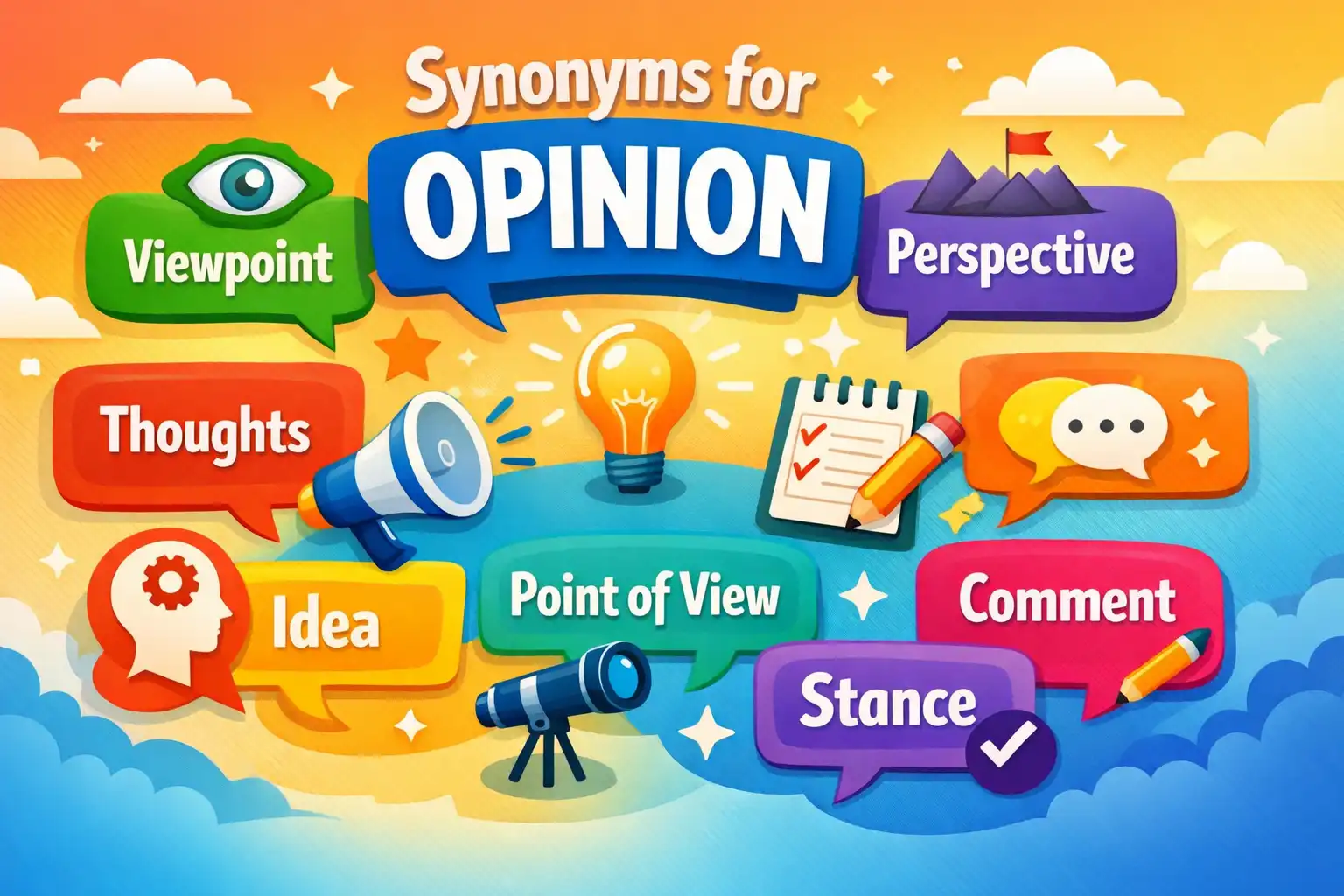
Finding the best synonyms for opinion is a simple way to make your daily writing clear and persuasive. When you look for another word for opinion, you unlock fresh paths to share your thoughts, reviews, or deep beliefs. Learning these diverse words meaning opinion helps you avoid repeating yourself and makes your voice sound confident. Building your vocabulary with these choices is a very easy step to writing better essays and posts.
Imagine sitting in a quiet, warmly lit coffee shop with a friend, talking about a newly released film. Saying “my opinion is that it was good” feels flat, empty, and boring. If you call it your take, your perspective, or your verdict, you instantly make the conversation more exciting. A single word can paint a clear, deep picture of your mind. For example, when a food critic shares their thoughts on a new dish, they do not just give an opinion; they share a sharp assessment that can make or break a restaurant.
In very simple terms, an opinion is what you think about something. It is not a hard fact, but it is how you feel or judge a topic.
- For students: Fresh words make your essays look mature and help you get better grades on papers.
- For bloggers: Fun words keep readers interested so they stay on your page longer.
- For content writers: Using natural keyword variations helps your articles rank beautifully on Google.
- For daily English users: It helps you express your thoughts clearly when talking to friends.
“All photography is propaganda. Every art is an opinion.” — Martin Parr
“The fewest words are always best when expressing an opinion.” — Unknown
Connotative Meaning of Opinion
The word opinion carries a sense of personal perspective, view, or belief. It shows subjective judgment rather than objective truth. In daily and professional life, sharing an opinion shows that you are actively engaging with a topic, using your mind to process details, and showing others how you see the world around you.
Etymology of Opinion
- Origin: Latin (opinio), meaning “belief, conjecture, or rumor.”
- Meaning Development: Came from opinari, meaning “to think, believe, or guess.”
- Transition: Entered Middle English through Old French (opinion) in the early 14th century.
- Modern English: Used as a noun to represent a personal view or judgment not necessarily based on fact.
Linguistic Profile of Opinion
- US Pronunciation (IPA): /əˈpɪn.jən/
- UK Pronunciation (IPA): /əˈpɪn.jən/
- Syllables: 3 syllables (o-pin-ion)
- Affixation Pattern: Root word opine with the noun-forming suffix -ion.
Comparison of Key Synonyms
To help you choose the right word instantly, here is a simple comparison table of some common synonyms for opinion:
| Keyword | Meaning | Usage Type | Context |
|---|---|---|---|
| Opinion | A belief or view about something. | Casual & Professional | Discussions, reviews, personal thoughts |
| Belief | Something you accept as true. | Emotional & Casual | Religion, core values, relationships |
| Stance | An official public opinion. | Formal & Professional | Debates, politics, corporate decisions |
| Impression | A quick first thought about something. | Casual | First meetings, quick reviews, events |
| Judgment | A decision made after thinking. | Formal & Professional | Legal courts, boss reviews, serious choices |
| Notion | A vague or simple thought. | Casual | Quick ideas, playful thoughts, theories |
| Perspective | A unique way of looking at a topic. | Professional & Casual | Life experiences, team projects, stories |
| Take | A personal, modern reaction. | Casual | Sports talks, pop culture, casual chats |
“An opinion should be a result of thought, not a substitute for it.” — Jef Mallett
50 Synonyms for Opinion
Here is your ultimate list of 50 alternative words to help you replace the word “opinion” in any situation.
1. View
- Pronunciation: US /vjuː/ | UK /vjuː/
- Meaning: This is how you see or think about a topic.
- Examples:
- He shared his view on the new school schedule.
- In my view, we should go home before it rains.
2. Belief
- Pronunciation: US /bɪˈliːf/ | UK /bɪˈliːf/
- Meaning: This is something you accept as true in your mind.
- Examples:
- It is her firm belief that honesty is the best path.
- His strong belief in teamwork helped us win the game.
3. Stance
- Pronunciation: US /stæns/ | UK /stɑːns/
- Meaning: This is your public opinion or position on a big topic.
- Examples:
- The mayor took a strong stance against city pollution.
- What is your stance on the new library budget?
4. Impression
- Pronunciation: US /ɪmˈpreʃ.ən/ | UK /ɪmˈpreʃ.ən/
- Meaning: This is an early opinion you get after a short look.
- Examples:
- My first impression of the new teacher was very good.
- She wanted to make a great impression at her job interview.
5. Judgment
- Pronunciation: US /ˈdʒʌdʒ.mənt/ | UK /ˈdʒʌdʒ.mənt/
- Meaning: This is an opinion or decision made after deep thought.
- Examples:
- You must use your own judgment to solve this puzzle.
- The expert gave his final judgment on the old painting.
6. Notion
- Pronunciation: US /ˈnoʊ.ʃən/ | UK /ˈnəʊ.ʃən/
- Meaning: This is a belief or a vague opinion about something.
- Examples:
- He had a silly notion that cats could talk.
- I do not like the notion of working on Saturdays.
7. Perspective
- Pronunciation: US /pɚˈspek.tɪv/ | UK /pəˈspek.tɪv/
- Meaning: This is your unique way of looking at a situation.
- Examples:
- Travel gives you a fresh perspective on different cultures.
- Let us look at the problem from a child’s perspective.
8. Take
- Pronunciation: US /teɪk/ | UK /teɪk/
- Meaning: This is your personal opinion or reaction to an event.
- Examples:
- What is your take on the new song they released?
- The coach gave his take on why the team lost the match.
9. Assessment
- Pronunciation: US /əˈses.mənt/ | UK /əˈses.mənt/
- Meaning: This is a careful opinion about the value of something.
- Examples:
- The mechanic gave a quick assessment of our car’s engine.
- Her assessment of the project was very helpful for us.
10. Sentiment
- Pronunciation: US /ˈsen.t̬ə.mənt/ | UK /ˈsen.tɪ.mənt/
- Meaning: This is an opinion that comes from your feelings.
- Examples:
- Public sentiment is growing against the new plastic bags.
- He agreed with the warm sentiment of the letter.
11. Position
- Pronunciation: US /pəˈzɪʃ.ən/ | UK /pəˈzɪʃ.ən/
- Meaning: This is your official opinion or stance on an issue.
- Examples:
- Our company position is to protect client privacy first.
- What is your position on the proposed park rules?
12. Outlook
- Pronunciation: US /ˈaʊt.lʊk/ | UK /ˈaʊt.lʊk/
- Meaning: This is your general attitude or way of looking at life.
- Examples:
- A positive outlook makes hard work feel much easier.
- Her outlook on the future is bright and full of hope.
13. Attitude
- Pronunciation: US /ˈæt̬.ə.tuːd/ | UK /ˈæt.ɪ.tʃuːd/
- Meaning: This is how you feel or think about someone or something.
- Examples:
- He has a helpful attitude when people ask for directions.
- Your attitude determines how well you solve problems today.
14. Thought
- Pronunciation: US /θɑːt/ | UK /θɔːt/
- Meaning: This is an idea or opinion that is in your mind.
- Examples:
- I had a sudden thought about how to fix the broken toy.
- Please share your thoughts on the dinner menu with us.
15. Conviction
- Pronunciation: US /kənˈvɪk.ʃən/ | UK /kənˈvɪk.ʃən/
- Meaning: This is a very strong and deep opinion that you hold.
- Examples:
- She spoke about her charity work with deep conviction.
- It is my conviction that every child deserves a good school.
16. Feeling
- Pronunciation: US /ˈfiː.lɪŋ/ | UK /ˈfiː.lɪŋ/
- Meaning: This is an opinion that is based on your emotions instead of facts.
- Examples:
- I have a bad feeling about leaving the dog home alone.
- My general feeling is that the party will be a big success.
17. Estimation
- Pronunciation: US /ˌes.təˈmeɪ.ʃən/ | UK /ˌes.tɪˈmeɪ.ʃən/
- Meaning: This is your personal opinion of the worth or value of someone.
- Examples:
- In my estimation, she is the best runner on the team.
- His estimation of the costs was very close to reality.
18. Verdict
- Pronunciation: US /ˈvɝː.dɪkt/ | UK /ˈvɜː.dɪkt/
- Meaning: This is a final opinion or decision about a matter.
- Examples:
- What is your verdict on the chocolate cake I baked?
- The public verdict on the new app has been wonderful.
19. Angle
- Pronunciation: US /ˈæŋ.ɡəl/ | UK /ˈæŋ.ɡəl/
- Meaning: This is a specific way of thinking about or showing a story.
- Examples:
- The reporter looked at the news story from a fresh angle.
- Try to find an interesting angle for your next blog post.
20. Theory
- Pronunciation: US /ˈθɪr.i/ | UK /ˈθɪə.ri/
- Meaning: This is an opinion or idea that explains how something works.
- Examples:
- My theory is that the key fell behind the couch.
- She has a great theory about why the leaves turn red.
21. Idea
- Pronunciation: US /aɪˈdiː.ə/ | UK /aɪˈdɪə/
- Meaning: This is a thought, plan, or opinion about what to do.
- Examples:
- I have an idea to go to the beach this Saturday.
- What is your idea of a perfect summer vacation?
22. Conclusion
- Pronunciation: US /kənˈkluː.ʒən/ | UK /kənˈkluː.ʒən/
- Meaning: This is an opinion you reach after thinking about all the facts.
- Examples:
- I came to the conclusion that we need a new washing machine.
- The doctor reached a clear conclusion after the checkup.
23. Evaluation
- Pronunciation: US /ɪˌvæl.juˈeɪ.ʃən/ | UK /ɪˌvæl.juˈeɪ.ʃən/
- Meaning: This is a formal opinion about the quality of something.
- Examples:
- The boss gave me a positive evaluation at work today.
- We need a careful evaluation of the safety rules.
24. Mindset
- Pronunciation: US /ˈmaɪnd.set/ | UK /ˈmaɪnd.set/
- Meaning: This is a set of opinions and attitudes that shape how you live.
- Examples:
- A growth mindset helps you learn from your mistakes.
- She tackled the difficult math puzzle with a calm mindset.
25. Slant
- Pronunciation: US /slænt/ | UK /slɑːnt/
- Meaning: This is a personal opinion that favors one side over another.
- Examples:
- The newspaper article had a strong political slant.
- I want to read a fair report without any personal slant.
26. Conjecture
- Pronunciation: US /kənˈdʒek.tʃɚ/ | UK /kənˈdʒek.tʃə/
- Meaning: This is an opinion formed without enough proof or facts.
- Examples:
- Most of the stories about his wealth are pure conjecture.
- We cannot make big plans based on simple conjecture.
27. Speculation
- Pronunciation: US /ˌspek.jəˈleɪ.ʃən/ | UK /ˌspek.jəˈleɪ.ʃən/
- Meaning: This is an opinion formed by guessing about the future.
- Examples:
- There is a lot of speculation about who will win the race.
- He dismissed the news report as simple speculation.
28. Guess
- Pronunciation: US /ɡes/ | UK /ɡes/
- Meaning: This is an opinion you give when you are not sure of the answer.
- Examples:
- My guess is that the movie will start in ten minutes.
- Take a wild guess at how many beans are in the jar!
29. Hypothesis
- Pronunciation: US /haɪˈpɑː.θə.sɪs/ | UK /haɪˈpɒθ.ə.sɪs/
- Meaning: This is a starting opinion or idea that you must test.
- Examples:
- The science class tested their hypothesis in the lab.
- His hypothesis was proven right after many long studies.
30. Interpretation
- Pronunciation: US /ɪnˌtɝː.prəˈteɪ.ʃən/ | UK /ɪnˌtɜː.prɪˈteɪ.ʃən/
- Meaning: This is your opinion on the meaning of something.
- Examples:
- The actor gave a beautiful interpretation of the old play.
- What is your interpretation of this abstract painting?
31. Posture
- Pronunciation: US /ˈpɑːs.tʃɚ/ | UK /ˈpɒs.tʃə/
- Meaning: This is an official opinion or attitude that a group shows.
- Examples:
- The country took a defensive posture during the talks.
- The school updated its posture on using online tools.
32. Appraisal
- Pronunciation: US /əˈpreɪ.zəl/ | UK /əˈpreɪ.zəl/
- Meaning: This is an expert opinion about the state or value of an item.
- Examples:
- We got a formal appraisal of our house before selling it.
- The jeweler gave an appraisal of the vintage watch.
33. Feedback
- Pronunciation: US /ˈfiːd.bæk/ | UK /ˈfiːd.bæk/
- Meaning: This is an opinion shared to help someone improve their work.
- Examples:
- The editor gave me great feedback on my short story.
- We welcome any helpful feedback from our new customers.
34. Deduction
- Pronunciation: US /dɪˈdʌk.ʃən/ | UK /dɪˈdʌk.ʃən/
- Meaning: This is an opinion you form by using logic and clues.
- Examples:
- His clever deduction helped us find the hidden key.
- Sherlock Holmes is famous for making a quick deduction.
35. Assumption
- Pronunciation: US /əˈsʌmp.ʃən/ | UK /əˈsʌmp.ʃən/
- Meaning: This is an opinion you hold to be true without any proof.
- Examples:
- It is a mistake to make an assumption about a person.
- We went to the park on the assumption that it was open.
36. Presumption
- Pronunciation: US /prɪˈzʌmp.ʃən/ | UK /prɪˈzʌmp.ʃən/
- Meaning: This is an opinion that you believe is likely true.
- Examples:
- The law works on the presumption that you are innocent.
- He acted on the presumption that she would say yes.
37. Intuition
- Pronunciation: US /ˌɪn.tuːˈɪʃ.ən/ | UK /ˌɪn.tʃuːˈɪʃ.ən/
- Meaning: This is an opinion or feeling that comes from your gut.
- Examples:
- My intuition told me to take the path on the right.
- She has a strong intuition about who to trust.
38. Reaction
- Pronunciation: US /riˈæk.ʃən/ | UK /riˈæk.ʃən/
- Meaning: This is an immediate opinion or feeling after something happens.
- Examples:
- What was his reaction when you told him the good news?
- Her reaction to the movie was better than I expected.
39. Side
- Pronunciation: US /saɪd/ | UK /saɪd/
- Meaning: This is the specific group of opinions that you support.
- Examples:
- Which side of the argument do you think is right?
- I will always take my sister’s side in a dispute.
40. Thesis
- Pronunciation: US /ˈθiː.sɪs/ | UK /ˈθiː.sɪs/
- Meaning: This is a main opinion or idea that you write about and support.
- Examples:
- She wrote her college thesis on clean wind energy.
- Your essay needs a clear thesis in the first paragraph.
41. Voice
- Pronunciation: US /vɔɪs/ | UK /vɔɪs/
- Meaning: This is the power or chance to share your personal opinion.
- Examples:
- The students wanted a voice in how the school was run.
- He used his voice to speak up for local animal shelters.
42. Ruling
- Pronunciation: US /ˈruː.lɪŋ/ | UK /ˈruː.lɪŋ/
- Meaning: This is an official opinion or decision made by a leader.
- Examples:
- The judge made a ruling on the ownership of the land.
- We must wait for the principal’s ruling on the club.
43. Stand
- Pronunciation: US /stænd/ | UK /stænd/
- Meaning: This is a firm opinion that you are ready to protect.
- Examples:
- She decided to take a stand against bullying at school.
- The teacher took a firm stand on late class homework.
44. Dictum
- Pronunciation: US /ˈdɪk.təm/ | UK /ˈdɪk.təm/
- Meaning: This is a formal statement of an opinion by an expert.
- Examples:
- We must remember the old dictum that time is money.
- The doctor shared a wise dictum about eating fresh food.
45. Creed
- Pronunciation: US /kriːd/ | UK /kriːd/
- Meaning: This is a set of strong opinions or beliefs that you live by.
- Examples:
- Kindness and hard work are part of our family creed.
- He chose to follow a simple creed of helping others.
46. Dogma
- Pronunciation: US /ˈdɔːɡ.mə/ | UK /ˈdɒɡ.mə/
- Meaning: This is a set of opinions that a group says is absolutely true.
- Examples:
- We should think for ourselves instead of following dogma.
- The scientist challenged the old dogma of his field.
47. Philosophy
- Pronunciation: US /fɪˈlɑː.sə.fi/ | UK /fɪˈlɒs.ə.fi/
- Meaning: This is a system of personal opinions about life and truth.
- Examples:
- Her philosophy is to enjoy every single day to the full.
- He shared his simple philosophy of running a business.
48. Tenet
- Pronunciation: US /ˈten.ɪt/ | UK /ˈten.ɪt/
- Meaning: This is one of the main opinions or rules of a group.
- Examples:
- Freedom of speech is a main tenet of our nation.
- Trust is a basic tenet of any strong friendship.
49. Pronouncement
- Pronunciation: US /prəˈnaʊns.mənt/ | UK /prəˈnaʊns.mənt/
- Meaning: This is a formal and public statement of an opinion.
- Examples:
- The king made a grand pronouncement about the taxes.
- We listened to the team leader’s pronouncement on the project.
50. Point of View
- Pronunciation: US /ˌpɔɪnt əv ˈvjuː/ | UK /ˌpɔɪnt əv ˈvjuː/
- Meaning: This is the specific way you look at and judge things.
- Examples:
- Try to understand this story from my point of view.
- He has an interesting point of view on modern art.
Antonyms of Opinion
To understand a word fully, it helps to see its opposites. The following terms represent hard truths, facts, or certainty that do not change with personal thoughts:
- Fact: Something that is known to be true or proven.
- Truth: The actual state of matter or reality.
- Certainty: A state of having absolutely no doubt.
- Reality: The real situation or things as they actually exist.
- Proof: Evidence that shows something is completely true.
- Knowledge: Information and skills gained through real experience.
Prototype Meaning and Categorization of Opinion
At its core, an opinion is a mental and personal judgment. In cognitive linguistics, it sits within the following semantic categories:
- Personal Perspective (The Self): How you view the world through your own eyes.
- Subjective Belief (The Faith): Accepting things as true without needing hard proof.
- Flexible Judgment (The Idea): Thoughts that can change when new facts appear.
- Emotional Reaction (The Heart): Feelings and sentiments triggered by events.
FAQ about Opinion and its Synonyms
1. What is the difference between an opinion and a fact?
A fact is something that can be proven true by testing, science, or records. An opinion is a personal belief or feeling that cannot be proven right or wrong.
2. Which synonym for opinion is best for formal essays?
The terms perspective, stance, assessment, or position are excellent for school essays. They sound mature, serious, and highly professional.
3. Can I use “take” in professional writing?
It is usually too casual. While “here is my take” is fine for a friendly chat with work friends, you should use terms like assessment or view in serious reports.
4. What is the difference between a stance and a view?
A view is simply what you think about a topic. A stance is an official public position that you are ready to defend against others.
5. What does “consensus of opinion” mean?
This is a phrase that means a group of people have discussed a topic and reached a shared belief or agreement.
6. How does “notion” differ from “conviction”?
A notion is a weak, playful, or vague thought that can change quickly. A conviction is an extremely deep, strong belief that you hold close to your heart.
Conclusion
Expanding your daily vocabulary with these fifty synonyms for opinion is a simple yet life-changing step toward clear and beautiful communication. When you learn to match the exact word to your situation, your writing gains instant power and color. Instead of repeating the same generic terms, bloggers can keep readers hooked, students can impress their teachers with academic prose, and professional writers can produce highly engaging articles.
We encourage you to practice these words as you draft your daily emails, write school essays, or speak with colleagues at work. By carefully choosing the perfect word, you bring energy to your thoughts and make your voice truly unforgettable.
“Don’t let the noise of others’ opinions drown out your own inner voice.” — Steve Jobs
“He who has no opinion of his own, but depends on the opinion of others, is a slave.” — Klopstock
“New opinions are always suspected, and usually opposed, without any other reason but because they are not already common.” — John Locke

Thomas Walker is a professional English consultant and content strategist with over eleven years of experience working with technology companies, business writers, and content teams who need precise, modern vocabulary guidance (Biography).