When you look for powerful synonyms for seeker, you are searching for words that describe someone on a passionate quest, a dedicated explorer of truth, or a determined pursuer of goals. Finding the right synonyms for seeker helps writers, bloggers, and students express ambition and curiosity with absolute precision. A seeker is simply a person who looks for something important or tries to find answers.
Imagine walking into a dark library searching for one rare book that holds the secret to your future. That restless drive inside you represents the exact spirit of a true seeker. In simple English, a seeker is someone who hunts for knowledge, meaning, or adventure.
This guide is extremely useful for students writing analytical essays, bloggers creating engaging personal development content, content writers building narrative arcs, and daily English users looking to enrich their vocabulary.
“The journey of a seeker begins the moment they decide truth matters more than comfort.”
“Words are the maps that every seeker uses to navigate the vast ocean of human thought.”
Linguistic Breakdown of Seeker
- Connotative Meaning: Eager, intellectual, adventurous, deeply driven, and spiritually or mentally restless.
- Etymology: Derived from Old English sēcan, meaning to look for, strive after, or try to obtain, tracing back to Proto-Germanic roots.
- Pronunciation (US): /ˈsiː.kɚ/
- Pronunciation (UK): /ˈsiː.kər/
- Syllables: Two (seek-er)
- Affixation Pattern: Base verb (seek) + agent suffix (-er), transforming an action into a doer or participant.
Comparison Table
| Keyword | Meaning | Usage Type | Context |
| Seeker | One who searches for something | Casual / Formal | General storytelling or life goals |
| Explorer | One who travels in search of discovery | Adventurous | Geography, science, or life journeys |
| Inquirer | One who asks for information | Formal / Academic | Research, journalism, interviews |
| Prober | One who investigates deeply | Professional | Technical analysis or deep questioning |
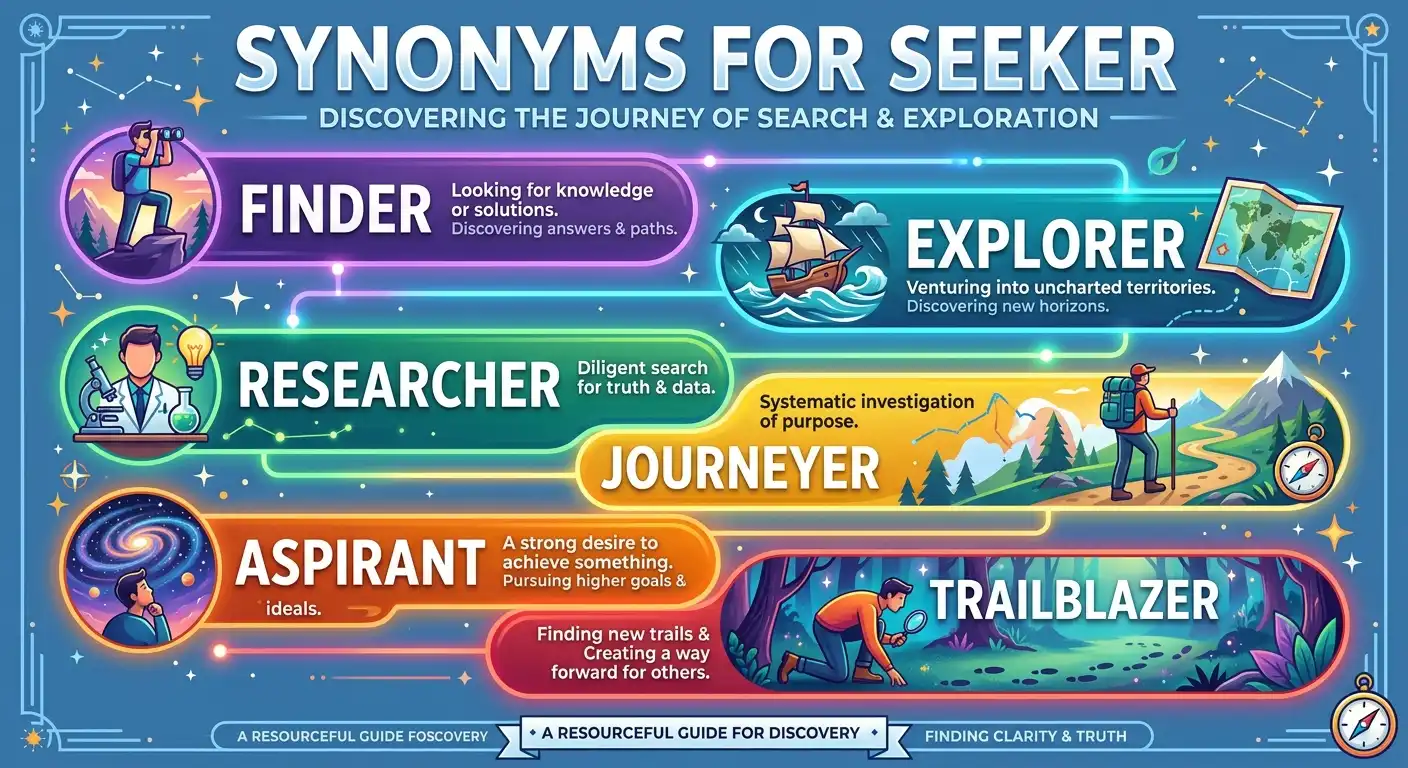
“Every great discovery is born from the relentless curiosity of an active seeker.”
Main Content – Synonyms List
1. Explorer
- Pronunciation: US: /ɪkˈsplɔːr.ɚ/ | UK: /ɪkˈsplɔːr.ər/
- Meaning: An explorer is a person who travels to new places to learn about them.
- Examples: The young explorer packed his compass for the mountain trek. She felt like an explorer in the massive city library.
2. Inquirer
- Pronunciation: US: /ɪnˈkwaɪ.rɚ/ | UK: /ɪnˈkwʌɪ.rər/
- Meaning: An inquirer is someone who asks questions to find facts.
- Examples: The curious inquirer raised her hand during the lecture. Every good scientist is an active inquirer of nature.
3. Searcher
- Pronunciation: US: /ˈsɜːr.tʃɚ/ | UK: /ˈsɜː.tʃə/
- Meaning: A searcher is a person who looks high and low for a missing item.
- Examples: The lost hiker was a desperate searcher looking for shelter. Dedicated searchers combed the beach for shells.
4. Hunter
- Pronunciation: US: /ˈhʌn.tɚ/ | UK: /ˈhʌn.tə/
- Meaning: A hunter is someone who tracks down specific goals or targets.
- Examples: The job hunter sent out twenty resumes this week. A treasure hunter never gives up on finding gold.
5. Pursuer
- Pronunciation: US: /pərˈsuː.ər/ | UK: /pəˈsuː.ə/
- Meaning: A pursuer is a person who chases after a dream or objective.
- Examples: As a passionate pursuer of art, she painted every single day. The fast runner was a fierce pursuer of the championship trophy.
6. Investigator
- Pronunciation: US: /ɪnˈves.təˌɡeɪ.t̬ɚ/ | UK: /ɪnˈvɛs.tɪ.ɡeɪ.tə/
- Meaning: An investigator is someone who looks into mysteries to find the truth.
- Examples: The clever detective acted as a private investigator in the town. She became an investigator of ancient history.
7. Prober
- Pronunciation: US: /ˈproʊ.bɚ/ | UK: /ˈprəʊ.bə/
- Meaning: A prober is someone who asks deep questions to uncover hidden facts.
- Examples: The sharp journalist was a tough prober during the interview. He proved to be a careful prober of medical mysteries.
8. Quester
- Pronunciation: US: /ˈkwɛs.tər/ | UK: /ˈkwɛs.tə/
- Meaning: A quester is a traveler on a long journey for a special purpose.
- Examples: The brave quester set out to save his kingdom. Every young student is a quester of knowledge.
9. Pilgrim
- Pronunciation: US: /ˈpɪl.ɡrɪm/ | UK: /ˈpɪl.ɡrɪm/
- Meaning: A pilgrim is a traveler going to a sacred place for religious reasons.
- Examples: The tired pilgrim walked miles toward the holy temple. She felt like a modern pilgrim seeking inner peace.
10. Wanderer
- Pronunciation: US: /ˈwɑːn.dɚ.ɚ/ | UK: /ˈwɒn.dər.ə/
- Meaning: A wanderer is someone who travels aimlessly without a fixed home.
- Examples: The lonely wanderer slept under the starry night sky. He was a joyful wanderer exploring quiet country roads.
11. Rover
- Pronunciation: US: /ˈroʊ.vɚ/ | UK: /ˈrəʊ.və/
- Meaning: A rover is a person or machine that wanders across wide areas.
- Examples: The Mars rover sent pictures back to planet Earth. The old sailor was a restless rover of the oceans.
12. Nomad
- Pronunciation: US: /ˈnoʊ.mæd/ | UK: /ˈnəʊ.mad/
- Meaning: A nomad is someone who moves from place to place rather than settling down.
- Examples: The desert nomad knew every hidden water well. Digital nomads work from laptops while traveling the world.
13. Drifter
- Pronunciation: US: /ˈdrɪf.tɚ/ | UK: /ˈdrɪf.tə/
- Meaning: A drifter is a person who moves casually from job to job or place to place.
- Examples: The quiet drifter stayed in town for only one week. He lived like a free drifter on the open highway.
14. Voyager
- Pronunciation: US: /ˈvɔɪ.ɪ.dʒɚ/ | UK: /ˈvɔɪ.ɪ.dʒə/
- Meaning: A voyager is someone who takes a long and exciting journey, usually by sea or space.
- Examples: The brave voyager sailed across the stormy Atlantic ocean. Space voyagers look deep into distant galaxies.
15. Traveler
- Pronunciation: US: /ˈtræv.əl.ɚ/ | UK: /ˈtræv.əl.ə/
- Meaning: A traveler is a person who goes from one place to another.
- Examples: The weary traveler rested his feet at the inn. Avid travelers collect stamps in their passports.
16. Pathfinder
- Pronunciation: US: /ˈpæθˌfaɪn.dɚ/ | UK: /ˈpɑːθˌfʌɪn.də/
- Meaning: A pathfinder is someone who finds a new route or discovers new ideas.
- Examples: She was a true pathfinder in modern computer science. The scout acted as the pathfinder through the thick forest.
17. Pioneer
- Pronunciation: US: /ˌpaɪ.əˈnɪr/ | UK: /ˌpʌɪ.əˈnɪə/
- Meaning: A pioneer is a person who is the first to explore or settle a new area.
- Examples: Early pioneers built wooden cabins in the wild west. He was a medical pioneer who saved thousands of lives.
18. Trailblazer
- Pronunciation: US: /ˈtreɪlˌbleɪ.zɚ/ | UK: /ˈtreɪlˌbleɪ.zə/
- Meaning: A trailblazer is someone who leads the way in making new discoveries.
- Examples: The young entrepreneur is a real trailblazer in green energy. She remains a trailblazer for women in engineering.
19. Adventurer
- Pronunciation: US: /ədˈven.tʃɚ.ɚ/ | UK: /ədˈvɛn.tʃər.ə/
- Meaning: An adventurer is a person who loves exciting and risky experiences.
- Examples: The daring adventurer climbed the highest snowy peak. Stories of brave adventurers fill children’s books.
20. Crusader
- Pronunciation: US: /kruːˈseɪ.dɚ/ | UK: /kruːˈseɪ.də/
- Meaning: A crusader is someone who fights hard for a major cause or belief.
- Examples: He was a dedicated crusader for animal rights. The local teacher acted as a crusader for better schools.
21. Zealot
- Pronunciation: US: /ˈzel.ət/ | UK: /ˈzɛl.ət/
- Meaning: A zealot is a person who has extremely strong feelings for a cause.
- Examples: The fitness zealot woke up at four every single morning. She was a health food zealot who avoided all sugar.
22. Enthusiast
- Pronunciation: US: /ɪnˈθuː.zi.æst/ | UK: /ɪnˈθuː.zi.ast/
- Meaning: An enthusiast is someone who is very interested in a particular activity.
- Examples: The gardening enthusiast grew giant red tomatoes. Train enthusiasts gathered at the old railway station.
23. Devotee
- Pronunciation: US: /ˌdev.əˈtiː/ | UK: /ˌdɛv.əˈtiː/
- Meaning: A devotee is a person who is very loyal to a hobby, sport, or idea.
- Examples: He is a loyal devotee of classic rock music. Classical art devotees visit the gallery every weekend.
24. Acolyte
- Pronunciation: US: /ˈæk.ə.laɪt/ | UK: /ˈak.ə.lʌɪt/
- Meaning: An acolyte is someone who follows and assists a leader or mentor.
- Examples: The young chef worked as an eager acolyte to the master baker. Faithful acolytes gathered to hear the philosopher speak.
25. Disciple
- Pronunciation: US: /dɪˈsaɪ.pəl/ | UK: /dɪˈsʌɪ.pəl/
- Meaning: A disciple is a person who learns from a teacher and follows their teachings.
- Examples: The wise teacher shared lessons with every eager disciple. She became a devoted disciple of modern economics.
26. Student
- Pronunciation: US: /ˈstuː.dənt/ | UK: /ˈstjuː.dنت/
- Meaning: A student is someone who is learning at a school or studying a subject.
- Examples: The hard-working student read three books over the weekend. An eternal student always looks for new things to learn.
27. Scholar
- Pronunciation: US: /ˈskɑː.lɚ/ | UK: /ˈskɒ.lə/
- Meaning: A scholar is an expert who studies a particular subject deeply.
- Examples: The brilliant scholar published a paper on medieval poetry. University scholars debated the difficult historical text.
28. Academic
- Pronunciation: US: /ˌæk.əˈdem.ɪk/ | UK: /ˌak.əˈdɛm.ɪk/
- Meaning: An academic is a teacher or researcher at a college or university.
- Examples: Several respected academics attended the international conference. He chose a quiet life as an academic researcher.
29. Intellectual
- Pronunciation: US: /ˌɪn.təlˈek.tʃu.əl/ | UK: /ˌɪn.tɛlˈɛk.tʃʊəl/
- Meaning: An intellectual is a person who enjoys serious study and deep thinking.
- Examples: Intellectuals gathered at the cafe to discuss philosophy. She was known among her peers as a sharp intellectual.
30. Thinker
- Pronunciation: US: /ˈθɪŋ.kɚ/ | UK: /ˈθɪŋ.kə/
- Meaning: A thinker is someone who spends time thinking deeply about ideas.
- Examples: The famous writer was a deep thinker about human rights. Independent thinkers rarely follow trends blindly.
31. Philosopher
- Pronunciation: US: /fəˈlɑː.sə.fɚ/ | UK: /fɪˈlɒ.sə.fə/
- Meaning: A philosopher is a person who studies the meaning of life and reality.
- Examples: The ancient Greek philosopher taught students in the public square. He read books written by a famous modern philosopher.
32. Observer
- Pronunciation: US: /əbˈzɝː.vɚ/ | UK: /əbˈzɜː.və/
- Meaning: An observer is someone who watches people or events carefully.
- Examples: The quiet observer noted every detail of the meeting. Wildlife observers watched the eagles build their nest.
33. Watcher
- Pronunciation: US: /ˈwɑːtʃ.ɚ/ | UK: /ˈwɒtʃ.ə/
- Meaning: A watcher is a person who keeps a close eye on something.
- Examples: Bird watchers gathered early in the morning with binoculars. She was a star watcher who loved late-night astronomy.
34. Stalker
- Pronunciation: US: /ˈstɑː.kɚ/ | UK: /ˈstɔː.kə/
- Meaning: A stalker is someone who follows a target quietly or stealthily.
- Examples: The stealthy hunter acted like a jungle stalker tracking prey. Wild predators move like silent stalkers in the tall grass.
35. Sleuth
- Pronunciation: US: /sluːθ/ | UK: /sluːθ/
- Meaning: A sleuth is an informal word for a detective or investigator.
- Examples: The amateur sleuth solved the mystery of the missing key. The newspaper sleuth uncovered the financial scandal.
36. Detective
- Pronunciation: US: /dɪˈtek.tɪv/ | UK: /dɪˈtɛk.tɪv/
- Meaning: A detective is an officer whose job is to solve crimes.
- Examples: The clever detective found fingerprints on the window frame. Detectives questioned witnesses near the crime scene.
37. Analyst
- Pronunciation: US: /ˈæn.ə.lɪst/ | UK: /ˈan.ə.lɪst/
- Meaning: An analyst is someone who examines data to understand how things work.
- Examples: The financial analyst reviewed stock market reports all morning. Data analysts look for trends in customer purchases.
38. Researcher
- Pronunciation: US: /riˈsɝː.tʃɚ/ | UK: /rɪˈsɜː.tʃə/
- Meaning: A researcher is a person who carries out scientific or academic studies.
- Examples: Medical researchers tested the new vaccine in the lab. The historical researcher spent months inside the old archives.
39. Experimenter
- Pronunciation: US: /ɪkˈsper.ə.men.t̬ɚ/ | UK: /ɪkˈspɛr.ɪ.mɛn.tə/
- Meaning: An experimenter is someone who tests new ideas through scientific trials.
- Examples: The young chemist was a bold experimenter in her lab. Creative chefs are experimenters with unique flavor combinations.
40. Tester
- Pronunciation: US: /ˈtes.tɚ/ | UK: /ˈtɛs.tə/
- Meaning: A tester is a person who checks the quality or performance of items.
- Examples: The software tester reported three bugs in the new app. Quality testers checked every single bicycle before packaging.
41. Aspirant
- Pronunciation: US: /əˈspɪr.ənt/ | UK: /əˈspʌɪ.rənt/
- Meaning: An aspirant is someone who has strong ambitions to achieve something great.
- Examples: Political aspirants gave speeches across the city square. The young acting aspirant auditioned for the Broadway play.
42. Claimant
- Pronunciation: US: /ˈkleɪ.mənt/ | UK: /ˈkleɪ.mənt/
- Meaning: A claimant is a person who officially makes a claim to something.
- Examples: The legal claimant proved ownership of the inherited property. Insurance claimants must submit receipts for their damaged goods.
43. Petitioner
- Pronunciation: US: /pəˈtɪʃ.ən.ɚ/ | UK: /pəˈtɪʃ.ən.ə/
- Meaning: A petitioner is someone who formally asks authorities for a change.
- Examples: The lead petitioner gathered signatures outside the town hall. Citizens acted as petitioners demanding cleaner public parks.
44. Suitor
- Pronunciation: US: /ˈsuː.t̬ɚ/ | UK: /ˈsuː.tə/
- Meaning: A suitor is a person trying to win someone’s hand in marriage or business.
- Examples: Several business suitors offered to buy the startup company. The polite suitor brought flowers for his beloved.
45. Solicitant
- Pronunciation: US: /səˈlɪs.ɪ.tənt/ | UK: /səˈlɪs.ɪ.tənt/
- Meaning: A solicitant is someone who formally requests assistance or approval.
- Examples: The grant solicitant waited anxiously for the funding decision. Scholarship solicitants submitted their essays on time.
46. Forager
- Pronunciation: US: /ˈfɔːr.ə.dʒɚ/ | UK: /ˈfɒr.ɪ.dʒə/
- Meaning: A forager is a person who searches widely for food or provisions.
- Examples: The forest forager picked wild berries and edible mushrooms. Ancient foragers relied on plants and hunting for survival.
47. Scavenger
- Pronunciation: US: /ˈskæv.ən.dʒɚ/ | UK: /ˈskav.ən.dʒə/
- Meaning: A scavenger is someone who collects discarded items or useful leftovers.
- Examples: The clever scavenger found old metal parts to build a bicycle. Beach scavengers looked for driftwood after the storm.
48. Prospector
- Pronunciation: US: /ˈprɑː.spek.tɚ/ | UK: /ˈprɒs.pɛk.tə/
- Meaning: A prospector is a person searching an area for gold, oil, or minerals.
- Examples: The lonely prospector panned for gold in the mountain river. Old gold prospectors built camps in the rugged hills.
49. Auditor
- Pronunciation: US: /ˈɑː.dɪ.tɚ/ | UK: /ˈɔː.dɪ.tə/
- Meaning: An auditor is someone who inspects financial accounts and records.
- Examples: The company auditor checked every receipt and invoice. Tax auditors reviewed corporate earnings for the fiscal year.
50. Inquisitor
- Pronunciation: US: /ɪnˈkwɪz.ə.t̬ɚ/ | UK: /ɪnˈkwɪz.ɪ.tə/
- Meaning: An inquisitor is a person who asks harsh or detailed questions.
- Examples: The lawyer acted like a strict inquisitor on the witness stand. She faced the panel like an anxious defendant before an inquisitor.
Antonyms of Seeker
- Avoider
- Escapist
- Quitter
- Ignorer
- Defeatist
- Surrenderer
Prototype Meaning and Categorization
A seeker prototypically represents human curiosity, agency, and forward motion. In cognitive semantics, it belongs to the agentive noun category—words that define individuals by their active pursuits, psychological motivations, or structural behaviors rather than static traits.
Frequently Asked Questions
1. What is the core definition of a seeker?
A seeker is an individual who actively looks for answers, knowledge, truth, or physical objectives with dedication and curiosity.
2. Can “seeker” be used in both professional and creative writing?
Yes, it works wonderfully in creative storytelling (spiritual or literal journeys) and professional contexts (job seekers, grant seekers).
3. How do synonyms like “explorer” differ from “seeker”?
An explorer emphasizes physical travel across uncharted territories, whereas a seeker can pursue abstract concepts like truth, meaning, or goals.
4. Are there negative connotations associated with any seeker synonyms?
Words like “zealot” or “stalker” carry intense or negative connotations, whereas words like “scholar” or “pathfinder” remain positive.
5. Why is vocabulary variety important for SEO content writers?
Using diverse synonyms prevents keyword repetition, improves readability scores, and keeps reader engagement high across long-form blog posts.
Conclusion
Mastering synonyms for seeker transforms your writing from repetitive to remarkably rich. When you carefully select words like explorer, pathfinder, scholar, or quester, you give your sentences texture, depth, and precise emotional resonance. Learning synonyms actively improves your writing by expanding your active vocabulary, elevates your blogging by keeping readers engaged, refines your speaking skills through varied articulation, and clarifies overall communication.
Make it a daily habit to practice these words in your professional emails, academic essays, and casual daily conversations. Experimenting with fresh vocabulary builds your confidence as a writer and helps your unique voice shine through every paragraph you craft.
“Precision in vocabulary is the hallmark of a master writer who respects both language and reader.”
“Keep searching, keep writing, and let every new word guide your creative journey.”

Thomas Walker is a professional English consultant and content strategist with over eleven years of experience working with technology companies, business writers, and content teams who need precise, modern vocabulary guidance (Biography).