When you look for powerful synonyms for shake, you are searching for precise words to describe quick movements, tremors, or vibrations. Synonyms for shake are alternative terms that help writers and speakers replace a repetitive action verb with something much more descriptive. Finding the right synonyms for shake allows you to paint a vivid picture in your reader’s mind without repeating the same basic word over and over.
Picture this: You are standing outside in the freezing winter cold, and your entire body begins to move rapidly back and forth. Or imagine a massive earthquake hitting a quiet town, causing every single building to rattle violently from side to side. In everyday English, we often just say “shake,” but that single word rarely captures the exact energy, emotion, or physical motion we actually mean.
“Shake” is a simple action word that means to move or cause to move back and forth or up and down with quick, short movements.
“Words are the clothing in which our thoughts take their most beautiful form.” – George W. Cable
This vocabulary guide is exceptionally useful for students writing essays, bloggers crafting engaging posts, content writers optimizing articles, and daily English users looking to speak with more confidence and clarity.
“The right word may be effective, but no word was ever as effective as a rightly timed pause.” – Mark Twain
Connotative Meaning of Shake
The word shake carries strong connotations of instability, emotional nervousness, physical coldness, or sudden disruption. Depending on the context, it can feel playful like shaking a maraca, or terrifying like an earth tremor.
Etymology of Shake
- Origin: Derived from the Old English word sceacan, meaning to bound, move rapidly, or agitate.
- Germanic Roots: Rooted in Proto-Germanic skakaną, relating to swinging or swift movement.
- Evolution: Transitioned from a medieval physical verb into a modern term for trembling, stirring, and emotional shock.
Pronunciation of Shake
- US IPA: /ʃeɪk/
- UK IPA: /ʃeɪk/
Syllables
- Count: 1 syllable (shake)
Affixation Pattern
- Base Word: Shake
- Derived Forms: Shakes, Shaken, Shaking, Shaky, Shakiness
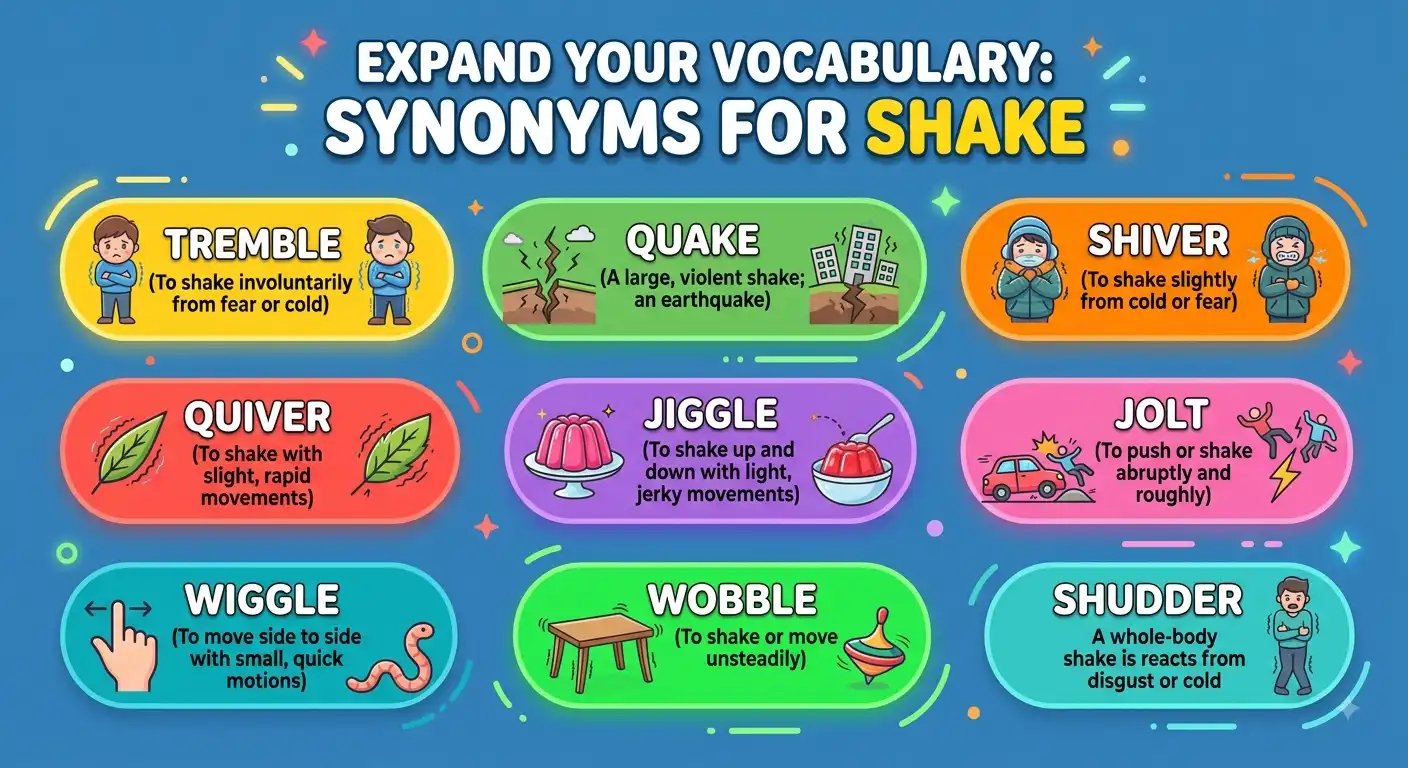
Comparison Table: Navigating Synonyms for Shake
| Keyword | Meaning | Usage Type | Context |
|---|---|---|---|
| Tremble | To shake involuntarily from fear or cold. | Emotional / Casual | Personal feelings, weather |
| Quiver | To shake with a slight, rapid motion. | Descriptive / Literary | Nature, emotional resonance |
| Vibrate | To move continuously back and forth rapidly. | Technical / Scientific | Machines, sound waves |
| Rattle | To make rapid, sharp, repetitive knocking sounds. | Casual / Physical | Objects, old vehicles |
| Shiver | To shake slightly because of cold or fear. | Daily Use / Physical | Body reactions, weather |
Main Content – Synonyms List
1. Tremble
Pronunciation: US /ˌtrɛmbəl/ | UK /ˌtrɛmbəl/ Meaning: To shake slightly because you are cold, scared, or nervous. Examples: Her hands began to tremble when she opened the acceptance letter. The little puppy started to tremble during the loud thunderstorm.
2. Quiver
Pronunciation: US /ˈkwɪvər/ | UK /ˈkwɪvər/ Meaning: To shake with a slight, fast motion. Examples: A small smile began to quiver on her lips. The arrow sat ready in the vibrating bow.
3. Vibrate
Pronunciation: US /ˈvaɪˌbreɪt/ | UK /ˈvaɪˈbreɪt/ Meaning: To move back and forth very fast. Examples: My phone started to vibrate during the quiet meeting. Heavy bass music caused the windows to vibrate.
4. Rattle
Pronunciation: US /ˈrævəl/ | UK /ˈrætl/ Meaning: To make short, sharp knocking sounds while moving. Examples: The old truck would rattle whenever it hit a pothole. Loose coins began to rattle inside my jacket pocket.
5. Shiver
Pronunciation: US /ˈʃɪvər/ | UK /ˈʃɪvər/ Meaning: To shake because you feel cold or frightened. Examples: We started to shiver while waiting outside in the snow. A cold wind made the hikers shiver uncontrollably.
6. Jiggle
Pronunciation: US /ˈdʒɪɡəl/ | UK /ˈdʒɪɡəl/ Meaning: To move up and down or back and forth with quick little movements. Examples: You have to jiggle the door handle to open it. She watched the jelly jiggle on her dessert plate.
7. Joggle
Pronunciation: US /ˈdʒɒɡəl/ | UK /ˈdʒɒɡəl/ Meaning: To shake or jog slightly with irregular bumps. Examples: The bumpy cart ride began to joggle our luggage. He gave the broken machine a sharp joggle.
8. Wobble
Pronunciation: US /ˈwɒbəl/ | UK /ˈwɒbəl/ Meaning: To move unsteadily from side to side. Examples: The loose bicycle wheel began to wobble dangerously. Learning to ride a bike means lots of wobbling.
9. Oscillate
Pronunciation: US /ˈɒsɪˌleɪt/ | UK /ˈɒsɪˌleɪt/ Meaning: To swing back and forth in a steady rhythm. Examples: The electric fan will oscillate to cool the room. Pendulums oscillate predictably in grandfather clocks.
10. Flutter
Pronunciation: US /ˈflʌtər/ | UK /ˈflʌtər/ Meaning: To move wings or parts quickly and lightly. Examples: Butterflies flutter around the colorful summer garden flowers. The loose flag began to flutter in the breeze.
11. Agitate
Pronunciation: US /ˈædʒɪˌteɪt/ | UK /ˈædʒɪˌteɪt/ Meaning: To stir, shake, or disturb liquid or feelings. Examples: Shake the bottle well to agitate the ingredients. Loud noises tend to agitate stray animals.
12. Flop
Pronunciation: US /flɒp/ | UK /flɒp/ Meaning: To move or fall in a heavy, loose way. Examples: He let his tired arms flop down by his sides. The wet fish began to flop on the boat deck.
13. Jolt
Pronunciation: US /dʒoʊlt/ | UK /dʒəʊlt/ Meaning: To give a sudden, rough jerk or movement. Examples: The sudden stop of the bus gave us a jolt. A loud thunderclap gave the sleeping cat a jolt.
14. Jerk
Pronunciation: US /dʒɜrk/ | UK /dʒɜːk/ Meaning: To make a sharp, sudden movement. Examples: Pull the emergency cord with a quick jerk. The car gave a strange jerk and stopped.
15. Pulse
Pronunciation: US /pʌls/ | UK /pʌls/ Meaning: To beat or vibrate with a steady rhythm. Examples: Neon lights seemed to pulse in the city night. His heartbeat began to pulse faster during the race.
16. Throbb
Pronunciation: US /θrɒb/ | UK /θrɒb/ Meaning: To beat or pulse with a strong, steady rhythm. Examples: My injured ankle began to throb after walking. Heavy bass music made the club floor throb.
17. Rock
Pronunciation: US /rɒk/ | UK /rɒk/ Meaning: To move gently back and forth or side to side. Examples: She gently rocked the crying baby to sleep. The small boat began to rock in the waves.
18. Sway
Pronunciation: US /sweɪ/ | UK /sweɪ/ Meaning: To move slowly and rhythmically from side to side. Examples: Tall pine trees sway gracefully in the strong wind. Couples began to sway to the romantic slow music.
19. Wave
Pronunciation: US /weɪv/ | UK /weɪv/ Meaning: To move back and forth or up and down. Examples: Children love to wave hello to passing train conductors. Golden wheat fields wave gently under the sun.
20. Brandish
Pronunciation: US /ˈbrændɪʃ/ | UK /ˈbrændɪʃ/ Meaning: To wave or shake something menacingly in the air. Examples: The knight began to brandish his gleaming sword. Actors brandish props convincingly during stage combat.
21. Flourish
Pronunciation: US /ˈflɜrɪʃ/ | UK /ˈflʌrɪʃ/ Meaning: To wave something around dramatically. Examples: The chef likes to flourish his knife with skill. She would flourish her diploma proudly at graduation.
22. Swish
Pronunciation: US /swɪʃ/ | UK /swɪʃ/ Meaning: To move with a soft brushing or hissing sound. Examples: The horse used its tail to swish away flies. Silk dresses swish softly as people walk past.
23. Whisk
Pronunciation: US /wɪsk/ | UK /wɪsk/ Meaning: To move or take something away quickly and lightly. Examples: Use a metal wire tool to whisk the eggs. The magic show assistant was whisked off stage.
24. Churn
Pronunciation: US /tʃɜrn/ | UK /tʃɜːn/ Meaning: To agitate liquid violently inside a container. Examples: Farmers use wooden barrels to churn fresh cream into butter. Rough ocean waves churn sand near the shore.
25. Tossing
Pronunciation: US /ˈtɒsɪŋ/ | UK /ˈtɒsɪŋ/ Meaning: To throw or move something about restlessly. Examples: Insomnia kept him tossing and turning all night long. Strong gales kept tossing the small fishing boat.
26. Stir
Pronunciation: US /stɜr/ | UK /stɜː(r)/ Meaning: To mix ingredients or cause light movement. Examples: Stir the hot soup gently with a wooden spoon. A gentle morning breeze began to stir the leaves.
27. Jar
Pronunciation: US /dʒɑr/ | UK /dʒɑː(r)/ Meaning: To shake or shock with a hard impact. Examples: The heavy landing will jar your sensitive joints. Loud unexpected sounds can jar your nerves.
28. Quake
Pronunciation: US /kweɪk/ | UK /kweɪk/ Meaning: To shake or shudder with great fear or force. Examples: The ground began to quake during the minor tremor. Fear made her voice quake when speaking publicly.
29. Shudder
Pronunciation: US /ˈʃʌdər/ | UK /ˈʃʌdər/ Meaning: To tremble suddenly from horror, cold, or disgust. Examples: I watched him shudder at the thought of eating insects. Freezing water made the swimmers shudder instantly.
30. Flinch
Pronunciation: US /flɪntʃ/ | UK /flɪntʃ/ Meaning: To make a quick nervous movement away from danger. Examples: Try not to flinch when the nurse gives shots. He didn’t flinch even when a loud firecracker popped.
31. Recoil
Pronunciation: US /rɪˈkɔɪl/ | UK /rɪˈkɔɪl/ Meaning: To spring back suddenly in fear or disgust. Examples: She stepped back with a quick recoil from the snake. Heavy cannons recoil violently when fired.
32. Rebound
Pronunciation: US /ˈriːbaʊnd/ | UK /rɪˈbaʊnd/ Meaning: To bounce back after hitting an object surface. Examples: Basketballs rebound off the backboard into the net. Economic markets tend to rebound after a slump.
33. Bounce
Pronunciation: US /baʊns/ | UK /baʊns/ Meaning: To spring back up after hitting a hard surface. Examples: Children love to bounce rubber balls on pavement. The tennis ball began to bounce across the court.
34. Bound
Pronunciation: US /baʊnd/ | UK /baʊnd/ Meaning: To move with energetic leaps and springy steps. Examples: Happy dogs bound across the green grassy park. Deer bound effortlessly over low wooden fences.
35. Leap
Pronunciation: US /liːp/ | UK /liːp/ Meaning: To jump or spring a long way across. Examples: Brave athletes leap over hurdles during track events. Frogs leap quickly from lily pad to pad.
36. Hop
Pronunciation: US /hɒp/ | UK /hɒp/ Meaning: To move by quick, small jumps on one foot. Examples: Little children love to hop around the playground. Rabbits hop playfully through green spring meadows.
37. Spring
Pronunciation: US /sprɪŋ/ | UK /sprɪŋ/ Meaning: To move forward or upward suddenly and quickly. Examples: Tigers spring silently toward their resting prey. Water springs cleanly from deep mountain rock sources.
38. Vault
Pronunciation: US /vɔːlt/ | UK /vɔːlt/ Meaning: To leap or jump over an obstacle gracefully. Examples: Gymnasts vault across heavy padded equipment pieces. Security guards can vault fences in emergency chases.
39. Twitch
Pronunciation: US /twɪtʃ/ | UK /twɪtʃ/ Meaning: To give a short, sudden, involuntary muscle movement. Examples: The sleeping puppy’s nose began to twitch happily. Tired eyes can twitch when under heavy stress.
40. Palpitate
Pronunciation: US /ˈpælPɪˌteɪt/ | UK /ˈpælpɪˌteɪt/ Meaning: To beat rapidly and strongly due to stress. Examples: Excitement made his chest palpitate before the concert. Medical monitors track patients who experience heart palpitation.
41. Flutter
Pronunciation: US /ˈflʌtər/ | UK /ˈflʌtər/ Meaning: To flap wings rapidly without flying far. Examples: Wounded birds flutter helplessly on garden grass. Paper notes flutter downward from open office windows.
42. Beat
Pronunciation: US /biːt/ | UK /biːt/ Meaning: To strike or pound repeatedly with force. Examples: Drums beat loudly during the parade performance. Heavy rain began to beat against window glass.
43. Pound
Pronunciation: US /paʊnd/ | UK /paʊnd/ Meaning: To strike or hit heavily and repeatedly. Examples: Angry neighbors pound loudly on apartment walls. Waves pound relentlessly against coastal rock cliffs.
44. Thump
Pronunciation: US /θʌmp/ | UK /θʌmp/ Meaning: To hit heavily, making a dull hollow sound. Examples: Drop heavy books and watch them thump on desks. Giant footsteps began to thump upstairs.
45. Bash
Pronunciation: US /bæʃ/ | UK /bæʃ/ Meaning: To strike with a heavy, damaging blow. Examples: Careless movers bash boxes against stair rails. Construction workers bash old drywall during remodeling.
46. Smash
Pronunciation: US /smæʃ/ | UK /smæʃ/ Meaning: To break violently into many sharp pieces. Examples: Accidental throws can smash window glass panes. Tennis players smash balls across court nets.
47. Clash
Pronunciation: US /klæʃ/ | UK /klæʃ/ Meaning: To strike together with a loud harsh sound. Examples: Cymbals clash loudly during marching band shows. Rival knights clash swords in fierce combat.
48. Clatter
Pronunciation: US /ˈklætər/ | UK /ˈklætər/ Meaning: To make a continuous rattling banging sound. Examples: Kitchen plates clatter when stacked carelessly. Pots and pans clatter inside metal cupboards.
49. Jolt
Pronunciation: US /dʒoʊlt/ | UK /dʒəʊlt/ Meaning: To shake someone or something abruptly. Examples: Hitting potholes will jolt passengers in cars. Caffeine can jolt tired minds awake instantly.
50. Jitter
Pronunciation: US /ˈdʒɪtər/ | UK /ˈdʒɪtər/ Meaning: To act nervously with small jerky movements. Examples: Too much espresso makes people jitter before meetings. Nervous candidates jitter while waiting for interviews.
Antonyms of Shake
- Steady
- Calm
- Stabilize
- Fix
- Still
- Rest
- Smooth
- Balance
Prototype Meaning and Categorization of Shake
As a linguistic prototype, shake represents the core semantic category of rapid, non-linear physical agitation. It bridges mechanical motion (vibration, oscillation) with involuntary physiological reactions (trembling, shivering) and causal human action (stirring, agitating).
Frequently Asked Questions (FAQ)
What is the primary definition of shake?
Shake refers to moving or causing something to move back and forth or up and down with rapid, short movements.
Why should I use synonyms for shake in my writing?
Using synonyms prevents repetitive language, enhances imagery, and makes your essays, blog posts, and stories much more engaging.
Is tremble a good synonym for emotional shaking?
Yes, tremble is ideal when describing involuntary body movements caused by fear, anxiety, cold, or excitement.
How do I choose between vibrate and rattle?
Use “vibrate” for high-frequency technological movements or sound waves, and “rattle” for physical objects making sharp knocking sounds.
Can shake be used as a noun?
Yes, shake functions as both a verb (to shake hands) and a noun (a milk shake or a sudden earth tremor).
What is the difference between shiver and quiver?
Shiver usually describes body shakes caused by cold or fear, whereas quiver describes a subtle, delicate trembling motion.
Conclusion
Expanding your vocabulary by mastering dynamic synonyms for shake transforms your writing from ordinary to exceptional. Whether you are drafting academic essays, publishing engaging blog posts, or simply sharpening your daily conversational skills, replacing weak verbs with precise vocabulary gives your voice authority and color. When you deliberately choose words like tremble, quiver, or vibrate, you give your readers a clearer window into your exact thoughts.
“The difference between the almost right word and the right word is really a large matter—it’s the difference between the lightning bug and the lightning.” – Mark Twain
We encourage you to practice integrating these powerful alternatives into your professional emails, school assignments, and everyday conversations starting today. Small vocabulary upgrades lead to massive improvements in how clearly and effectively you connect with others.
“Language is the dress of thought.” – Samuel Johnson

Thomas Walker is a professional English consultant and content strategist with over eleven years of experience working with technology companies, business writers, and content teams who need precise, modern vocabulary guidance (Biography).