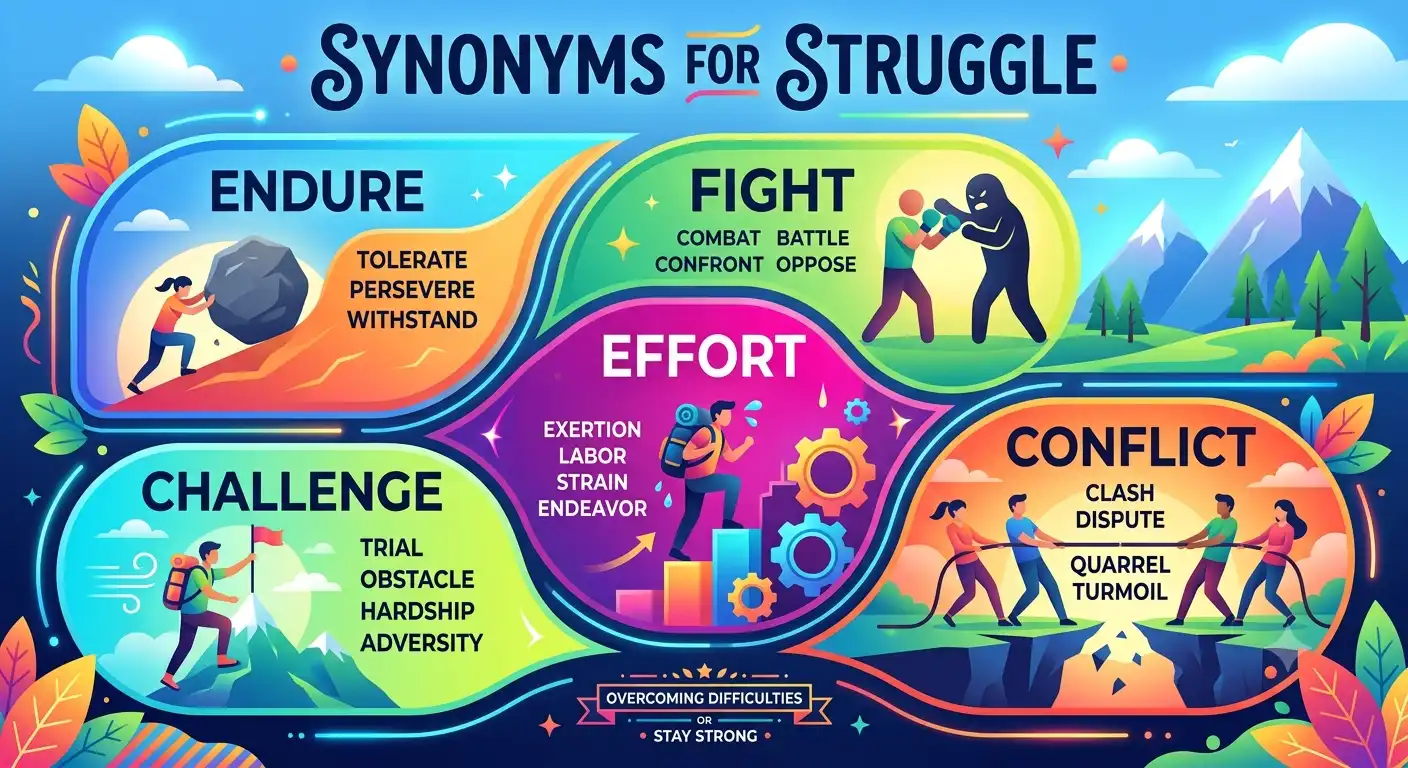
Finding the right synonyms for struggle can instantly transform your sentences from dull to highly dynamic. When we talk about overcoming hardships, using diverse synonyms for struggle keeps readers emotionally invested. Learning synonyms for struggle is the ultimate secret to conveying real effort and grit in your articles, essays, and creative stories.
Imagine a small plant cracking through concrete to reach the warm sunlight. It does not simply struggle; it bursts through the hard ground, strains against gravity, and fights for life. That simple change of words is why synonyms are so powerful. In very simple English, “struggle” means to try incredibly hard to do something when there are big problems in your way.
“The triumph is nothing without the struggle.” — Wilma Rudolph
“Strength and growth come only through continuous effort and struggle.” — Napoleon Hill
Expanding your range of expression is incredibly helpful for several groups of writers:
- For students: It helps you describe deep historical conflicts or difficult characters in literature with more emotional depth.
- For bloggers: It keeps your readers completely hooked with exciting and active action words.
- For content writers: It boosts your search rankings by using natural variety that search engines love.
- For daily English users: It helps you share your personal stories, hard days, and triumphs with absolute clarity.
Connotative Meaning of Struggle
The word “struggle” has a strong connotation of heavy effort, friction, and emotional weight. It suggests that there is a barrier in the way of success. When we use it, we think of sweat, tears, and determination. It is not just about doing work; it is about fighting against something that wants to stop you.
Etymology of Struggle
- Struggle (Root): Derived from the Middle English word struglen.
- Origin: Likely connected to older Scandinavian words or dialectal words meaning “to walk with difficulty” or “to scuffle.”
- Evolution: Used since the late 14th century to show physical wrestling, which later grew to include mental and emotional hardships.
Linguistic Profile of Struggle
- US Pronunciation (IPA): /ˈstrʌɡ.əl/
- UK Pronunciation (IPA): /ˈstrʌɡ.əl/
- Syllables: 2 syllables (strug-gle)
- Affixation Pattern: Base word with no active affixes.
Comparison of Key Synonyms
To help you choose the right word instantly, here is a simple comparison of key synonyms:
| Keyword | Meaning | Usage Type | Context |
|---|---|---|---|
| Battle | Fight hard against a big problem. | Professional & Casual | Health issues, business challenges, weather |
| Cope | Deal with a hard situation successfully. | Emotional & Casual | Family worries, mental stress, changes |
| Strive | Try very hard to reach a high goal. | Formal & Professional | School tasks, sports, career milestones |
| Wrestle | Move or think hard to solve a problem. | Casual & Emotional | Decisions, physical tasks, complex ideas |
| Grapple | Try to understand or control a threat. | Literary & Formal | Intellectual debates, police work, dark thoughts |
| Flounder | Move clumsily or struggle to make progress. | Casual & Literary | Speaking in public, swimming, bad business choices |
50 Synonyms for Struggle
Here is your ultimate list of 50 synonyms to describe hard work, deep efforts, and overcoming obstacles.
1. Battle
- Pronunciation: US /ˈbæt.əl/ | UK /ˈbæt.əl/
- Meaning: This means to fight very hard against a difficult situation or problem.
- Examples:
- She had to battle the cold wind all morning.
- He will battle the disease with great courage.
2. Fight
- Pronunciation: US /faɪt/ | UK /faɪt/
- Meaning: This means to use your power to beat a bad situation.
- Examples:
- They will fight to keep their small neighborhood park open.
- We must fight against these unfair new rules.
3. Strive
- Pronunciation: US /straɪv/ | UK /straɪv/
- Meaning: This means to try very hard to get or do something.
- Examples:
- I always strive to do my best in school.
- We strive for a peaceful and happy home.
4. Grapple
- Pronunciation: US /ˈɡræp.əl/ | UK /ˈɡræp.əl/
- Meaning: This means to try hard to understand or solve a deep problem.
- Examples:
- The team had to grapple with the new math puzzle.
- Scientists grapple with finding a cure for the cold.
5. Wrestle
- Pronunciation: US /ˈres.əl/ | UK /ˈres.əl/
- Meaning: This means to struggle with a difficult choice or a heavy object.
- Examples:
- He had to wrestle with his conscience before telling the truth.
- We tried to wrestle the heavy couch up the stairs.
6. Cope
- Pronunciation: US /koʊp/ | UK /kəʊp/
- Meaning: This means to deal with a tough situation in a good way.
- Examples:
- The young boy learned how to cope with his fear.
- She found a way to cope with the busy schedule.
7. Endeavor
- Pronunciation: US /ɪnˈdev.ɚ/ | UK /ɪnˈdev.ər/
- Meaning: This means to make a serious and planned effort to do something.
- Examples:
- They will endeavor to finish the project by noon.
- He did endeavor to be polite to the mean clerk.
8. Flounder
- Pronunciation: US /ˈflaʊn.dɚ/ | UK /ˈflaʊn.dər/
- Meaning: This means to move clumsily or have trouble finding the right words.
- Examples:
- The poor speaker began to flounder during the tough presentation.
- We saw the sheep flounder in the deep wet mud.
9. Labor
- Pronunciation: US /ˈleɪ.bɚ/ | UK /ˈleɪ.bər/
- Meaning: This means to do hard physical or mental work over a long time.
- Examples:
- They had to labor in the hot sun all afternoon.
- She had to labor for hours to write the report.
10. Toil
- Pronunciation: US /tɔɪl/ | UK /tɔɪl/
- Meaning: This means to do very hard, tiring, and boring physical work.
- Examples:
- The farmers toil in the fields from dawn to dark.
- He had to toil all night to clean the store.
11. Strain
- Pronunciation: US /streɪn/ | UK /streɪn/
- Meaning: This means to use too much power or effort, which causes hurt.
- Examples:
- Do not strain your eyes by reading in the dark.
- He had to strain to lift the heavy box.
12. Sweat
- Pronunciation: US /swet/ | UK /swet/
- Meaning: This means to work so hard that you get hot and tired.
- Examples:
- I had to sweat over this paper for three days.
- They did sweat to build the wooden cabin.
13. Scuffle
- Pronunciation: US /ˈskʌf.əl/ | UK /ˈskʌf.əl/
- Meaning: This means to fight in a quick, confused, and messy way.
- Examples:
- The two boys began to scuffle over the soccer ball.
- We heard a small animal scuffle in the dry leaves.
14. Clash
- Pronunciation: US /klæʃ/ | UK /klæʃ/
- Meaning: This means to fight or argue because you have different opinions.
- Examples:
- The two big groups clash over the new rules.
- Their ideas clash when they try to paint together.
15. Conflict
- Pronunciation: US /ˈkɑːn.flɪkt/ | UK /ˈkɒn.flɪkt/
- Meaning: This means to disagree strongly or have a fight with someone.
- Examples:
- My work hours conflict with my soccer practice time.
- The neighbors conflict over where to build the fence.
16. Slog
- Pronunciation: US /slɑːɡ/ | UK /slɒɡ/
- Meaning: This means to work hard or walk slowly through something difficult.
- Examples:
- We had to slog through the deep, wet snow.
- He will slog through his homework before dinner tonight.
17. Plod
- Pronunciation: US /plɑːd/ | UK /plɒd/
- Meaning: This means to walk or work slowly and heavily but steadily.
- Examples:
- The heavy horse had to plod along the dirt road.
- I must plod through this thick textbook to pass.
18. Contend
- Pronunciation: US /kənˈtend/ | UK /kənˈtend/
- Meaning: This means to compete or deal with a major difficulty.
- Examples:
- She had to contend with a bad cold during exams.
- The players contend for the shiny gold trophy today.
19. Hassle
- Pronunciation: US /ˈhæs.əl/ | UK /ˈhæs.əl/
- Meaning: This means to argue or deal with an annoying, hard task.
- Examples:
- It is a hassle to clean this dirty oven.
- Please do not hassle me while I am working.
20. Agonize
- Pronunciation: US /ˈæɡ.ə.naɪz/ | UK /ˈæɡ.ə.naɪz/
- Meaning: This means to worry for a long time about a choice.
- Examples:
- Do not agonize over the small mistakes you made.
- She will agonize for days about which dress to buy.
21. Hustle
- Pronunciation: US /ˈhʌs.əl/ | UK /ˈhʌs.əl/
- Meaning: This means to work very fast and make a quick effort.
- Examples:
- You must hustle if you want to win the game.
- She had to hustle to sell all her fresh pies.
22. Scramble
- Pronunciation: US /ˈskræm.bəl/ | UK /ˈskræm.bəl/
- Meaning: This means to move quickly using both your hands and feet.
- Examples:
- The hikers had to scramble up the steep rocks.
- I had to scramble to find my car keys.
23. Tackle
- Pronunciation: US /ˈtæk.əl/ | UK /ˈtæk.əl/
- Meaning: This means to make a big effort to solve a problem.
- Examples:
- We must tackle the dirty kitchen before we go out.
- He decided to tackle his biggest fear today.
24. Confront
- Pronunciation: US /kənˈfrʌnt/ | UK /kənˈfrʌnt/
- Meaning: This means to face a difficult situation or person directly.
- Examples:
- He had to confront his friend about the broken toy.
- We must confront the big issues in our company.
“Where there is no struggle, there is no strength.” — Frederick Douglass
25. Resist
- Pronunciation: US /rɪˈzɪst/ | UK /rɪˈzɪst/
- Meaning: This means to fight against something or refuse to give in.
- Examples:
- It is hard to resist eating another sweet cookie.
- They will resist the plans to cut down the trees.
26. Combat
- Pronunciation: US /ˈkɑːm.bæt/ | UK /ˈmɒm.bæt/
- Meaning: This means to fight against something harmful or bad.
- Examples:
- We use soap to combat dirty germs on our hands.
- The city wants to combat the bad traffic problem.
27. Drudge
- Pronunciation: US /drʌdʒ/ | UK /drʌdʒ/
- Meaning: This means to do hard, boring, and low-level work.
- Examples:
- I had to drudge in the kitchen all morning cleaning pans.
- He did drudge through the heavy paperwork for days.
28. Grind
- Pronunciation: US /ɡraɪnd/ | UK /ɡraɪnd/
- Meaning: This means to work hard continuously without taking any break.
- Examples:
- Students must grind hard during the final exam week.
- She had to grind for years to build her shop.
29. Oppose
- Pronunciation: US /əˈpoʊz/ | UK /əˈpəʊz/
- Meaning: This means to speak or act against a new plan.
- Examples:
- Many people oppose the new taxes in our town.
- They oppose the idea of building a road here.
30. Attempt
- Pronunciation: US /əˈtempt/ | UK /əˈtempt/
- Meaning: This means to try to do a hard task or activity.
- Examples:
- I will attempt to climb the tall tree tomorrow.
- She made an attempt to fix the broken radio.
31. Exert
- Pronunciation: US /ɪɡˈzɝːt/ | UK /ɪɡˈzɜːt/
- Meaning: This means to put a lot of mental or physical effort into a task.
- Examples:
- You must exert yourself if you want to win.
- Do not exert too much force on that plastic toy.
32. Suffer
- Pronunciation: US /ˈsʌf.ɚ/ | UK /ˈsʌf.ər/
- Meaning: This means to feel physical or mental pain from a hardship.
- Examples:
- The dry plants suffer when there is no summer rain.
- He had to suffer through a very loud concert.
33. Endure
- Pronunciation: US /ɪnˈdʊr/ | UK /ɪnˈdjʊər/
- Meaning: This means to experience a hard situation without giving up.
- Examples:
- They had to endure the freezing weather for hours.
- She can endure a lot of stress without crying.
34. Brave
- Pronunciation: US /breɪv/ | UK /breɪv/
- Meaning: This means to face a dangerous situation with great courage.
- Examples:
- The small kids had to brave the heavy rainstorm.
- He will brave the cold water to save his dog.
35. Weather
- Pronunciation: US /ˈweð.ɚ/ | UK /ˈweð.ər/
- Meaning: This means to deal with and survive a difficult time successfully.
- Examples:
- The small boat had to weather the rough sea waves.
- Our friendship will weather this silly little argument.
36. Muddle through
- Pronunciation: US /ˈmʌd.əl θruː/ | UK /ˈmʌd.əl θruː/
- Meaning: This means to manage to get through a task without plan or skill.
- Examples:
- I do not know French, but I will muddle through.
- We had to muddle through the complicated game rules.
37. Soldier on
- Pronunciation: US /ˈsoʊl.dʒɚ ɑːn/ | UK /ˈsəʊl.dʒər ɒn/
- Meaning: This means to keep going forward even when things are very hard.
- Examples:
- Although she was tired, she had to soldier on.
- The team decided to soldier on despite losing players.
38. Tug
- Pronunciation: US /tʌɡ/ | UK /tʌɡ/
- Meaning: This means to pull something very hard with a lot of effort.
- Examples:
- The dog began to tug on the thick leather leash.
- He had to tug the heavy drawer to open it.
39. Vie
- Pronunciation: US /vaɪ/ | UK /vaɪ/
- Meaning: This means to compete with others to get something good.
- Examples:
- The two schools vie for the top track prize.
- Many young artists vie for the spot in the gallery.
40. Spar
- Pronunciation: US /spɑːr/ | UK /spɑː/
- Meaning: This means to argue in a friendly way or practice boxing.
- Examples:
- The two friends love to spar about political news.
- The boxers began to spar in the gym ring.
41. Tussle
- Pronunciation: US /ˈtʌs.əl/ | UK /ˈtʌs.əl/
- Meaning: This means to have a short physical fight or tough argument.
- Examples:
- The kids had a small tussle over the green crayon.
- We had to tussle with the wet umbrella.
42. Feud
- Pronunciation: US /fjuːd/ | UK /fjuːd/
- Meaning: This means to have an angry disagreement that lasts for years.
- Examples:
- The two old families feud over the land line.
- They continue to feud about that old business deal.
43. Dispute
- Pronunciation: US /dɪˈspjuːt/ | UK /dɪˈspjuːt/
- Meaning: This means to argue about whether something is true or right.
- Examples:
- We dispute the idea that the task is too hard.
- The players dispute the call made by the referee.
44. Work
- Pronunciation: US /wɝːk/ | UK /wɜːk/
- Meaning: This means to do activities that need mental or physical effort.
- Examples:
- She must work hard to pay for her new school.
- We work together to solve the computer bug.
45. Push
- Pronunciation: US /pʊʃ/ | UK /pʊʃ/
- Meaning: This means to make a strong effort to achieve a major goal.
- Examples:
- The company will push to finish the project early.
- You must push past the pain to finish the run.
46. Sweat it out
- Pronunciation: US /swet ɪt aʊt/ | UK /swet ɪt aʊt/
- Meaning: This means to wait anxiously or work hard to finish a task.
- Examples:
- We had to sweat it out until the test scores came.
- The players will sweat it out during the hard practice.
47. Plough through
- Pronunciation: US /plaʊ θruː/ | UK /plaʊ θruː/
- Meaning: This means to finish a difficult or long task with big effort.
- Examples:
- I have to plough through this big pile of letters.
- The tractor had to plough through the thick deep mud.
48. Chafe
- Pronunciation: US /tʃeɪf/ | UK /tʃeɪf/
- Meaning: This means to feel annoyed or limited by rules or boundaries.
- Examples:
- The creative designer began to chafe under the tight rules.
- Dogs often chafe when they are kept inside too long.
49. Buckle
- Pronunciation: US /ˈbʌk.əl/ | UK /ˈbʌk.əl/
- Meaning: This means to struggle and bend under very heavy weight or pressure.
- Examples:
- The metal bridge began to buckle under the heavy truck.
- He did not buckle even when the work grew very hard.
50. Persevere
- Pronunciation: US /ˌpɝː.səˈvɪr/ | UK /ˌpɜː.sɪˈvɪər/
- Meaning: This means to keep trying to do something despite major difficulties.
- Examples:
- You must persevere if you want to learn the piano.
- She decided to persevere and finish the long race.
Antonyms of Struggle
To understand “struggle” fully, it is helpful to look at its direct opposites. In communication and learning, these terms represent peace and easy progress:
- Ease: Doing something without any trouble, pain, or hard work.
- Peace: A state of calm where there are no fights, arguments, or problems.
- Success: Reaching your goals easily without falling down or hurting.
- Surrender: Giving up the fight completely so you do not have to try anymore.
- Comfort: A pleasant state of being relaxed and free from pain.
Prototype Meaning and Categorization of Synonyms for Struggle
The different synonyms for struggle can be easily divided into four main categories:
- Active Resistance (The Combative): Words like battle, fight, combat, and resist that show active opposition to a force.
- Heavy Work and Grit (The Physical): Terms like labor, toil, slog, plod, and grind that point to physical or mental exhaustion.
- Mental and Emotional Trial (The Psychological): Descriptions like agonize, cope, suffer, and wrestle that highlight internal friction.
- Persistent Forward Motion (The Determined): Phrases like strive, persevere, soldier on, and endeavor that look at moving forward.
FAQ about Synonyms for Struggle
1. What is the difference between “struggle” and “strive”?
While they are very similar, struggle usually refers to dealing with heavy obstacles or pain (e.g., “I struggle with math”), while strive refers to working positively toward a high goal (e.g., “I strive to be a doctor”).
2. Can “cope” be used as a direct synonym for struggle?
Yes, cope is an excellent synonym when you are talking about managing emotional stress or dealing with a difficult situation without giving up.
3. What is a formal synonym for struggle in business writing?
In formal emails or reports, words like endeavor, contend, or exert effort are preferred because they sound much more professional and polite.
4. Is “slog” too casual for formal academic writing?
Yes, slog is a highly casual and descriptive word. It is perfect for personal blogs or casual storytelling, but you should avoid it in academic essays.
5. How does choosing the right synonym for struggle improve my SEO?
Using diverse words stops search engines from flags of keyword stuffing. It makes your writing natural, keeping your human readers engaged on the page longer.
6. How do you pronounce “struggle” correctly?
In both US and UK English, it is pronounced as /ˈstrʌɡ.əl/ and contains exactly two syllables (strug-gle).
Conclusion
Expanding your vocabulary with fifty unique synonyms for struggle is a powerful way to make your communication much more engaging. When you select the exact word that fits your situation, your writing gains immediate emotional depth and impact. Rather than repeating the same common verbs, bloggers can craft highly relatable articles, students can write persuasive essays, and business professionals can make their messages highly clear and professional. Using active vocabulary keeps your readers curious and ensures that your unique voice sounds completely authentic.
We encourage you to practice using these terms as you write your school papers, draft work emails, or chat with your friends. By paying attention to the small differences in these words, you can match your tone to your specific audience perfectly. Do not be afraid to experiment with new terms in your next conversation. With regular practice, choosing the right synonym will become completely natural, helping you share your thoughts, challenges, and successes with confidence. Every time you swap a dull word for a dynamic one, you take a big step forward as a writer. Your voice will sound brighter, and your ideas will carry much more weight. Keep exploring the beauty of the English language, and watch how quickly your sentences begin to shine.
“The struggle you’re in today is developing the strength you need for tomorrow.” — Robert Tew
“It is during our darkest moments that we must focus to see the light.” — Aristotle

Thomas Walker is a professional English consultant and content strategist with over eleven years of experience working with technology companies, business writers, and content teams who need precise, modern vocabulary guidance (Biography).