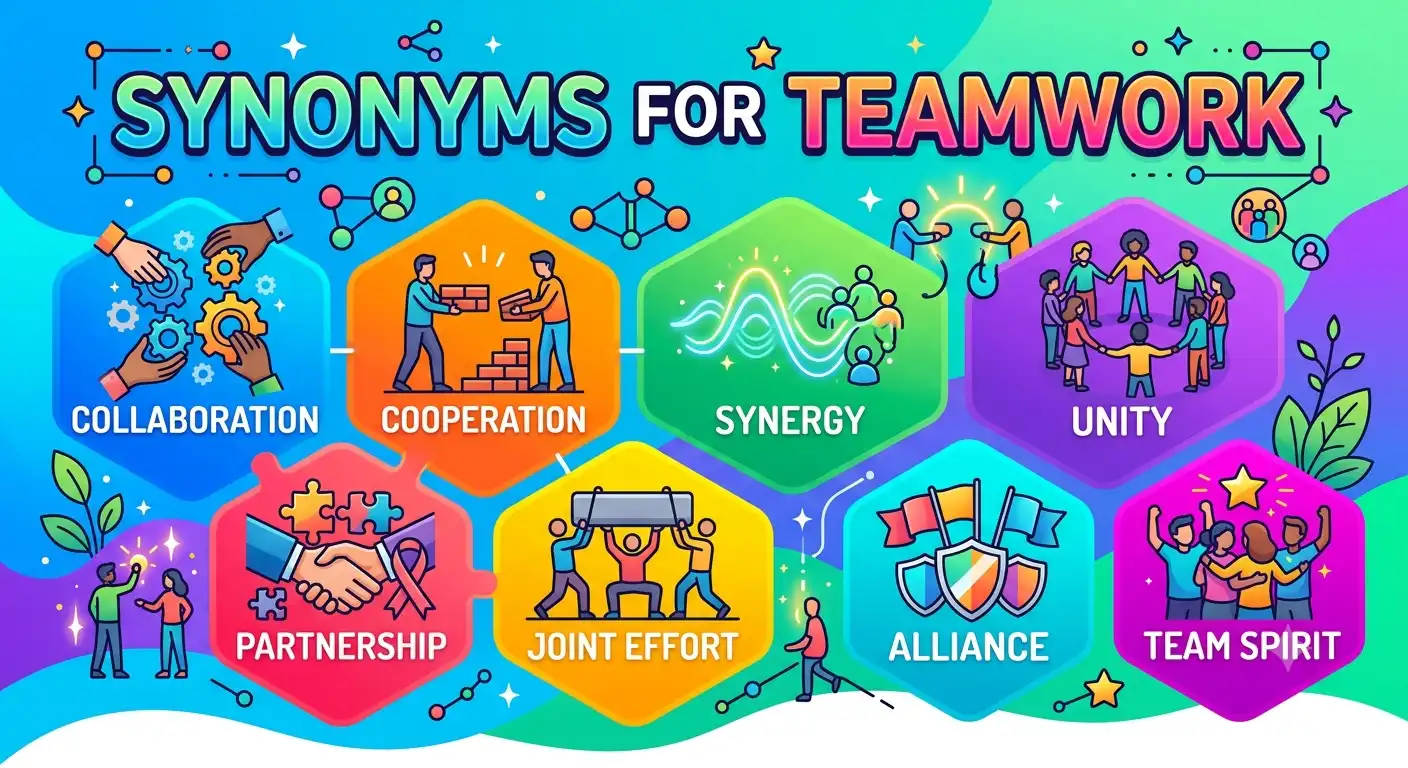
People achieve great things when they work together. Knowing synonyms for teamwork helps you describe these joint efforts. Finding the best synonyms for teamwork makes your writing strong and clear. If you use different synonyms for teamwork, your resumes and essays will look very professional.
Imagine a student named Leo who is writing a resume. He helped his school team build a small robot. Leo wants to show his group skills, but he writes the word “teamwork” five times on his one-page resume. His writing feels boring and repetitive. This guide helps you avoid that problem. It gives you fresh choices to describe group work.
In simple English, synonyms for teamwork are other words that mean working together as a group. Instead of saying the same word many times, you can use words like collaboration, synergy, or partnership.
This guide is very useful for four main groups:
- Students: Use these terms to write top essays and build strong college resumes.
- Bloggers: Keep your readers happy with simple, engaging, and clear terms.
- Content Writers: Write great articles that rank high on Google search.
- Daily English Users: Speak with confidence when talking about group tasks at work.
“Great things are never done by one person, they are done by a team.”
“The right words help us build bridges and work better together.”
Linguistic Profile of the Focus Keyword
- Connotative Meaning: The warm feeling of trust, shared goals, and helping each other win.
- Etymology of the Core Word (Teamwork):
- Team: From the Old English word tēam, which means a family or a set of draft animals working together.
- Work: From the Old English word weorc, which means labor, action, or busy deed.
- The two words joined together in the early 20th century to describe group effort.
- Pronunciation (US & UK – IPA):
- US: /ˈtiːm.wɝːk/
- UK: /ˈtiːm.wɜːk/
- Syllables: team-work (2 syllables)
- Affixation Pattern: Compound word made of two base roots (team + work) with zero extra affixes.
Comparison Table
| Keyword | Meaning | Usage Type | Context |
|---|---|---|---|
| Collaboration | Working together to create or build something new. | Professional | Project planning, creative work. |
| Cooperation | Helping someone else with their plan or task. | Casual | Daily tasks, household chores. |
| Synergy | Group work that yields better results than working alone. | Professional | Business growth, tech teams. |
| Camaraderie | Close friendship and trust among team members. | Emotional | Sports teams, close office groups. |
| Alliance | An agreement where groups work for shared goals. | Formal | Business deals, international plans. |
| Joint Effort | A task that requires everyone to help. | Casual | Community cleanups, school tasks. |
50 Synonyms for Teamwork
1. Collaboration
- Pronunciation: US /kəˌlæb.əˈreɪ.ʃən/ & UK /kəˌlæb.əˈreɪ.ʃən/
- Meaning: People working together to make or build something.
- Examples:
- Our team worked in close collaboration to finish the app.
- The school project was a great collaboration between three classes.
2. Cooperation
- Pronunciation: US /koʊˌɑː.pəˈreɪ.ʃən/ & UK /kəʊˌɒp.ərˈeɪ.ʃən/
- Meaning: The act of helping others to reach a common goal.
- Examples:
- We need your cooperation to keep the school clean.
- The work went fast because of excellent cooperation among us.
3. Partnership
- Pronunciation: US /ˈpɑːrt.nɚ.ʃɪp/ & UK /ˈpɑːt.nə.ʃɪp/
- Meaning: Two or more people working as close mates.
- Examples:
- Our partnership helped us win the science contest.
- They formed a great business partnership to sell books.
4. Synergy
- Pronunciation: US /ˈsɪn.ɚ.dʒi/ & UK /ˈsɪn.ə.dʒi/
- Meaning: Working together to get a much better result.
- Examples:
- The synergy between our design and tech teams was amazing.
- We created great synergy by combining our ideas.
5. Alliance
- Pronunciation: US /əˈlaɪ.əns/ & UK /əˈlaɪ.əns/
- Meaning: A formal union of groups for a good reason.
- Examples:
- The two schools formed an alliance to share resources.
- Our library alliance helps kids get free books.
6. Coordination
- Pronunciation: US /koʊˌɔːr.dənˈeɪ.ʃən/ & UK /kəʊˌɔː.dɪˈneɪ.ʃən/
- Meaning: Organizing different parts so they work well together.
- Examples:
- Good coordination kept the dance team in step.
- The project failed because we had poor coordination.
7. Unity
- Pronunciation: US /ˈjuː.nə.t̬i/ & UK /ˈjuː.nə.ti/
- Meaning: The state of being joined together as one.
- Examples:
- The game showed the true unity of our team.
- We must work in unity to solve this issue.
8. Joint Effort
- Pronunciation: US /dʒɔɪnt ˈef.ɚt/ & UK /dʒɔɪnt ˈef.ət/
- Meaning: A job done by two or more people together.
- Examples:
- Building the community playground was a joint effort.
- The report succeeded because of a joint effort.
9. Camaraderie
- Pronunciation: US /ˌkɑː.məˈrɑː.dɚ.i/ & UK /ˌkæm.əˈrɑː.dər.i/
- Meaning: Trust and friendship among people in a group.
- Examples:
- I love the warm camaraderie of our soccer team.
- High office camaraderie makes work fun every day.
10. Cohesion
- Pronunciation: US /koʊˈhiː.ʒən/ & UK /kəʊˈhiː.ʒən/
- Meaning: The act of sticking together as a tight group.
- Examples:
- Good communication builds strong team cohesion.
- Our group lacks the cohesion needed to win.
11. Team Spirit
- Pronunciation: US /tiːm ˈspɪr.ɪt/ & UK /tiːm ˈspɪr.ɪt/
- Meaning: Feeling happy and proud to work with your group.
- Examples:
- The players showed amazing team spirit after the loss.
- We wear matching shirts to boost our team spirit.
12. Esprit de Corps
- Pronunciation: US /esˌpriː də ˈkɔːr/ & UK /esˌpriː də ˈkɔː/
- Meaning: A proud feeling of devotion shared by a group.
- Examples:
- The soldiers had a strong sense of esprit de corps.
- Our club has a bright and happy esprit de corps.
13. Fellowship
- Pronunciation: US /ˈfel.oʊ.ʃɪp/ & UK /ˈfel.əʊ.ʃɪp/
- Meaning: Friendly feelings shared by people with similar interests.
- Examples:
- We enjoyed a sweet fellowship at the club dinner.
- The church group promotes fellowship among neighbors.
14. Union
- Pronunciation: US /ˈjuː.njən/ & UK /ˈjuː.njən/
- Meaning: The act of joining two or more things together.
- Examples:
- The union of our two offices made work easier.
- They work in perfect union to help the poor.
15. Association
- Pronunciation: US /əˌsoʊ.siˈeɪ.ʃən/ & UK /əˌsəʊ.siˈeɪ.ʃən/
- Meaning: A group of people organized for a shared purpose.
- Examples:
- She joined the parent-teacher association to help schools.
- Our neighborhood association hosts a fun run every year.
16. Coalition
- Pronunciation: US /koʊ.əˈlɪʃ.ən/ & UK /kəʊ.əˈlɪʃ.ən/
- Meaning: A temporary group formed to complete a specific task.
- Examples:
- The green coalition works to plant more city trees.
- They built a coalition to fight for lower taxes.
17. Solidarity
- Pronunciation: US /ˌsɑː.lɪˈdær.ə.t̬i/ & UK /ˌsɒl.ɪˈdær.ə.ti/
- Meaning: Agreement and support among members of a group.
- Examples:
- The workers showed solidarity during the strike.
- We stand in solidarity with our local farmers.
18. Combined Effort
- Pronunciation: US /kəmˈbaɪnd ˈef.ɚt/ & UK /kəmˈbaɪnd ˈef.ət/
- Meaning: Work done by mixing everyone’s strength together.
- Examples:
- Winning the match took a great combined effort.
- The garden grew well due to our combined effort.
19. Concert
- Pronunciation: US /ˈkɑːn.sɚt/ & UK /ˈkɒn.sət/
- Meaning: Working together in complete agreement and rhythm.
- Examples:
- The departments acted in concert to launch the product.
- We must plan in concert to avoid any errors.
20. Harmony
- Pronunciation: US /ˈhɑːr.mə.ni/ & UK /ˈhɑː.mə.ni/
- Meaning: A state of peaceful agreement and cooperation.
- Examples:
- Our staff works in perfect harmony every single day.
- We need more harmony to get this project done.
21. Interplay
- Pronunciation: US /ˈɪn.t̬ɚ.pleɪ/ & UK /ˈɪn.tə.pleɪ/
- Meaning: The way two or more things affect each other.
- Examples:
- I love the active interplay between the two actors.
- The success came from the interplay of youth and skill.
22. Coaction
- Pronunciation: US /koʊˈæk.ʃən/ & UK /kəʊˈæk.ʃən/
- Meaning: Actions done by working together as a team.
- Examples:
- Their constant coaction helped them solve the riddle.
- We need daily coaction to keep the project moving.
23. Alignment
- Pronunciation: US /əˈlaɪn.mənt/ & UK /əˈlaɪn.mənt/
- Meaning: Agreement between different people or group goals.
- Examples:
- The team alignment kept us focused on the main task.
- Our goals are in perfect alignment with your plans.
24. Mutual Assistance
- Pronunciation: US /ˈmjuː.tʃu.əl əˈsɪs.təns/ & UK /ˈmjuː.tʃu.əl əˈsɪs.təns/
- Meaning: Helping each other out when someone needs it.
- Examples:
- The two countries signed a mutual assistance pact.
- We practiced mutual assistance to clean the messy yard.
“When we share the load, the path to success becomes short and easy.”
25. Joint Action
- Pronunciation: US /dʒɔɪnt ˈæk.ʃən/ & UK /dʒɔɪnt ˈæk.ʃən/
- Meaning: Something that a group does together to get results.
- Examples:
- Our joint action stopped the park from closing down.
- The police took joint action to help secure the road.
26. Collective Action
- Pronunciation: US /kəˈlek.tɪv ˈæk.ʃən/ & UK /kəˈlek.tɪv ˈæk.ʃən/
- Meaning: Action taken by a group of people to improve things.
- Examples:
- Collective action helped the workers get better hours.
- We need collective action to clean up the ocean beaches.
27. Collaborative Effort
- Pronunciation: US /kəˈlæb.rə.t̬ɪv ˈef.ɚt/ & UK /kəˈlæb.ər.ə.tɪv ˈef.ət/
- Meaning: A push made by many people working as a team.
- Examples:
- The art piece was a beautiful collaborative effort.
- Writing this big guide took a collaborative effort.
28. Team-Playing
- Pronunciation: US /ˈtiːmˌpleɪ.ɪŋ/ & UK /ˈtiːmˌpleɪ.ɪŋ/
- Meaning: Behaving as a helpful member of a working team.
- Examples:
- His team-playing skills made him the best hire.
- She teaches team-playing to young kids in camp.
29. Teaming Up
- Pronunciation: US /ˈtiːm.ɪŋ ʌp/ & UK /ˈtiːm.ɪŋ ʌp/
- Meaning: Joining with another person to do a task.
- Examples:
- Teaming up with my friend made the work simple.
- We are teaming up to build a new website.
30. Peer Support
- Pronunciation: US /pɪr səˈpɔːrt/ & UK /pɪə səˈpɔːt/
- Meaning: Help that comes from people in your same group.
- Examples:
- The school offers peer support for new young students.
- I survived the hard class thanks to peer support.
31. Group Effort
- Pronunciation: US /ɡruːp ˈef.ɚt/ & UK /ɡruːp ˈef.ət/
- Meaning: A task that needs the whole group to help.
- Examples:
- Cleaning the big room was a total group effort.
- Our success was a group effort from start to end.
32. Shared Work
- Pronunciation: US /ʃerd wɝːk/ & UK /ʃeəd wɜːk/
- Meaning: Labor that is split evenly among the team members.
- Examples:
- Shared work makes the hard chores go very fast.
- We believe in shared work to avoid stress.
33. Co-Partnership
- Pronunciation: US /koʊ ˈpɑːrt.nɚ.ʃɪp/ & UK /kəʊ ˈpɑːt.nə.ʃɪp/
- Meaning: A joint state of sharing a business or project.
- Examples:
- The co-partnership helped them open three new shops.
- Our co-partnership is built on deep personal trust.
34. Community Spirit
- Pronunciation: US /kəˈmjuː.nə.t̬i ˈspɪr.ɪt/ & UK /kəˈmjuː.nə.ti ˈspɪr.ɪt/
- Meaning: Friendly pride and desire to help your neighborhood.
- Examples:
- The town bake sale showed great community spirit.
- We need community spirit to fix the local park.
35. Sync
- Pronunciation: US /sɪŋk/ & UK /sɪŋk/
- Meaning: Working together at the exact same speed and time.
- Examples:
- Our sales and marketing teams must stay in sync.
- We need to sync our calendars to meet tomorrow.
36. Integration
- Pronunciation: US /ˌɪn.t̬əˈɡreɪ.ʃən/ & UK /ˌɪn.tɪˈɡreɪ.ʃən/
- Meaning: Combining different parts to make a complete whole.
- Examples:
- The integration of the two schools went very well.
- We need smooth integration of our computer programs.
37. Combined Work
- Pronunciation: US /kəmˈbaɪnd wɝːk/ & UK /kəmˈbaɪnd wɜːk/
- Meaning: Tasks that are put together into one big project.
- Examples:
- Our combined work produced a beautiful school book.
- The display is the combined work of five artists.
38. Shared Labor
- Pronunciation: US /ʃerd ˈleɪ.bɚ/ & UK /ʃeəd ˈleɪ.bə/
- Meaning: Splitting up physical or mental work among friends.
- Examples:
- Farming was easy due to the rule of shared labor.
- We practice shared labor to build the new shed.
39. Concord
- Pronunciation: US /ˈkɑːn.kɔːrd/ & UK /ˈkɒn.kɔːd/
- Meaning: Agreement and peace between different groups of people.
- Examples:
- The nations signed a treaty to live in perfect concord.
- Our team works in concord to avoid silly fights.
40. Mutual Aid
- Pronunciation: US /ˈmjuː.tʃu.əl eɪd/ & UK /ˈmjuː.tʃu.əl eɪd/
- Meaning: People in a group helping each other with food or work.
- Examples:
- The neighbors started a mutual aid fund for food.
- We relied on mutual aid after the heavy storm.
41. Co-Labor
- Pronunciation: US /koʊ ˈleɪ.bɚ/ & UK /kəʊ ˈleɪ.bə/
- Meaning: Working right alongside another person to finish a task.
- Examples:
- My friend and I co-labor in the community garden.
- They co-labor to write high quality school guides.
42. Cooperative Play
- Pronunciation: US /koʊˈɑː.pə.rə.t̬ɪv pleɪ/ & UK /kəʊˈɒp.ər.ə.tɪv pleɪ/
- Meaning: Playing a game where everyone works to win together.
- Examples:
- The kids learned cooperative play in soccer class.
- I prefer cooperative play games over fighting games.
43. Allied Effort
- Pronunciation: US /ˈælaɪd ˈef.ɚt/ & UK /ˈælaɪd ˈef.ət/
- Meaning: A push made by two separate friendly groups.
- Examples:
- The event was an allied effort of two charity clubs.
- We made an allied effort to plant fresh flowers.
44. Joint Venture
- Pronunciation: US /dʒɔɪnt ˈven.tʃɚ/ & UK /dʒɔɪnt ˈven.tʃə/
- Meaning: A business project set up by two working teams.
- Examples:
- The tech firms started a joint venture in Japan.
- Our joint venture helped us build a faster car.
45. Mass Action
- Pronunciation: US /mæs ˈæk.ʃən/ & UK /mæs ˈæk.ʃən/
- Meaning: A very large group of people working together at once.
- Examples:
- Mass action was needed to clean the dirty lake.
- The citizens took mass action to plant new trees.
46. Unified Front
- Pronunciation: US /ˈjuː.nə.faɪd frʌnt/ & UK /ˈjuː.nə.faɪd frʌnt/
- Meaning: Presenting ourselves as one strong group to others.
- Examples:
- The teachers showed a unified front to the board.
- We must maintain a unified front to win the deal.
47. Consensus
- Pronunciation: US /kənˈsen.səs/ & UK /kənˈsen.səs/
- Meaning: An agreement that everyone in the group accepts.
- Examples:
- The committee reached a consensus on the new rules.
- We need a clear consensus before we spend money.
48. Co-Working
- Pronunciation: US /koʊ ˈwɝː.kɪŋ/ & UK /kəʊ ˈwɜː.kɪŋ/
- Meaning: Sharing an office space with other creative workers.
- Examples:
- I enjoy the social vibe of our local co-working space.
- Co-working helps me meet other young writers.
49. Collective Power
- Pronunciation: US /kəˈlek.tɪv ˈpaʊ.ɚ/ & UK /kəˈlek.tɪv ˈpaʊ.ə/
- Meaning: The total strength a group has when working together.
- Examples:
- We used our collective power to change the school policy.
- The team had the collective power to win the cup.
50. Joint Force
- Pronunciation: US /dʒɔɪnt fɔːrs/ & UK /dʒɔɪnt fɔːs/
- Meaning: Two or more groups merging to complete a job.
- Examples:
- The police and fire crews became a joint force.
- We created a joint force to fight local trash.
Antonyms of the Focus Keyword (Teamwork)
- Rivalry: A situation where people compete to prove who is best.
- Individualism: Doing things on your own without group help.
- Isolation: Being completely separate from others while you work.
- Conflict: Fighting or disagreeing with your team members.
- Division: Splitting a group into smaller, angry parts.
Prototype Meaning and Categorization
- Domain: Professional Writing, Resume Building, Group Dynamics.
- Semantic Category: Social cooperation, unified human actions, joint efforts.
- Grammatical Category: Noun phrase (often used as an action descriptor in writing).
Frequently Asked Questions
1. Can I use “synergy” on a professional resume?
Yes. “Synergy” is a great word for a business resume. It shows that you know how to combine efforts to get big results.
2. What is the main difference between cooperation and collaboration?
Cooperation means helping someone finish their task. Collaboration means working together to build a brand new idea from scratch.
3. Is “esprit de corps” too fancy for a daily email?
Yes. “Esprit de corps” is a bit formal. It is better to use “team spirit” or “cohesion” in your regular emails.
4. Can I use “team-playing” in my college essay?
Yes. “Team-playing” is a natural term. It shows that you value the thoughts and support of your classmates.
5. Why should I stop repeating “teamwork” in my writing?
Repeating the same word makes your writing look lazy. Using different words keeps your reader interested.
6. What is a good casual synonym for teamwork?
“Teaming up” or “group effort” are perfect casual words. They sound friendly and work well in daily chats.
Conclusion
Learning fresh synonyms for teamwork is a great way to boost your writing and speaking power. When you know more words, your daily communication becomes much brighter. You will not have to repeat the same basic words on your job resume. Instead, you can pick the exact term that fits your goal. For instance, you can use “collaboration” when writing a formal cover letter. You can use “camaraderie” when talking about your favorite sports team. This keeps your writing exciting and very easy to read.
We want you to start practicing these terms today. Try to use one in your next email to a coworker. You can also slip one into your next school essay or use it during a chat with a friend. The more you practice, the more natural they will sound. Your voice is very powerful. A rich vocabulary makes your voice even stronger. Take this simple step to grow your skills today!
“Alone we can do so little, together we can do so much.”
“Words build teams, and great teams change the world.”

Thomas Walker is a professional English consultant and content strategist with over eleven years of experience working with technology companies, business writers, and content teams who need precise, modern vocabulary guidance (Biography).