You’ve written a scene where your character is lost, overwhelmed, or mentally scattered—but something feels off. The emotion isn’t landing. The confusion doesn’t feel real. That’s where choosing the right words becomes critical.
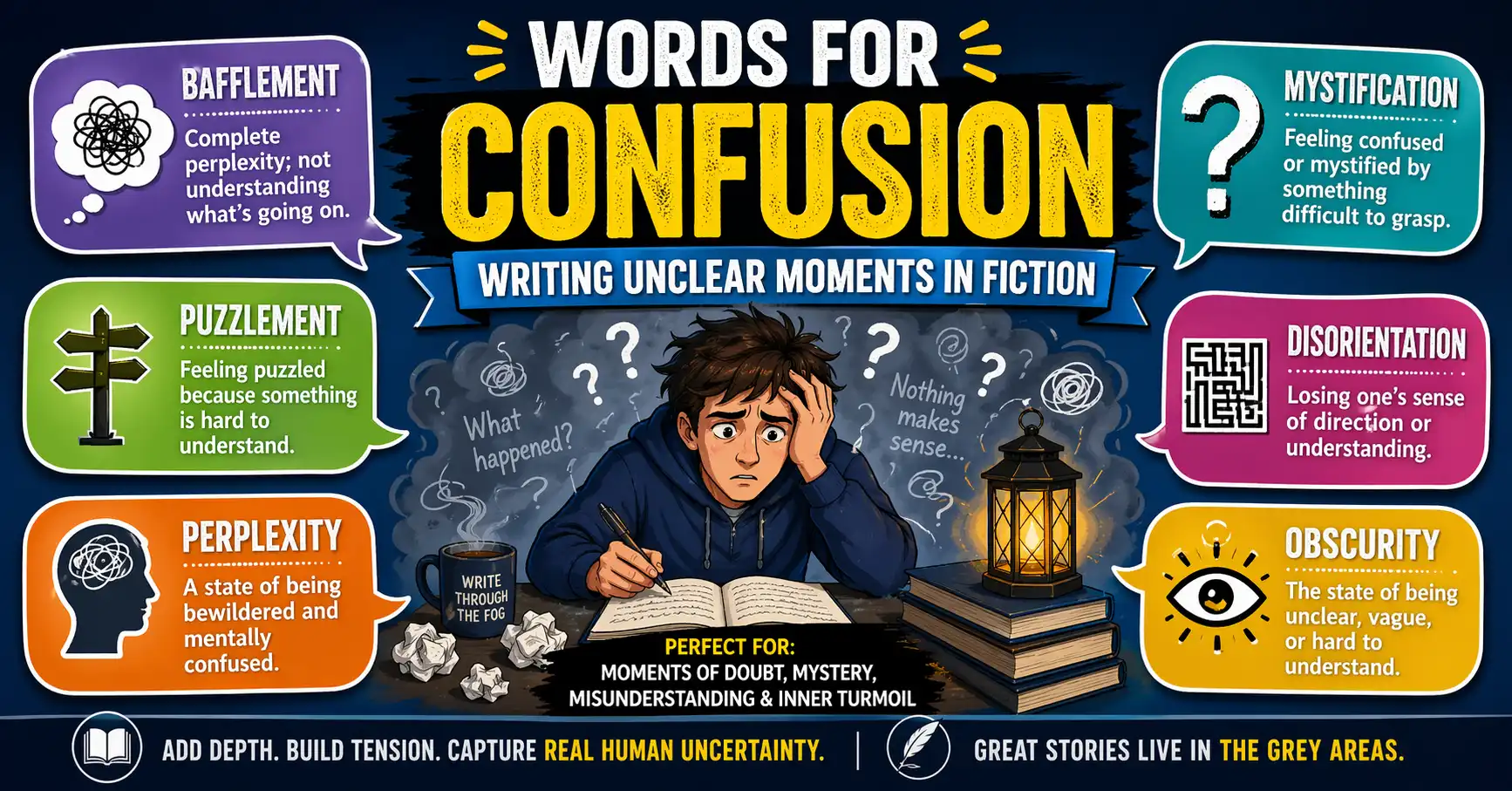
In this guide on words for confusion writing unclear moments in fiction, you’ll learn how to express disorientation, doubt, and mental fog with precision. Whether you’re crafting suspense, emotional conflict, or psychological depth, the vocabulary you use shapes how readers experience uncertainty.
As a professional writing consultant, I’ve worked with countless writers who struggle with vague or repetitive wording. You don’t need more words—you need better ones. This article will give you a complete synonym list, usage tips, and real examples so your scenes feel vivid, not muddled.
Quick Answer:
The best words for confusion in fiction include terms like bewildered, disoriented, perplexed, dazed, and baffled. These words help you show unclear moments with emotional depth and clarity. Choose based on intensity, tone, and context—formal terms suit narration, while informal ones fit dialogue or internal thoughts.
What does “confusion” mean?
In fiction, confusion refers to a mental state where a character cannot clearly understand what is happening. It may involve:
- Lack of clarity
- Emotional overwhelm
- Misinterpretation of events
- Cognitive overload
In professional writing terms, confusion is not just “not understanding.” It is a narrative tool. It builds tension, reveals character vulnerability, and drives plot progression.
According to writing standards, especially in narrative technique, confusion must be intentional and controlled. Random vagueness weakens storytelling, while structured confusion engages readers.
Complete Synonyms List
Here are powerful alternatives you can use instead of repeating “confusion”:
- Bewilderment
- Perplexity
- Disorientation
- Bafflement
- Daze
- Fog
- Uncertainty
- Doubt
- Muddle
- Puzzle
- Chaos (mental)
- Disarray (internal state)
- Cognitive overload
- Hesitation
- Indecision
Professional Use:
In business storytelling or case studies, terms like uncertainty and cognitive overload are more appropriate than emotional words like daze.
Comparison Table
| Word | Simple Meaning | Best Used When | Avoid When |
| Bewildered | Completely confused | Sudden shock scenes | Mild confusion |
| Perplexed | Deeply puzzled | Analytical characters | Fast-paced action |
| Disoriented | Lost sense of direction | Physical or mental confusion | Simple misunderstandings |
| Baffled | Unable to understand | Dialogue or reactions | Formal narration |
| Dazed | Mentally stunned | Trauma or impact scenes | Logical confusion |
| Uncertain | Not sure | Professional or internal monologue | High emotional intensity |
| Muddled | Mixed up thoughts | Casual tone | Formal writing |
| Foggy | Unclear thinking | Introspection | Technical narration |
Formal vs Informal Synonyms
| Formal Words | Informal Words |
| Perplexed | Mixed up |
| Disoriented | Lost |
| Uncertain | Not sure |
| Cognitive overload | Brain fog |
| Ambiguous | Vague |
| Indecisive | Can’t decide |
Professional Insight:
In workplace or tech-related storytelling, formal synonyms maintain credibility. Informal ones work better in character dialogue.
Real Example Sentences
Here are practical ways to use these words:
- She stood there, completely bewildered, unable to process what she had just heard.
- His mind felt foggy, as if every thought was slipping away.
- The sudden noise left him dazed and slow to react.
- She grew perplexed by the conflicting instructions.
- He felt disoriented, unsure of where he was or how he got there.
- The situation became a muddle of half-truths and assumptions.
- Her expression showed clear uncertainty during the meeting.
- He was baffled by the unexpected outcome.
Writer’s Tip:
Instead of saying “he was confused,” show it through behavior: hesitation, silence, or repeated questions.
When to Use vs When NOT to Use
When to Use:
Use confusion-related words when:
- Your character faces unexpected events
- You want to slow pacing and build tension
- The plot requires uncertainty or mystery
- Emotional realism is important
When NOT to Use:
Avoid overusing confusion words when:
- The reader already understands the situation clearly
- It disrupts pacing in action scenes
- You repeat the same word multiple times
- It becomes a substitute for weak storytelling
In our experience helping writers, overusing “confused” reduces impact. Precision matters more than frequency.
Common Mistakes Writers Make
- Repeating the same word
Using “confused” multiple times weakens writing. - Using vague descriptions
Saying “he felt weird” doesn’t create clarity. - Ignoring context
“Dazed” implies shock, not logical confusion. - Mixing tones
Formal narration with slang terms feels inconsistent. - Over-explaining
Let actions show confusion instead of long explanations.
Tips and Best Practices
1. Match the word to the situation
Different types of confusion require different words.
2. Show, don’t tell
Instead of naming confusion, describe:
- Pauses
- Body language
- Contradictions
3. Use variety carefully
Synonyms should fit tone—not just avoid repetition.
4. Control pacing
Confusion slows scenes. Use it intentionally.
5. Align with character voice
A scientist will say “uncertain.” A teenager might say “lost.”
Professional Use:
In corporate storytelling, confusion often reflects decision-making pressure. Words like uncertainty and ambiguity are preferred.
Frequently Asked Questions
Q1: What are the best words to describe confusion in fiction?
A: The best words include bewildered, perplexed, disoriented, baffled, and dazed. Each carries a slightly different tone. Choose based on intensity and context to ensure your writing feels precise and natural rather than repetitive.
Q2: How do I show confusion without using the word “confused”?
A: Use actions and reactions. Show hesitation, repeated questions, or silence. Describe body language like frowning or looking around. This approach follows narrative best practices and creates stronger emotional engagement for readers.
Q3: Is “confusion” good for professional or business writing?
A: In professional contexts, words like uncertainty, ambiguity, and lack of clarity are more appropriate. They sound more precise and align with formal communication standards used in reports and workplace narratives.
Q4: What is the difference between “perplexed” and “bewildered”?
A: Perplexed suggests thoughtful confusion, often intellectual. Bewildered is stronger and emotional, usually caused by sudden or overwhelming situations. Choosing correctly helps refine tone and character depth.
Q5: Can too much confusion harm a story?
A: Yes. Excessive confusion frustrates readers. According to narrative structure principles, confusion should create tension—not block understanding. Always give readers enough context to stay engaged.
Q6: Which synonym works best in dialogue?
A: Informal words like lost, mixed up, or not sure work best in dialogue. They sound natural and reflect how people actually speak, making characters feel more realistic.
Q7: How does confusion affect pacing in fiction?
A: Confusion slows pacing because it forces reflection and uncertainty. This is useful in suspense or emotional scenes but should be avoided in fast action sequences where clarity is essential.
Q8: Are there technical terms for confusion in writing?
A: Yes. Terms like cognitive overload, ambiguity, and uncertainty are often used in professional or technical writing. These provide more precise meanings, especially in business or analytical contexts.
Conclusion
Mastering words for confusion writing unclear moments in fiction helps you turn vague scenes into powerful storytelling moments. By choosing precise synonyms, showing instead of telling, and matching tone to context, you create deeper emotional impact.
Writers we work with often improve dramatically just by replacing generic words with targeted vocabulary. It’s a small change with big results.
You might also want to read our guide on descriptive words for emotions to strengthen your character writing even further. Keep practicing—your clarity will grow with every sentence you write.

Thomas Walker is a professional English consultant and content strategist with over eleven years of experience working with technology companies, business writers, and content teams who need precise, modern vocabulary guidance (Biography).