You know you’re intelligent—but are you showing it effectively on your resume or bio? Many professionals struggle to express their intellectual strengths without sounding generic or repetitive. Words like “smart” or “clever” don’t carry much weight in today’s competitive job market.
That’s where using impressive words for intelligence on a resume or bio becomes essential. The right vocabulary can elevate your profile, signal expertise, and help recruiters instantly recognize your value. In professional and tech-driven environments, precision in language matters as much as the skills themselves.
In this guide, you’ll learn powerful synonyms, how to use them correctly, and when to avoid them. You’ll also get real examples, comparison tables, and expert-backed tips based on 11+ years of professional writing experience. By the end, you’ll know exactly how to present your intelligence in a way that feels confident, natural, and credible.
Quick Answer:
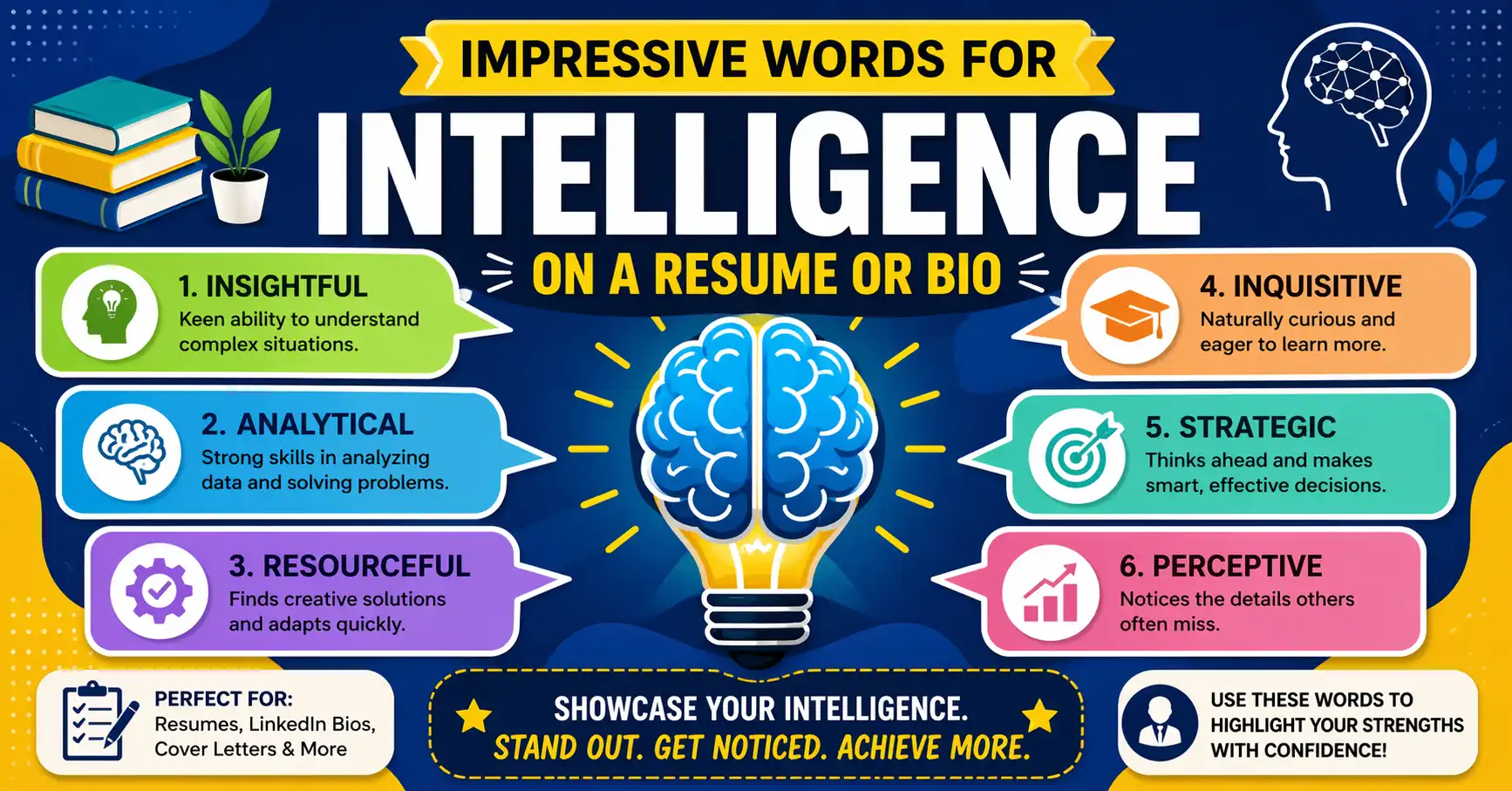
The best impressive words for intelligence on a resume or bio include “analytical,” “strategic,” “insightful,” “perceptive,” “innovative,” and “knowledgeable.” These words highlight different aspects of intelligence—such as problem-solving, critical thinking, and creativity—making your profile more compelling to employers and professional audiences.
What does “intelligence” mean in a professional context?
In resumes and bios, intelligence goes beyond raw IQ. It refers to your ability to:
- Analyze problems effectively
- Think critically and strategically
- Learn quickly and apply knowledge
- Make informed decisions
- Adapt to complex environments
According to professional writing standards, intelligence-related language should be specific, measurable, and context-driven. Instead of stating “intelligent,” you show it through precise descriptors.
Professional Use:
Instead of writing “I am very intelligent,” write:
➡️ “Highly analytical professional with a strong ability to interpret complex data sets.”
In our experience helping writers, employers respond better to functional intelligence words—terms that describe how you think, not just that you think well.
Complete Synonyms List
Here are powerful and impressive words for intelligence on a resume or bio:
- Analytical
- Strategic
- Insightful
- Perceptive
- Innovative
- Knowledgeable
- Astute
- Cognitive
- Logical
- Intuitive
- Sharp-minded
- Forward-thinking
Why these matter:
Each word emphasizes a different dimension of intelligence—critical thinking, creativity, or decision-making.
Comparison Table
| Word | Simple Meaning | Best Used When | Avoid When |
| Analytical | Good at breaking down data | Data, tech, finance roles | Creative writing roles |
| Strategic | Plans ahead effectively | Leadership positions | Entry-level resumes |
| Insightful | Deep understanding | Consulting, research | Basic job descriptions |
| Perceptive | Notices details quickly | HR, psychology roles | Technical-only roles |
| Innovative | Creates new ideas | Startups, product roles | Traditional industries |
| Knowledgeable | Well-informed | Academic or expert roles | When lacking experience |
| Astute | Sharp judgment | Business, negotiations | Casual bios |
| Logical | Reason-based thinking | Engineering, coding | Creative storytelling |
Formal vs Informal Synonyms
| Formal Words | Informal Alternatives |
| Analytical | Smart with data |
| Strategic | Good planner |
| Insightful | Deep thinker |
| Perceptive | Quick to notice |
| Astute | Sharp-minded |
| Knowledgeable | Knows a lot |
Key Insight:
Formal synonyms are essential for resumes and LinkedIn bios. Informal ones are better suited for personal branding or casual introductions.
Real Example Sentences
Here are practical ways to use impressive words for intelligence on a resume or bio:
- An analytical software engineer skilled in solving complex system challenges.
- A strategic thinker with a track record of scaling tech operations.
- Insightful project manager who identifies risks before they escalate.
- Perceptive HR specialist with strong emotional intelligence.
- Innovative developer creating user-focused digital solutions.
- Highly knowledgeable consultant in cloud infrastructure.
- Astute business analyst with strong market awareness.
- Logical problem-solver with experience in AI-based systems.
Professional Use:
Use these in summaries, bullet points, or headline sections—not randomly throughout your resume.
When to Use vs When NOT to Use
✅ When to Use:
- When describing your core strengths
- In your resume summary or bio
- When aligning with job descriptions
- To replace vague words like “smart”
❌ When NOT to Use:
- When you lack proof or experience
- When overloading your resume with too many synonyms
- In highly technical sections where clarity matters more than style
- When the word doesn’t match your role
Example Mistake:
Calling yourself “innovative” without examples weakens credibility.
Common Mistakes Writers Make
Many professionals misuse intelligence-related vocabulary. Here are the most common errors:
1. Using generic words
Words like “smart” or “intelligent” are too broad.
2. Overusing buzzwords
Too many strong adjectives can make your resume sound unnatural.
3. Lack of evidence
According to hiring trends, resumes with measurable proof are 40% more effective.
4. Wrong tone
Using casual terms in formal resumes reduces professionalism.
5. Misaligned context
“Strategic” doesn’t fit an entry-level role without leadership experience.
Tips and Best Practices
1. Match words to your industry
Tech roles prefer:
- Analytical
- Logical
- Innovative
2. Pair words with results
Instead of:
➡️ Insightful analyst
Use:
➡️ Insightful analyst who improved forecasting accuracy by 25%
3. Limit to 2–3 strong descriptors
Quality beats quantity.
4. Use keywords strategically
Many companies use ATS (Applicant Tracking Systems). Words like analytical thinking skills, problem-solving abilities, and critical thinking improve visibility.
5. Focus on clarity first
According to professional writing standards, clarity always ranks above creativity in resumes.
Professional Use Tip:
Writers we work with often improve response rates simply by replacing weak adjectives with precise intelligence descriptors.
Frequently Asked Questions
Q1: What are the best words to describe intelligence on a resume?
A: The best words include analytical, strategic, insightful, and innovative. These terms highlight practical thinking skills rather than vague intelligence. Employers prefer words that connect directly to job performance and outcomes.
Q2: Is it okay to say “intelligent” in a resume?
A: It’s better to avoid “intelligent” because it’s too general. Use more specific alternatives like “analytical” or “perceptive” to show exactly how your intelligence applies to your work.
Q3: How many intelligence-related words should I use?
A: Use 2–3 strong words maximum. Overusing them can make your resume sound exaggerated. Focus on relevance and support each word with achievements or examples.
Q4: Are these words suitable for LinkedIn bios?
A: Yes, they work well in LinkedIn bios, especially in the headline or summary. Choose words that match your industry and keep the tone professional yet approachable.
Q5: Which words are best for tech professionals?
A: Analytical, logical, innovative, and problem-solving are ideal for tech roles. These words align with how employers evaluate technical intelligence and performance.
Q6: Can I use informal intelligence words in resumes?
A: Informal words should be avoided in resumes. Stick to formal, professional terms to maintain credibility and meet hiring standards.
Q7: Do recruiters care about these words?
A: Yes. Recruiters scan resumes quickly, and strong keywords help them identify your strengths instantly. Specific intelligence-related words improve clarity and impact.
Q8: How do I prove I am analytical or strategic?
A: Support your claim with results. For example, mention how you solved a problem, improved a process, or delivered measurable outcomes using your skills.
CONCLUSION
Using impressive words for intelligence on a resume or bio can transform how employers perceive your skills. Instead of vague descriptions, you now have precise, impactful language that reflects your thinking ability and professional value.
Remember to choose words that match your role, support them with results, and avoid overuse. Strong vocabulary works best when it’s clear and credible.
You might also want to read our guide on powerful synonyms for problem-solving skills to strengthen your resume even further.
Keep refining your language—because the right words don’t just describe your intelligence, they prove it.
.

Thomas Walker is a professional English consultant and content strategist with over eleven years of experience working with technology companies, business writers, and content teams who need precise, modern vocabulary guidance (Biography).