
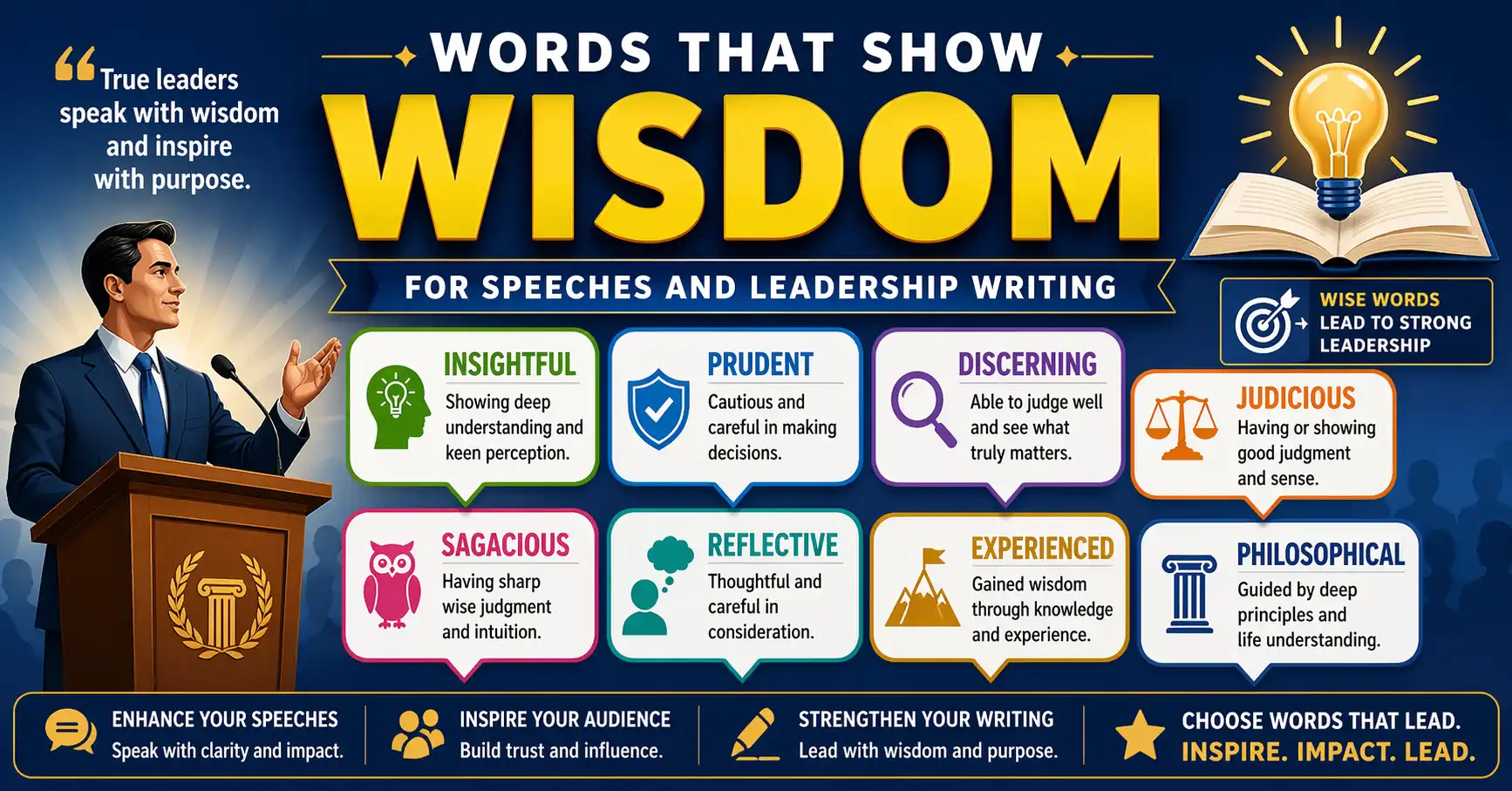
Have you ever stood in front of a crowd and wanted to sound truly inspiring? It can be hard to find the right words to make people stop and listen. For example, imagine a leader who speaks calmly and makes everyone feel safe during a storm. To do this, we need words that show wisdom for speeches and leadership writing. These are special words that show you think deeply and care about others. Learning words that show wisdom for speeches and leadership writing is useful for everyone. Students can write better essays. Bloggers can gain more trust. Content writers can make their articles stand out. Daily English users can speak with more confidence. Let us look at fifty amazing words that show wisdom for speeches and leadership writing to help you lead!
1. Wise
Meaning: Having or showing good judgment and deep knowledge.
Examples:
- The old teacher gave me some wise advice about my future.
- It is wise to save your money for a rainy day.
2. Sage
Meaning: Very wise, especially because you have lived a long time and seen a lot.
Examples:
- She listened to the sage words of her grandmother.
- His sage advice helped the team win the big game.
3. Vision
Meaning: The ability to think about and plan for the future with great imagination.
Examples:
- The new president had a clear vision for our town.
- She wrote down her vision to keep her team focused.
4. Insight
Meaning: A deep and clear understanding of a complicated problem or situation.
Examples:
- His book gives a wonderful insight into how animals live.
- She shared a helpful insight during our morning meeting.
5. Clarity
Meaning: The quality of being easy to see, hear, or understand.
Examples:
- He spoke with great clarity so everyone could follow along.
- We need more clarity before we start this big project.
6. Patience
Meaning: The ability to stay calm when things are difficult or take a long time.
Examples:
- It takes a lot of patience to teach young children.
- He waited with quiet patience for his turn to speak.
7. Humility
Meaning: The quality of not thinking you are better than other people.
Examples:
- The great leader showed deep humility by listening to everyone.
- She accepted the big award with grace and humility.
8. Integrity
Meaning: The quality of being honest and having strong moral principles.
Examples:
- He is a man of great integrity who always tells the truth.
- We must run our business with complete integrity.
9. Balance
Meaning: A state where different things are equal and work well together.
Examples:
- She tried to find a healthy balance between work and play.
- A good leader keeps a cool balance during hard times.
10. Foresight
Meaning: The ability to judge what will happen or be needed in the future.
Examples:
- He had the foresight to bring an umbrella on a cloudy day.
- Her career success was due to her amazing foresight.
11. Guidance
Meaning: Help or advice given to someone to point them in the right direction.
Examples:
- We looked to our coach for guidance before the final match.
- The school counselor provides excellent guidance for students.
12. Reason
Meaning: The power of the mind to think, understand, and form opinions logically.
Examples:
- He used calm reason to solve the argument between his friends.
- There is a clear reason for every rule in this house.
13. Truth
Meaning: The real facts about a situation instead of lies or guesses.
Examples:
- It is always best to tell the honest truth.
- She searched for the truth in the old history books.
14. Depth
Meaning: The quality of having a lot of serious thought, feeling, or meaning.
Examples:
- His short poem had a surprising amount of depth.
- They had a conversation of great depth about their dreams.
15. Growth
Meaning: The process of developing, improving, and becoming stronger over time.
Examples:
- Reading books is a great way to help your personal growth.
- The small company showed steady growth over the last year.
16. Calm
Meaning: A peaceful state of mind with no worry, anger, or excitement.
Examples:
- She kept a calm face even when the room got noisy.
- His calm voice made the frightened child feel safe.
17. Steady
Meaning: Happening or developing in a smooth, sure, and regular way.
Examples:
- He held the ladder with a steady hand so I could climb.
- We made steady progress on our group project today.
18. Kind
Meaning: Caring about others and wanting to help them feel happy.
Examples:
- She gave the lost traveler a very kind smile.
- It is important to be kind to everyone you meet.
19. Honest
Meaning: Good and truthful because you do not tell lies or steal.
Examples:
- Give me your honest opinion about my new drawing.
- He is an honest boy who returned the lost wallet.
20. Fair
Meaning: Treating everyone in equal and right ways according to the rules.
Examples:
- The referee made a fair decision at the end of the game.
- We want a fair chance to show what we can do.
21. Just
Meaning: Morally right, fair, and based on what is true.
Examples:
- The judge wanted to make a just decision for the family.
- They fought for a just cause to help poor people.
22. Bold
Meaning: Brave and confident because you are not afraid of danger or ideas.
Examples:
- The young leader made a bold move to change the rules.
- She gave a bold speech about protecting the forest.
23. Gentle
Meaning: Calm, kind, and doing things softly without any force.
Examples:
- He gave the little puppy a gentle pat on the head.
- Her gentle words comforted me when I was feeling down.
24. Open
Meaning: Willing to listen to new ideas and different opinions.
Examples:
- A good manager always keeps an open mind.
- We had an open talk about how to fix our mistakes.
25. Sincere
Meaning: Honest and real because you truly mean what you say.
Examples:
- She offered a sincere apology for being late to class.
- His letter was filled with sincere thanks to his friends.
26. Smart
Meaning: Having a clean, quick mind that learns and understands things easily.
Examples:
- He came up with a smart way to clean the kitchen fast.
- She is a smart student who asks a lot of questions.
27. Brilliant
Meaning: Extremely clever, bright, and talented at what you do.
Examples:
- The scientist gave a brilliant answer to the hard question.
- It was a brilliant plan that saved us a lot of time.
28. Astute
Meaning: Very quick to notice and understand things to get an advantage.
Examples:
- The astute businessman bought the land before prices went up.
- She made an astute observation about the behavior of the birds.
29. Sharp
Meaning: Quick to notice, hear, or understand things around you.
Examples:
- He has a very sharp mind for solving math puzzles.
- Her sharp eyes spotted the mistake in the report.
30. Clever
Meaning: Good at learning things quickly and finding smart solutions.
Examples:
- The clever monkey figured out how to open the cage door.
- She wrote a clever story with a surprise ending.
31. Deep
Meaning: Showing or requiring a lot of serious and quiet thought.
Examples:
- He fell into a deep thought and did not hear me enter.
- She shares a deep connection with her older sister.
32. Noble
Meaning: Having very high moral qualities like honesty and courage.
Examples:
- Saving the injured bird was a very noble act.
- He came from a noble family with a long history of helping others.
33. Pure
Meaning: Clean, good, and not mixed with any bad thoughts or things.
Examples:
- The child showed a pure joy when he saw the snow.
- Her intentions were pure when she offered to help.
34. Warm
Meaning: Friendly, loving, and making other people feel happy and welcome.
Examples:
- They gave us a warm welcome when we arrived at their home.
- She has a very warm heart and loves to share her food.
35. Understanding
Meaning: The ability to look at a situation and feel sympathy for others.
Examples:
- My boss was very understanding when my car broke down.
- We need to show more understanding toward our neighbors.
36. Knowledge
Meaning: The facts, information, and skills that you learn through education.
Examples:
- Reading books is the best way to gain new knowledge.
- He has a deep knowledge of ancient history.
37. Perspective
Meaning: A particular way of thinking about and looking at something.
Examples:
- Traveling to new countries gives you a fresh perspective on life.
- Let us look at the problem from a different perspective.
38. Reflection
Meaning: Serious and quiet thought about your past choices and actions.
Examples:
- After some quiet reflection, he decided to change his job.
- She wrote a diary as a reflection of her daily life.
39. Thoughtful
Meaning: Thinking carefully about things and remembering the needs of others.
Examples:
- It was very thoughtful of you to send me a birthday card.
- He gave a thoughtful look before answering my question.
40. Mindful
Meaning: Being careful and aware of what you are doing right now.
Examples:
- We must be mindful of our health as we grow older.
- She is always mindful of how her words affect other people.
41. Experience
Meaning: The knowledge and skill you get from doing something for a long time.
Examples:
- He has ten years of experience working as a builder.
- We learned a lot from our bad experience in the rain.
42. Perception
Meaning: The way you notice things with your senses or understand them with your mind.
Examples:
- Her perception of the art piece was different from mine.
- The medicine changed his perception of pain.
43. Intellect
Meaning: The power of the human mind to think and learn serious things.
Examples:
- She is a writer of great intellect and deep ideas.
- He used his intellect to invent a new water filter.
44. Judgment
Meaning: The ability to make sensible decisions after thinking carefully.
Examples:
- You must trust your own judgment when choosing a path.
- The manager showed poor judgment by ignoring the warning.
45. Prudence
Meaning: The habit of being careful and avoiding unnecessary risks.
Examples:
- Financial prudence is key to saving money for college.
- He acted with great prudence during the difficult trial.
46. Discernment
Meaning: The ability to judge people and situations well and clearly.
Examples:
- She showed great discernment by choosing the best candidate.
- It takes discernment to tell the difference between real and fake news.
47. Awareness
Meaning: Knowledge or understanding of a particular subject or situation.
Examples:
- The school campaign raised awareness about recycling plastic.
- He has a strong awareness of his own strengths and weaknesses.
48. Learning
Meaning: The act of getting knowledge or skills by studying or practicing.
Examples:
- Continuous learning keeps your brain active and healthy.
- She has a true love of learning and reads every day.
49. Real
Meaning: True, honest, and not fake or copied from somewhere else.
Examples:
- He is a real friend who stays with you during hard times.
- She showed real courage when she stood up to the bully.
50. Strong
Meaning: Having a powerful mind and heart that do not give up easily.
Examples:
- She is a strong woman who overcame many difficulties.
- We must build a strong foundation for our future.
Conclusion
Learning words that show wisdom helps improve your daily writing, blogging, public speaking, and overall communication. When you use better words, people listen to you more. We encourage you to practice using these fifty words in your next emails, school essays, and daily conversations. Choosing strong, meaningful words will help you connect with others and lead with confidence. Keep practicing every day, and watch your creative writing and public speaking skills blossom!

Thomas Walker is a professional English consultant and content strategist with over eleven years of experience working with technology companies, business writers, and content teams who need precise, modern vocabulary guidance (Biography).