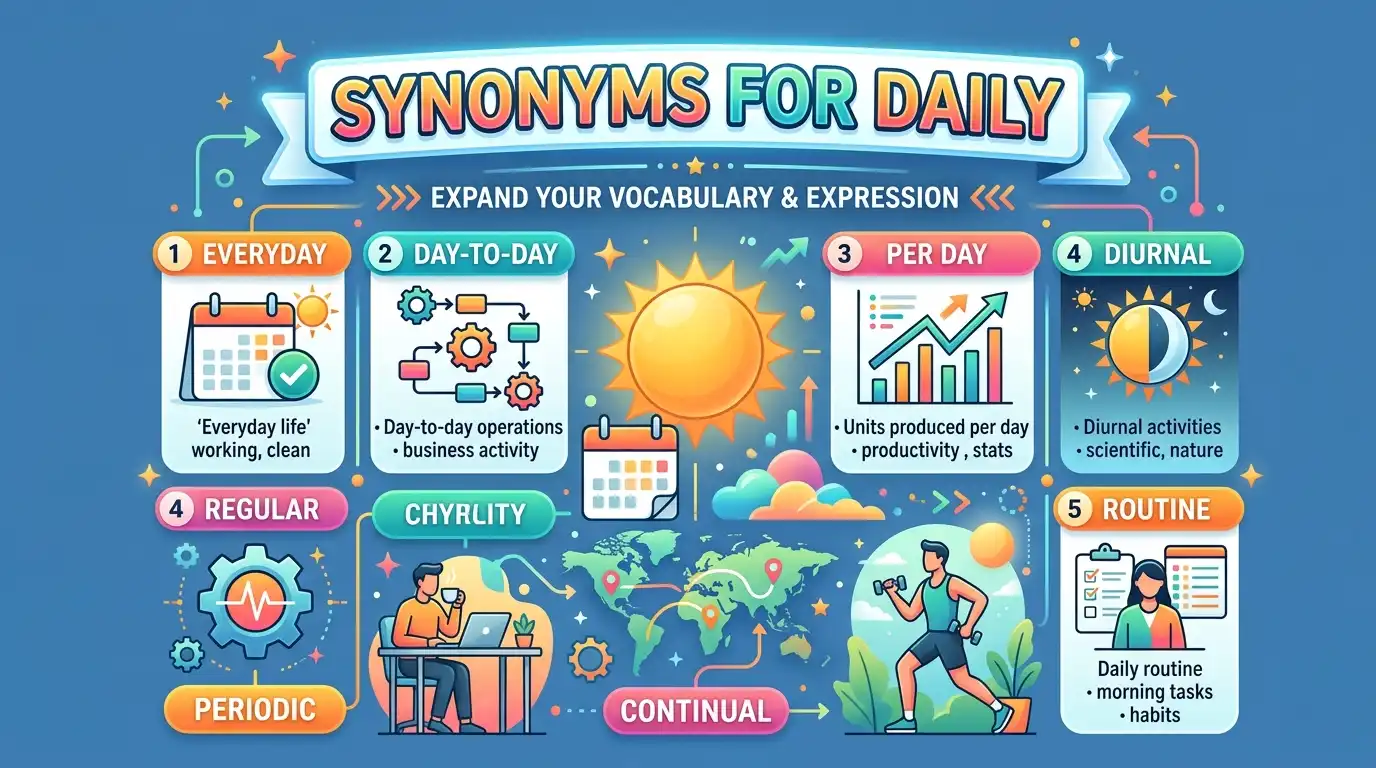
Finding the right synonyms for daily can immediately transform repetitive writing into clear, engaging content. When you explore synonyms for daily, you discover precise words that describe events happening every single day. Learning versatile synonyms for daily gives you the vocabulary power to express routines, schedules, and habits with total clarity.
Imagine waking up every morning at 7:00 AM, making a warm cup of coffee, and checking your email inbox. This action is a daily habit, something that occurs every day without fail. The word daily simply means happening, done, or produced every day. It is an easy, common word that describes events that repeat with the sun.
Mastering different synonyms for daily helps students write better school essays and helps bloggers create fresh, engaging posts. Content writers can avoid repeating the same phrase in their articles, while everyday English users can speak with greater confidence.
“We are what we repeatedly do. Excellence, then, is not an act, but a habit.” — Will Durant
“Success is the sum of small efforts, repeated day in and day out.” — Robert Collier
Linguistic Profile of “Daily”
Connotative Meaning
The word daily carries connotations of consistency, reliability, and structure. Depending on the context, it can feel comforting and stable (a daily exercise routine) or slightly boring and repetitive (a daily chore).
Etymology
- Old English: Derived from dæglic (dæg meaning “day” + -lic suffix meaning “like” or “characteristic of”).
- Proto-Germanic: Roots trace back to *dagalīkaz, denoting temporal recurrence.
- Middle English: Evolved into dayly or dailey before taking its modern form.
Pronunciation
- US IPA: /ˈdeɪ.li/
- UK IPA: /ˈdeɪ.li/
Syllables
2 Syllables: day-ly
Affixation Pattern
- Root Word: Day (Noun)
- Suffix: -ly (Transforms noun into adjective/adverb)
- Pattern: Root + Adjectival/Adverbial Suffix
“Words have energy and power with the ability to help, to heal, to hinder, to hurt, to harm, to humiliate, and to humble.” — Yehuda Berg
Comparison Table of “Daily” Synonyms
| Keyword | Meaning | Usage Type | Context |
| Everyday | Suitable for normal, ordinary days | Casual / Conversational | Clothing, tasks, conversations |
| Day-to-day | Happening continuously as part of routine | Professional / Casual | Workplace tasks, general life |
| Diurnal | Active or occurring during daylight hours | Academic / Scientific | Animal behavior, plant cycles |
| Quotidian | Occurring every day; ordinary or mundane | Literary / Formal | Writing, philosophy, essays |
| Circadian | Related to natural 24-hour biological body cycles | Scientific / Medical | Sleep cycles, bodily rhythms |
| Routine | Performed regularly as part of a fixed procedure | Professional / Functional | Work schedules, fitness plans |
| Habitual | Done constantly or out of habit | Casual / Emotional | Behaviors, personal traits |
| Workaday | Related to normal workdays; ordinary | Literary / Casual | Job responsibilities, life routine |
24 Best Synonyms for Daily
1. Everyday
- Pronunciation: US: /ˈɛvriˌdeɪ/ | UK: /ˈɛvri.deɪ/
- Meaning: Happening or used on normal days.
- Examples:
- She wore her comfortable everyday shoes to the grocery store.
- Cleaning the kitchen counter is an everyday task for our family.
2. Diurnal
- Pronunciation: US: /daɪˈɜːrnəl/ | UK: /daɪˈɜːnəl/
- Meaning: Active during the day instead of the night.
- Examples:
- Hawks are diurnal birds that hunt while the sun is up.
- Humans are naturally diurnal creatures who sleep at night.
3. Quotidian
- Pronunciation: US: /kwoʊˈtɪdiən/ | UK: /kwɒˈtɪdɪən/
- Meaning: Happening every day in a ordinary way.
- Examples:
- Taking out the trash is a quotidian activity we often forget about.
- The author wrote about the quotidian life of small-town families.
4. Day-to-Day
- Pronunciation: US: /ˌdeɪ.təˈdeɪ/ | UK: /ˌdeɪ.təˈdeɪ/
- Meaning: Happening regularly as part of standard life or work.
- Examples:
- She manages the day-to-day operations of the small bakery.
- His day-to-day schedule includes morning walks and evening reading.
5. Routine
- Pronunciation: US: /ruːˈtiːn/ | UK: /ruːˈtiːn/
- Meaning: Done regularly following a fixed order or plan.
- Examples:
- Brushing your teeth is a routine health practice.
- The pilot made a routine inspection of the airplane before takeoff.
6. Regular
- Pronunciation: US: /ˈrɛɡjələr/ | UK: /ˈreɡjələr/
- Meaning: Happening again and again with equal time between.
- Examples:
- She keeps a regular schedule for her homework and sleep.
- Drinking regular meals keeps your body healthy and energized.
7. Habitual
- Pronunciation: US: /həˈbɪtʃuəl/ | UK: /həˈbɪtʃuəl/
- Meaning: Done regularly out of habit.
- Examples:
- His habitual morning check of the news keeps him informed.
- She took her habitual seat near the front window of the bus.
8. Daily-Occurring
- Pronunciation: US: /ˈdeɪli əˈkɜːrɪŋ/ | UK: /ˈdeɪli əˈkɜːrɪŋ/
- Meaning: Taking place once every single day.
- Examples:
- High tide is a daily-occurring event near the ocean shore.
- Sunset is a beautiful daily-occurring sight in our valley.
9. Circadian
- Pronunciation: US: /sɜːrˈkeɪdiən/ | UK: /sɜːˈkeɪdɪən/
- Meaning: Related to the natural 24-hour cycle of living things.
- Examples:
- Exposure to bright sunlight helps reset your circadian sleep rhythm.
- Shift workers often struggle with changes to their circadian clock.
10. Perennial
- Pronunciation: US: /pəˈrɛniəl/ | UK: /pəˈrenɪəl/
- Meaning: Lasting for a long time or continually recurring.
- Examples:
- Traffic delays are a perennial issue for people living in big cities.
- Spring flowers bring perennial joy to our local neighborhood park.
11. Day-by-Day
- Pronunciation: US: /ˌdeɪ.baɪˈdeɪ/ | UK: /ˌdeɪ.baɪˈdeɪ/
- Meaning: Progressing steadily one day at a time.
- Examples:
- His health is improving day-by-day after the treatment.
- We take our travel plans day-by-day during rainy weather.
12. Constant
- Pronunciation: US: /ˈkɑːnstənt/ | UK: /ˈkɒnstənt/
- Meaning: Happening continuously without stopping.
- Examples:
- The ticking clock provided a constant sound in the quiet library.
- She remained a constant friend through all of his hardships.
13. Frequent
- Pronunciation: US: /ˈfriːkwənt/ | UK: /ˈfriːkwənt/
- Meaning: Happening often or at short intervals.
- Examples:
- He makes frequent trips to the local grocery store.
- Buses make frequent stops along the busy downtown route.
14. Continual
- Pronunciation: US: /kənˈtɪnjuəl/ | UK: /kənˈtɪnjʊəl/
- Meaning: Happening repeatedly over a period of time.
- Examples:
- The continual sound of rain helped her fall asleep fast.
- Regular practice leads to continual growth in your writing skills.
15. Standard
- Pronunciation: US: /ˈstændərd/ | UK: /ˈstændəd/
- Meaning: Normal and expected in regular situations.
- Examples:
- Arriving ten minutes early is standard policy for employees.
- They followed the standard recipe to bake the birthday cake.
16. Commonplace
- Pronunciation: US: /ˈkɑːmənˌpleɪs/ | UK: /ˈkɒmən.pleɪs/
- Meaning: Ordinary and seen everywhere day after day.
- Examples:
- Smartphones have become commonplace in modern daily life.
- Electric scooters are now a commonplace sight on city sidewalks.
17. Unremarkable
- Pronunciation: US: /ˌʌnrɪˈmɑːrkəbəl/ | UK: /ˌʌnrɪˈmɑːkəbəl/
- Meaning: Normal and not special or unusual.
- Examples:
- It was an unremarkable Tuesday filled with normal chores.
- The weather remained mild and unremarkable throughout the week.
18. Workaday
- Pronunciation: US: /ˈwɜːrkədeɪ/ | UK: /ˈwɜːkədeɪ/
- Meaning: Ordinary, practical, and relating to regular working days.
- Examples:
- She put on her workaday clothes before heading to the office.
- He quickly returned to his workaday duties after the long vacation.
19. Monotonous
- Pronunciation: US: /məˈnɑːtənəs/ | UK: /məˈnɒtənəs/
- Meaning: Boring because it stays the same every day.
- Examples:
- Staring at spreadsheet rows all day felt monotonous to him.
- The speaker had a monotonous voice that made listeners sleepy.
20. Steady
- Pronunciation: US: /ˈstɛdi/ | UK: /ˈstedi/
- Meaning: Firm, continuous, and happening without changes.
- Examples:
- She maintained a steady pace while running her morning lap.
- Continuous practice leads to steady improvement in vocabulary.
21. Ongoing
- Pronunciation: US: /ˈɑːnˌɡoʊɪŋ/ | UK: /ˈɒnˌɡəʊɪŋ/
- Meaning: Continuing to happen or develop currently.
- Examples:
- Scientists conduct ongoing research to learn more about space.
- Road repairs are an ongoing effort throughout the summer months.
22. Clockwork
- Pronunciation: US: /ˈklɑːkwɜːrk/ | UK: /ˈklɒkwɜːk/
- Meaning: Very regular and happening smoothly at precise times.
- Examples:
- The train arrives at 8:00 AM with clockwork precision.
- Her morning fitness routine runs like clockwork every day.
23. Customary
- Pronunciation: US: /ˈkʌstəˌmɛri/ | UK: /ˈkʌstəməri/
- Meaning: According to custom or standard habit.
- Examples:
- It is customary to greet your coworkers when arriving at work.
- She took her customary seat at the head of the dinner table.
24. Frequentative
- Pronunciation: US: /frɪˈkwɛntətɪv/ | UK: /frɪˈkwɛntətɪv/
- Meaning: Expressing repeated or frequent action (grammatical usage).
- Examples:
- The verb form has a frequentative meaning indicating repeated actions.
- Linguists analyze frequentative suffixes to study word origins.
Antonyms of “Daily”
Understanding opposite terms provides complete context for how to use synonyms for daily correctly:
- Infrequent: Not happening often.
- Rare: Happening very seldom.
- Sporadic: Occurring at irregular intervals with no set pattern.
- Occasional: Happening now and then.
- Nocturnal: Happening or active at night rather than during the day.
- Annual: Happening once every year instead of every day.
- Weekly: Happening once every seven days.
Prototype Meaning and Categorization of “Daily”
The core prototype of daily is rooted in temporal recurrence based on the 24-hour cycle of Earth.
We can categorize synonyms for daily into four distinct linguistic buckets:
- Casual & Conversational: Everyday, day-to-day, day-by-day.
- Professional & Functional: Routine, regular, standard, customary, clockwork.
- Scientific & Academic: Diurnal, circadian, frequentative, perennial.
- Literary & Descriptive: Quotidian, workaday, commonplace, monotonous.
Frequently Asked Questions (FAQs)
What is the best synonym for daily in formal writing?
Quotidian or diurnal are excellent choices for academic, literary, or scientific contexts where formal vocabulary is required.
Is “everyday” always the same as “daily”?
While very similar, everyday is an adjective meaning ordinary or suitable for common days (e.g., everyday clothes), while daily can function as both an adjective and an adverb (e.g., I run daily).
What is the difference between daily and diurnal?
Daily means happening every single day. Diurnal specifically means occurring during daylight hours or taking place over a 24-hour biological cycle.
Can I use “day-to-day” in business emails?
Yes! Day-to-day is widely accepted in professional environments to describe recurring work operations, responsibilities, and tasks.
How do synonyms for daily improve SEO content?
Using diverse synonyms for daily prevents keyword stuffing, increases topical authority, and keeps readers engaged without repetitive phrasing.
What is a scientific word for daily bodily cycles?
Circadian is the scientific term used to describe physical, mental, and behavioral changes that follow a 24-hour daily cycle.
Conclusion
Expanding your vocabulary with precise synonyms for daily equips you with tools to write and speak more dynamic English. Replacing generic terms with descriptive alternatives improves reading flow, enhances context, and enriches your tone across all forms of communication.
Whether you are crafting academic essays, writing engaging blog posts, composing business emails, or holding daily conversations, selecting the exact synonym makes your message clear and memorable. Practicing these terms in your daily writing builds natural linguistic confidence.
“By changing our vocabulary, we can instantly change how we think, how we feel, and how we live.” — Tony Robbins
“The limit of my language means the limits of my world.” — Ludwig Wittgenstein

Thomas Walker is a professional English consultant and content strategist with over eleven years of experience working with technology companies, business writers, and content teams who need precise, modern vocabulary guidance (Biography).