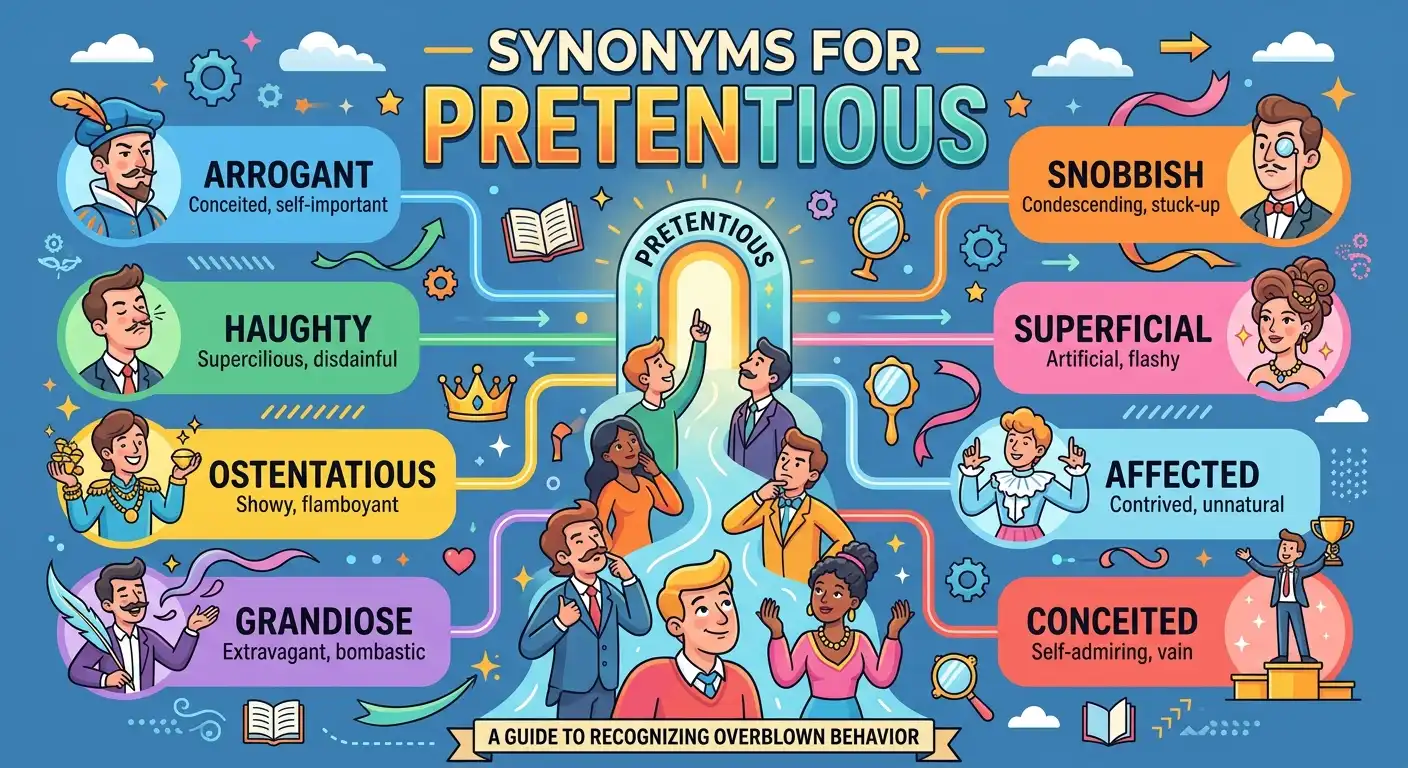
When you explore synonyms for pretentious, you discover clearer ways to describe people who act overly important. Learning synonyms for pretentious helps you avoid repeating the same word in your essays and blog posts. Mastering these synonyms for pretentious also improves your overall vocabulary quickly and easily.
Picture a guy named Mark at a local dinner party. He swishes his juice glass like fine wine and speaks loudly with a fake foreign accent just to sound smarter than everyone else in the room. That behavior is what we call pretentious. In simple terms, pretentious means acting like you are richer, smarter, or more important than you really are. Understanding words like this is extremely useful for students writing essays, bloggers crafting engaging posts, content writers editing copy, and daily English users who want to express themselves with precision. Short, clear words make your message stand out every single day.
“Words have energy and power with the ability to help, to heal, to hinder, to hurt, to harm, to humiliate, and to humble.” – Yehuda Berg
“The limits of my language mean the limits of my world.” – Ludwig Wittgenstein
Word Analysis: Pretentious
Connotative Meaning
The word pretentious carries a strong negative connotation. It implies insincerity, vanity, false pride, and an annoying effort to seek unearned admiration from others.
Etymology (Origin & History)
- Latin Root: Derived from praetendere, meaning “to stretch out,” “to hold before,” or “to pretend.”
- French Influence: Evolved into the French word prétentieux, which means “claiming undeserved importance.”
- English Adoption: Entered the English language in the 19th century to describe exaggerated self-importance.
Pronunciation (IPA)
- US IPA: /prɪˈten.ʃəs/
- UK IPA: /prɪˈten.ʃəs/
Syllables
- Count: 3 Syllables
- Breakdown: Pre – ten – tious
Affixation Pattern
- Root Word: Pretend / Pretens (from Latin praetendere)
- Suffix: -ious (adjective suffix meaning “full of” or “characterized by”)
Comparison Table: Pretentious vs. Similar Words
| Keyword | Meaning | Usage Type | Context |
| Pretentious | Acting more important or smarter than you are | Casual / Formal | Daily interactions, creative writing, social commentary |
| Ostentatious | Showing off wealth or goods openly | Formal / Professional | Luxury habits, fashion, architecture, events |
| Pompous | Overly self-important in speech or manner | Casual / Formal | Workplace leaders, public speeches, formal events |
| Grandiose | Appearing grand or exaggerated on a large scale | Formal / Analytical | Business plans, personal ambitions, architecture |
| Snobbish | Looking down on people who seem lower in status | Casual / Daily | Social circles, clubs, casual conversations |
| Showy | Bright and designed to attract attention | Casual / Daily | Fashion, cars, home decoration |
| Affected | Artificial or unnatural behavior to impress | Formal / Descriptive | Acting style, accents, voice tone |
| Supercilious | Behaving as if one is superior to others | Formal / Literary | Formal reviews, classic literature, workplace dynamics |
Main Content: 24 Synonyms for Pretentious
1. Ostentatious
- Pronunciation: US: /ˌɑː.stənˈteɪ.ʃəs/ | UK: /ˌɒs.tenˈteɪ.ʃəs/
- Meaning: Ostentatious means showing off wealth or skill to make other people notice you.
- Examples:
- He wore an ostentatious gold watch to the casual lunch meeting.
- Her ostentatious house had big marble statues in the front yard.
2. Pompous
- Pronunciation: US: /ˈpɑːm.pəs/ | UK: /ˈpɒm.pəs/
- Meaning: Pompous describes a person who acts way too serious and self-important.
- Examples:
- The mayor gave a pompous speech that bored the entire crowd.
- Nobody liked his pompous tone during the team meeting.
3. Grandiose
- Pronunciation: US: /ˈɡræn.di.oʊs/ | UK: /ˈɡræn.di.əʊs/
- Meaning: Grandiose means making things seem bigger or more main than they really are.
- Examples:
- She shared grandiose plans for a company that had no money.
- His grandiose ideas were impossible to complete on time.
4. Affected
- Pronunciation: US: /əˈfek.tɪd/ | UK: /əˈfek.tɪd/
- Meaning: Affected describes behavior or speech that is fake and meant to impress others.
- Examples:
- She spoke with an affected accent after returning from her trip.
- His affected manners made him seem unnatural at the party.
5. Snobbish
- Pronunciation: US: /ˈsnɑː.bɪʃ/ | UK: /ˈsnɒ.bɪʃ/
- Meaning: Snobbish means treating other people as if they are less important than you.
- Examples:
- The waiter was snobbish toward customers who ordered cheap meals.
- She gave a snobbish smile and ignored my simple question.
6. Supercilious
- Pronunciation: US: /ˌsuː.pɚˈsɪl.i.əs/ | UK: /ˌsuː.pəˈsɪl.i.əs/
- Meaning: Supercilious means acting like you are better than everyone else.
- Examples:
- The salesman gave us a supercilious look when we asked for a discount.
- Her supercilious attitude made it hard to work together.
“Simplicity is the ultimate sophistication.” – Leonardo da Vinci
7. Conceited
- Pronunciation: US: /kənˈsiː.t̬ɪd/ | UK: /kənˈsiː.tɪd/
- Meaning: Conceited means having way too much pride in your own looks or abilities.
- Examples:
- He is so conceited that he looks in every mirror he passes.
- Nobody enjoys listening to a conceited person talk about themselves.
8. Showy
- Pronunciation: US: /ˈʃoʊ.i/ | UK: /ˈʃəʊ.i/
- Meaning: Showy means very bright and colorful in a way that demands attention.
- Examples:
- She bought a showy red sports car to impress her friends.
- The restaurant had showy lights but served basic food.
9. Flashy
- Pronunciation: US: /ˈflæʃ.i/ | UK: /ˈflæʃ.i/
- Meaning: Flashy means cheap-looking while trying hard to look expensive and bright.
- Examples:
- He wore a flashy suit to the quiet family dinner.
- Her flashy jewelry attracted everyone in the dark room.
10. Haughty
- Pronunciation: US: /ˈhɑː.t̬i/ | UK: /ˈhɔː.ti/
- Meaning: Haughty describes an arrogant person who looks down on other people.
- Examples:
- The princess gave a haughty nod to the young servant.
- His haughty tone offended everyone sitting at the table.
11. High-falutin
- Pronunciation: US: /ˌhaɪ.fəˈluː.tn̩/ | UK: /ˌhaɪ.fəˈluː.tɪn/
- Meaning: High-falutin means using big words or fancy ideas to sound important.
- Examples:
- We just want simple food without any high-falutin names.
- He used high-falutin words that nobody in the class understood.
12. Uppity
- Pronunciation: US: /ˈʌp.ə.t̬i/ | UK: /ˈʌp.ə.ti/
- Meaning: Uppity describes someone who acts like they are higher in rank than they are.
- Examples:
- The new manager got uppity on his very first day at work.
- Don’t get uppity just because you won one small game.
13. Self-important
- Pronunciation: US: /ˌself.ɪmˈpɔːr.tnt/ | UK: /ˌself.ɪmˈpɔː.tənt/
- Meaning: Self-important means believing your own opinion is more valuable than anyone else’s.
- Examples:
- The self-important speaker talked for two hours straight.
- He walked into the room with a self-important look on his face.
14. Vainglorious
- Pronunciation: US: /ˌveɪnˈɡlɔːr.i.əs/ | UK: /ˌveɪnˈɡlɔː.ri.əs/
- Meaning: Vainglorious means showing excessive pride in your own small achievements.
- Examples:
- The vainglorious king built huge statues of himself everywhere.
- Her vainglorious posts on social media turned off her followers.
15. Flamboyant
- Pronunciation: US: /flæmˈbɔɪ.ənt/ | UK: /flæmˈbɔɪ.ənt/
- Meaning: Flamboyant means very bright, noisy, and confident in a noticeable way.
- Examples:
- The singer wore a flamboyant jacket covered in sparkling silver feathers.
- His flamboyant personality made him the center of attention.
16. Pedantic
- Pronunciation: US: /pəˈdæn.t̬ɪk/ | UK: /pəˈdæn.tɪk/
- Meaning: Pedantic means caring too much about tiny rules and small details when teaching.
- Examples:
- The professor gave a pedantic lecture on English grammar rules.
- Her pedantic corrections made writing class feel very stressful.
17. Overblown
- Pronunciation: US: /ˌoʊ.vɚˈbloʊn/ | UK: /ˌəʊ.vəˈbləʊn/
- Meaning: Overblown means made to look much bigger or better than it really is.
- Examples:
- The movie received overblown praise before it even opened.
- His overblown claims about his job were easy to disprove.
18. High-sounding
- Pronunciation: US: /ˈhaɪˌsaʊn.dɪŋ/ | UK: /ˈhaɪˌsaʊn.dɪŋ/
- Meaning: High-sounding describes words or promises that sound grand but mean very little.
- Examples:
- The politician made many high-sounding promises during the election.
- Avoid using high-sounding phrases when a simple word works better.
19. Stuck-up
- Pronunciation: US: /ˈstʌk.ʌp/ | UK: /ˈstʌk.ʌp/
- Meaning: Stuck-up is a casual word for someone who thinks they are too good for others.
- Examples:
- She was so stuck-up that she ignored her old classmates.
- Nobody wanted to sit near the stuck-up student at lunch.
20. Arrogant
- Pronunciation: US: /ˈær.ə.ɡənt/ | UK: /ˈær.ə.ɡənt/
- Meaning: Arrogant means proudly believing you are better or smarter than other people.
- Examples:
- His arrogant answer annoyed the teacher and the whole class.
- An arrogant leader rarely listens to good advice from others.
21. Artificial
- Pronunciation: US: /ˌɑːr.t̬əˈfɪʃ.əl/ | UK: /ˌɑː.tɪˈfɪʃ.əl/
- Meaning: Artificial means not real or sincere in how you act around people.
- Examples:
- She greeted the guest with an artificial smile and cold eyes.
- His artificial excitement about the project felt completely fake.
22. Pretended
- Pronunciation: US: /prɪˈten.dɪd/ | UK: /prɪˈten.dɪd/
- Meaning: Pretended means put on as a false show rather than being genuine.
- Examples:
- He showed a pretended interest in her hobby just to be polite.
- Her pretended kindness disappeared as soon as the manager left.
23. Overambitious
- Pronunciation: US: /ˌoʊ.vɚ.æmˈbɪʃ.əs/ | UK: /ˌəʊ.vər.æmˈbɪʃ.əs/
- Meaning: Overambitious means trying to do way more than is possible or realistic.
- Examples:
- Their overambitious goal caused the entire team to burn out.
- He made an overambitious promise that he could not keep.
24. Snobby
- Pronunciation: US: /ˈsnɑː.bi/ | UK: /ˈsnɒ.bi/
- Meaning: Snobby means acting like you belong to a higher class than others.
- Examples:
- The boutique had a snobby atmosphere that made shoppers uncomfortable.
- Don’t be snobby toward people who prefer simple things.
Antonyms of Pretentious
Understanding antonyms helps you see the full spectrum of a word’s meaning. Here are the main opposites of pretentious:
- Humble: Modest in behavior and not showing off.
- Unpretentious: Simple, natural, and free from fake manners.
- Down-to-earth: Practical, realistic, and easy to talk to.
- Genuine: Honest, real, and sincere in everyday actions.
- Modest: Not talking proudly about your own achievements.
Prototype Meaning and Categorization
- Semantic Category: Behavioral Character Trait / Social Evaluation Descriptor.
- Prototype Concept: The core prototype of pretentious is an individual or object asserting an elevated status, level of intelligence, or artistic value that is not genuinely backed by reality. It fits squarely in the category of words used to criticize insincerity and social posturing.
Frequently Asked Questions (FAQs)
1. What is the most common synonym for pretentious?
The most common and widely used synonyms for pretentious are pompous, showy, and ostentatious.
2. What is the main difference between pretentious and pompous?
Pretentious focuses on trying to seem smarter, wealthier, or more artistic than you actually are. Pompous focuses on acting solemn, grand, and overly self-important in speech or demeanor.
3. Is pretentious always used negatively?
Yes, pretentious is almost always used as a negative descriptor because it calls out fake behavior and exaggerated self-worth.
4. Can an object or place be called pretentious?
Yes! Movies, restaurants, books, clothes, and art galleries are often called pretentious if they try too hard to seem sophisticated or high-class.
5. How do you pronounce pretentious correctly?
In both American and British English, pretentious is pronounced as /prɪˈten.ʃəs/.
6. What is the opposite of a pretentious person?
The opposite of a pretentious person is someone who is down-to-earth, humble, genuine, or unpretentious.
Conclusion
Expanding your vocabulary with synonyms for pretentious significantly strengthens your everyday communication skills. When you know precise words like ostentatious, pompous, affected, or supercilious, your writing becomes more vibrant and specific. Bloggers can create far more engaging posts, students can write richer academic essays, and professionals can communicate with greater clarity in daily emails. Replaces generic descriptions with vibrant, tailored vocabulary that paints a vivid picture for your readers.
To make these words a permanent part of your personal vocabulary, practice using them consistently. Try replacing basic words in your daily journal, incorporating them into your upcoming essays, or weaving them into conversational emails with colleagues. Developing a rich vocabulary is a gradual step-by-step journey, and every new synonym you master elevates your confidence as a communicator. Start applying these terms today to express your thoughts with precision and flair!
“Proper words in proper places, make the true definition of a style.” – Jonathan Swift
“By words the mind is winged.” – Aristophanes

Thomas Walker is a professional English consultant and content strategist with over eleven years of experience working with technology companies, business writers, and content teams who need precise, modern vocabulary guidance (Biography).