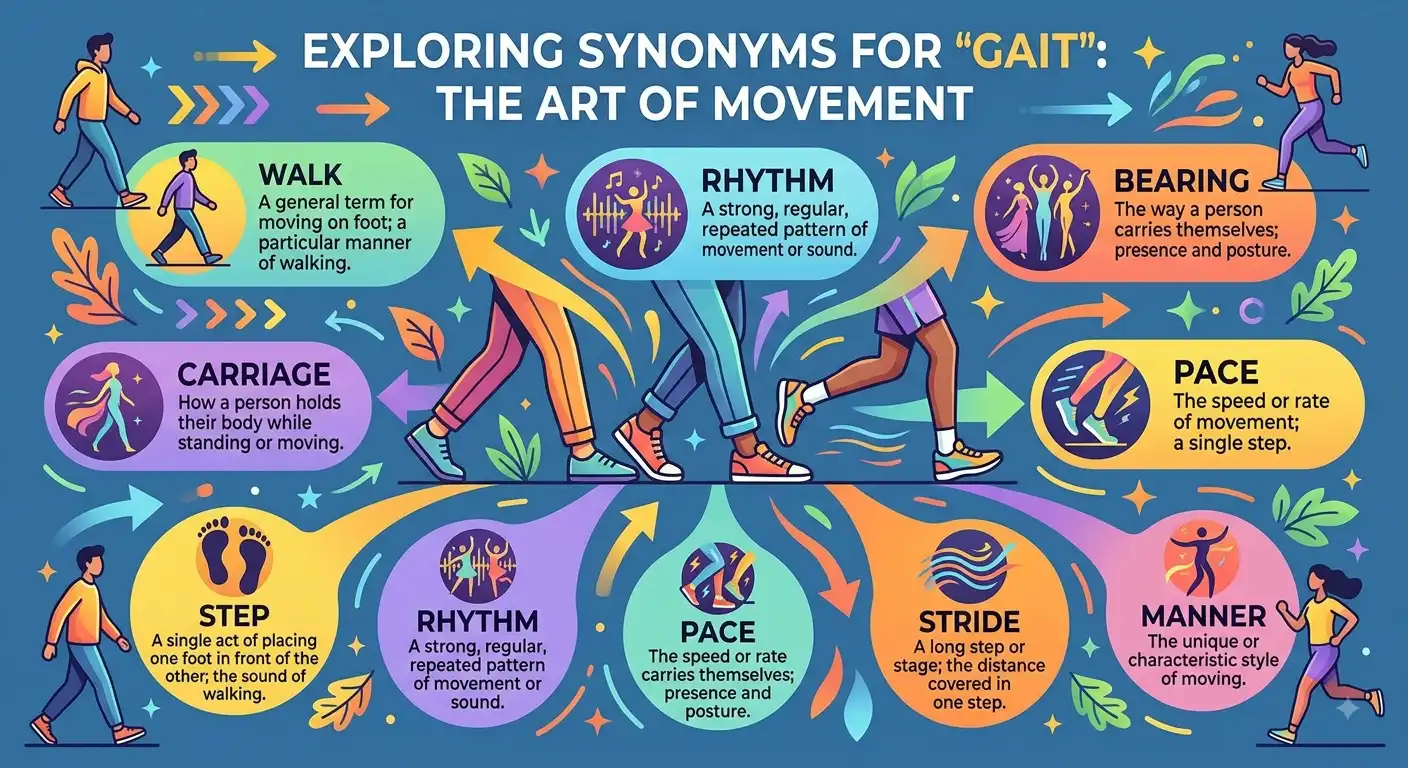
What is a gait? Simply put, gait refers to a person’s particular way or manner of walking. Your gait is your unique physical stride, and exploring different synonyms for gait helps you describe movement with precision. Imagine watching someone approach from across a crowded room. You notice immediately how they move. Are they rushing, strolling, or dragging their feet? The way a person walks tells a silent story about their mood, confidence, and health.
“Walking is man’s best medicine.” – Hippocrates
Writers often fall into the trap of repeating simple verbs and nouns, making stories feel flat. Enriching your vocabulary with exact synonyms for gait transforms ordinary descriptions into vivid, cinematic imagery.
“An early-morning walk is a blessing for the whole day.” – Henry David Thoreau
This guide is especially useful for students crafting descriptive essays, bloggers building vivid character profiles, content writers sharpening their creative prose, and daily English users who simply want to expand their linguistic toolkit.
Connotative Meaning of Gait
The word gait carries a neutral, objective connotation often associated with biomechanics, physical posture, and rhythm. However, depending on context, it can evoke grace, urgency, weariness, or stealth.
Etymology of Gait
- Origin: Derived from Middle English gate, meaning a way, path, or street, originating from Old Norse gata (path or road).
- Evolution: Shifted in meaning during the 16th century from “a journey or path” to “the manner of walking along a path.”
Pronunciation of Gait
- US IPA: /ɡeɪt/
- UK IPA: /ɡeɪt/
Syllables of Gait
- 1 syllable (gait)
Affixation Pattern of Gait
- Base root word with no common prefixes or suffixes in standard modern usage.
| Keyword | Meaning | Usage Type | Context |
| Stride | A long, purposeful step forward. | Formal / Professional | Workplace, athletic reporting |
| Tread | The sound or manner of foot placement. | Emotional / Literary | Daily storytelling, creative writing |
| Pace | The consistent speed of walking. | Casual / Daily Use | Casual conversation, fitness tracking |
| March | A steady, uniform, and determined walk. | Formal | Military, organized public events |
| Stroll | A relaxed, leisurely, and slow walk. | Casual | Casual weekend walks, park settings |
1. Stride
Pronunciation: US /straɪd/, UK /straɪd/ Meaning: A stride is a long, confident step taken while walking. Examples: He walked across the room with a long stride. She took a powerful stride toward the finish line.
2. Pace
Pronunciation: US /peɪs/, UK /peɪs/ Meaning: Your pace is the steady speed at which you walk or run. Examples: We maintained a steady pace during our hike. He quickened his pace because he was late.
3. Tread
Pronunciation: US /tred/, UK /tred/ Meaning: Tread describes the sound or manner of your feet pressing down as you walk. Examples: I heard her quiet tread on the wooden stairs. Be careful where you tread in the dark.
4. March
Pronunciation: US /mɑːrtʃ/, UK /mɑːrtʃ/ Meaning: A march is a firm, rhythmic walk done together in step. Examples: The soldiers began their morning march. The band led the celebratory march down Main Street.
5. Stroll
Pronunciation: US /stroʊl/, UK /strəʊl/ Meaning: A stroll is a slow, relaxed, and casual walk. Examples: They took a pleasant stroll through the garden. Let us go for a quick stroll after dinner.
6. Swagger
Pronunciation: US /ˈswæɡər/, UK /ˈswæɡə(r)/ Meaning: A swagger is a proud, confident, and slightly arrogant way of walking. Examples: He entered the room with an unmistakable swagger. Her bold swagger showed her self-assurance.
7. Limp
Pronunciation: US /lɪmp/, UK /lɪmp/ Meaning: A limp is an uneven walk caused by an injured leg or foot. Examples: He walked with a noticeable limp after soccer practice. The dog had a slight limp in its front paw.
8. Shuffle
Pronunciation: US /ˈʃʌfəl/, UK /ˈʃʌfl/ Meaning: A shuffle is a slow walk where your feet drag along the ground. Examples: I heard the soft shuffle of slippers in the hallway. He walked with a tired shuffle after work.
9. Slog
Pronunciation: US /slɑːɡ/, UK /slɒɡ/ Meaning: A slog is a heavy, slow, and exhausting walk. Examples: It was a muddy slog up the steep hill. Their hike turned into a long slog through rain.
10. Totter
Pronunciation: US /ˈtɑːtər/, UK /ˈtɒtə(r)/ Meaning: To totter is to walk with weak, shaky, or unsteady steps. Examples: The toddler began to totter across the living room rug. She started to totter in her high heels.
11. Waddle
Pronunciation: US /ˈwɑːdəl/, UK /ˈwɒdl/ Meaning: A waddle is a clumsy walk shifting from side to side like a duck. Examples: The happy duck began to waddle toward the pond. The heavy backpack made him waddle down the path.
12. Hobble
Pronunciation: US /ˈhɑːbəl/, UK /ˈhɒbl/ Meaning: To hobble is to walk with difficulty, often due to pain or injury. Examples: He managed to hobble over to the medical kit. She had to hobble home on a twisted ankle.
13. Amble
Pronunciation: US /ˈæmbəl/, UK /ˈæmbl/ Meaning: An amble is a slow, relaxed, and easygoing walk. Examples: We enjoyed a peaceful amble along the riverbank. They would often amble through town on Sundays.
14. Saunter
Pronunciation: US /ˈsɔːntər/, UK /ˈsɔːntə(r)/ Meaning: To saunter is to walk in a slow, calm, and confident way without hurry. Examples: He decided to saunter into the coffee shop. She gave a friendly wave and continued her saunter.
15. Prance
Pronunciation: US /præns/, UK /prɑːns/ Meaning: To prance is to walk with high, springy, and proud steps. Examples: The proud horse began to prance around the ring. The young gymnast loved to prance across the stage.
16. Swagger
Pronunciation: US /ˈswæɡər/, UK /ˈswæɡə(r)/ Meaning: A bouncing, bold walk that shows off confidence. Examples: He walked with an unmistakable swagger after winning. Her playful swagger turned heads everywhere.
17. Trudge
Pronunciation: US /trʌdʒ/, UK /trʌdʒ/ Meaning: To trudge is to walk slowly and with heavy steps because you are tired. Examples: They had to trudge through the deep winter snow. It was a long trudge back to the campsite.
18. Plod
Pronunciation: US /plɑːd/, UK /plɒd/ Meaning: To plod is to walk slowly and heavily without much energy. Examples: The tired workers began to plod toward the exit. He could only plod along the dusty trail.
19. Trek
Pronunciation: US /trek/, UK /trek/ Meaning: A trek is a long, hard, and challenging walk over rough ground. Examples: Their daily mountain trek lasted for four hours. We packed light gear for our jungle trek.
20. Hike
Pronunciation: US /haɪk/, UK /haɪk/ Meaning: A hike is a long walk taken for pleasure or exercise in nature. Examples: We went on a scenic hike through the national park. That steep forest hike was quite exhausting.
21. Slink
Pronunciation: US /slɪŋk/, UK /slɪŋk/ Meaning: To slink is to walk quietly and secretly, trying not to be seen. Examples: The cat tried to slink across the living room floor. He attempted to slink away unnoticed.
22. Stealthy walk
Pronunciation: US /ˈstelθi wɔːk/, UK /ˈstelθi wɔːk/ Meaning: A very quiet, cautious movement designed to avoid detection. Examples: Her stealthy walk kept her hidden in the shadows. They practiced a stealthy walk during their game.
23. Creep
Pronunciation: US /kriːp/, UK /kriːp/ Meaning: To creep is to move slowly, quietly, and carefully. Examples: The thief tried to creep down the dark hallway. I watched the spider creep up the wall.
24. Prowl
Pronunciation: US /praʊl/, UK /praʊl/ Meaning: To prowl is to move quietly and carefully around an area, hunting or searching. Examples: The hungry tiger began to prowl through the tall grass. Stray cats prowl the neighborhood at night.
25. Slither
Pronunciation: US /ˈslɪðər/, UK /ˈslɪðə(r)/ Meaning: To slither is to slide smoothly and quietly like a snake. Examples: We watched the snake slither across the warm path. The wet rope seemed to slither off the desk.
26. Bound
Pronunciation: US /baʊnd/, UK /baʊnd/ Meaning: To bound is to walk or run with large, energetic steps and leaps. Examples: The excited dog began to bound across the yard. The deer would bound gracefully over fences.
27. Leap
Pronunciation: US /liːp/, UK /liːp/ Meaning: A leap is a big jump forward or across a space. Examples: With one mighty leap, he cleared the stream. She made a daring leap onto the platform.
28. Skip
Pronunciation: US /skɪp/, UK /skɪp/ Meaning: To skip is to move forward with a light, bouncy step and a hop. Examples: The happy child loved to skip down the sidewalk. She began to skip when she heard good news.
29. Hop
Pronunciation: US /hɑːp/, UK /hɒp/ Meaning: To hop is to move forward by jumping on one foot. Examples: The little rabbit started to hop across the lawn. He had to hop on one foot after twisting his ankle.
30. Spring
Pronunciation: US /sprɪŋ/, UK /sprɪŋ/ Meaning: To spring is to move suddenly and quickly upward or forward. Examples: He could spring into action at a moment’s notice. The athlete was ready to spring off the blocks.
31. Drift
Pronunciation: US /drɪft/, UK /drɪft/ Meaning: To drift is to move smoothly and effortlessly without strong direction. Examples: She seemed to drift through the crowded gallery. The boat began to drift toward the center of the lake.
32. Float
Pronunciation: US /floʊt/, UK /fləʊt/ Meaning: To float is to move lightly and gracefully as if carried by air. Examples: The dancer seemed to float across the wooden stage. Her light dress made her float through the room.
33. Glider
Pronunciation: US /ˈɡlaɪdər/, UK /ˈɡlaɪdə(r)/ Meaning: Moving smoothly, continuously, and effortlessly without sudden stops. Examples: He moved like a glider across the polished floor. Her smooth glider motion looked effortless.
34. Slide
Pronunciation: US /slaɪd/, UK /slaɪd/ Meaning: To slide is to move smoothly along a slippery surface. Examples: The children love to slide down the snowy hill. He tried to slide across the slick kitchen floor.
35. Glide
Pronunciation: US /ɡlaɪd/, UK /ɡlaɪd/ Meaning: To glide is to move smoothly, quietly, and with ease. Examples: The ice skater began to glide across the rink. Elegant swans glide peacefully across the pond.
36. Scoot
Pronunciation: US /skuːt/, UK /skuːt/ Meaning: To scoot is to move or slide a short distance quickly. Examples: Please scoot over so I can sit on the bench. He had to scoot quickly to avoid the puddle.
37. Scurry
Pronunciation: US /ˈskɜːri/, UK /ˈskʌri/ Meaning: To scurry is to move with short, quick, and hurried steps. Examples: Mice began to scurry behind the kitchen cabinets. The children rushed to scurry indoors when it rained.
38. Scamper
Pronunciation: US /ˈskæmpər/, UK /ˈskæmpə(r)/ Meaning: To scamper is to run or move playfully with light, quick steps. Examples: Squirrels love to scamper up the tall oak trees. The puppies began to scamper across the lawn.
39. Dash
Pronunciation: US /dæʃ/, UK /dæʃ/ Meaning: A dash is a quick, sudden run over a short distance. Examples: She made a quick dash for the closing elevator doors. He took a fast dash through the rain.
40. Sprint
Pronunciation: US /sprɪnt/, UK /sprɪnt/ Meaning: A sprint is a short, fast burst of running at top speed. Examples: The runner prepared for the final sprint to the line. He made a quick sprint to catch the bus.
41. Bolt
Pronunciation: US /boʊlt/, UK /bəʊlt/ Meaning: To bolt is to run away suddenly out of fear or surprise. Examples: The frightened rabbit decided to bolt into the brush. He made a sudden bolt for the open exit.
42. Dart
Pronunciation: US /dɑːrt/, UK /dɑːt/ Meaning: To dart is to move swiftly and suddenly in a specific direction. Examples: A small bird would dart between the leafy branches. He saw a shadow dart across the alley.
43. Flit
Pronunciation: US /flɪt/, UK /flɪt/ Meaning: To flit is to move quickly and lightly from place to place. Examples: Butterflies flit from flower to flower in the sun. Her thoughts seemed to flit from topic to topic.
44. Rush
Pronunciation: US /rʌʃ/, UK /rʌʃ/ Meaning: To rush is to move with great urgency and high speed. Examples: There is no need to rush through your homework. Commuters began to rush toward the morning train.
45. Hurry
Pronunciation: US /ˈhɜːri/, UK /ˈhʌri/ Meaning: To hurry is to move or act with greater speed than usual. Examples: Please hurry so we do not miss the movie start. She had to hurry to finish her project on time.
46. Jog
Pronunciation: US /dʒɑːɡ/, UK /dʒɒɡ/ Meaning: A jog is a slow, steady run taken for exercise. Examples: He goes for a morning jog around the neighborhood. She enjoys a relaxing jog by the seaside park.
47. Trot
Pronunciation: US /trɑːt/, UK /trɒt/ Meaning: A trot is a moderate, rhythmic pace faster than a walk. Examples: The horse moved into a smooth trot across the field. The puppy broke into a happy trot to greet us.
48. Canter
Pronunciation: US /ˈkæntər/, UK /ˈkæntə(r)/ Meaning: A canter is a slow, easy gallop ridden by a horse. Examples: The rider urged her horse into a gentle canter. They enjoyed a lovely canter through the meadows.
49. Gallop
Pronunciation: US /ˈɡæləp/, UK /ˈɡæləp/ Meaning: A gallop is the fastest running gait of a horse. Examples: The wild horses broke into a powerful gallop. We watched the horses gallop across the open plain.
50. Promenade
Pronunciation: US /ˌprɑːməˈnɑːd/, UK /ˌprɒmɪˈnɑːd/ Meaning: A promenade is a slow, formal, and public walk taken for leisure. Examples: Couples enjoyed a romantic evening promenade by the sea. The festival featured a traditional weekend promenade.
Antonyms of Focus Keyword
- Stillness, immobility, stationariness, standing, pause, halt.
Prototype Meaning and Categorization of Focus Keyword
- Category: Human locomotion / Physical movement
- Prototype: A bipedal, rhythmic, and forward-moving stride characteristic of human walking.
FAQ of Gait
- What is the exact definition of gait?
- Gait refers to a person’s manner of walking or moving on foot.
- How is gait different from speed?
- While speed measures how fast you move, gait describes the specific style, rhythm, and form of your movement.
- Can animals have a gait?
- Yes, animals possess distinct gaits such as trots, canters, gallops, and paces.
- Why do writers use synonyms for gait?
- Using varied synonyms for gait prevents repetitive writing and paints a clearer picture for readers.
- What are common medical uses of the word gait?
- Doctors analyze a patient’s gait to diagnose neurological or orthopedic conditions.
- How can I improve my description of walking in stories?
- Swap out basic verbs like “walked” for expressive synonyms for gait like swagger, shuffled, or sauntered.
Learning synonyms improves your writing by adding variety, enhances your blogging by engaging readers with vivid verbs, sharpens your speaking skills, and refines overall communication. By diversifying your vocabulary, you avoid repetitive phrasing and bring your descriptions to life. Encourage yourself to practice these new words in daily emails, creative essays, and everyday conversations with friends and colleagues. Consistent practice turns rich vocabulary into second nature.
“The art of writing is the art of discovering what you believe.” – Gustave Flaubert
“Words are, of course, the most powerful drug used by mankind.” – Rudyard Kipling

Thomas Walker is a professional English consultant and content strategist with over eleven years of experience working with technology companies, business writers, and content teams who need precise, modern vocabulary guidance (Biography).