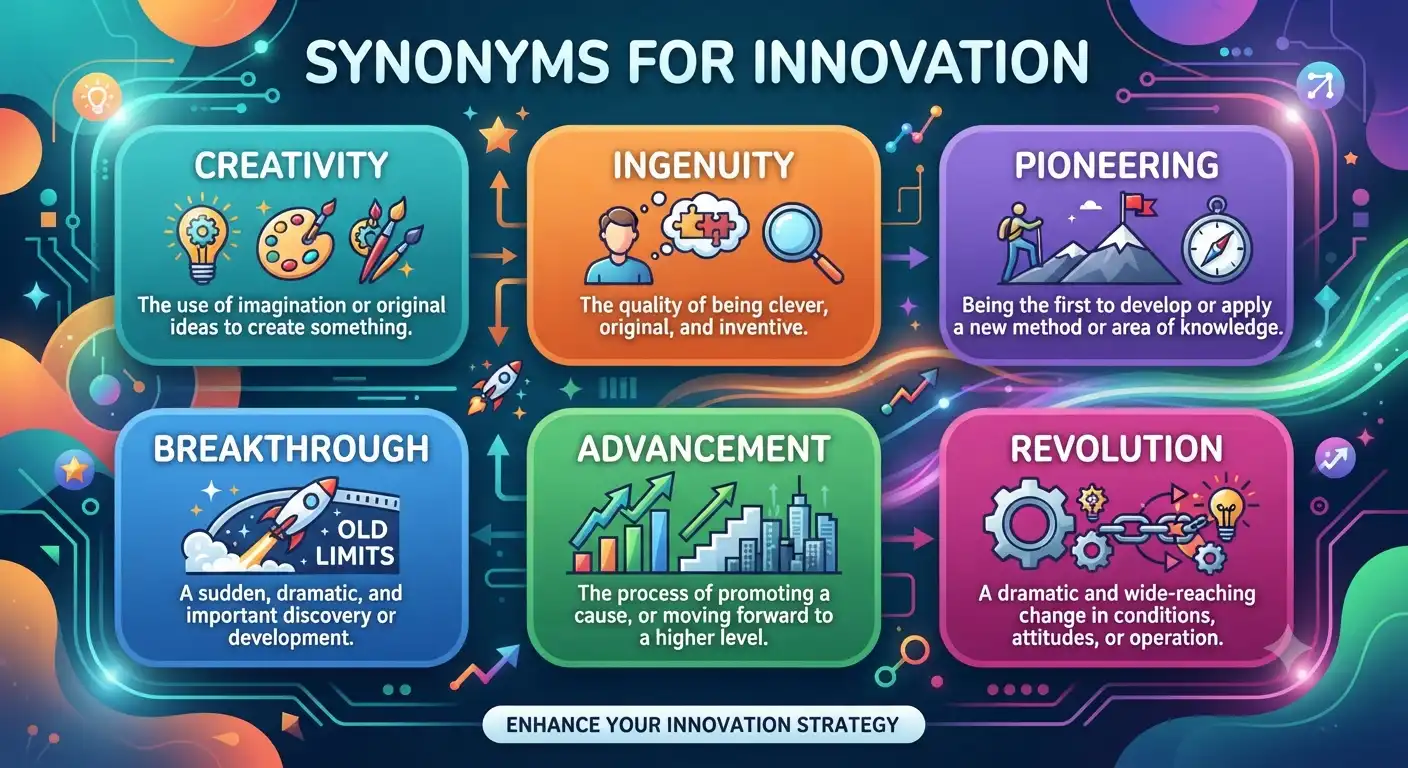
When we talk about progress or new ideas, finding the perfect word can make a massive difference. That is why learning synonyms for innovation is so important. Synonyms for innovation are different words that describe creating new things, making changes, or bringing fresh ideas to life. Using these synonyms for innovation helps you express complex thoughts easily and keeps your audience interested in what you have to say.
Imagine trying to explain a cool new project to a client or writing a paper for school. If you use the word “innovation” over and over, your writing starts to feel repetitive and dry. For example, saying “Our company is focused on tech innovation” is fine, but it sounds a bit basic. If you say “Our team just made a massive breakthrough,” you instantly capture everyone’s attention and sound like a leader. In simple terms, innovation means making or using a brand-new idea to solve a problem.
This guide is highly useful for everyone. Students can use these fresh words to write higher-quality essays and improve their school grades. Bloggers can use them to write highly engaging articles that hook readers immediately. Content writers can make their copy flow beautifully without repetitive phrasing. Daily English users can speak with more confidence and variety in casual settings.
“Innovation distinguishes between a leader and a follower.” — Steve Jobs
“The true sign of intelligence is not knowledge but imagination.” — Albert Einstein
Linguistic Overview of “Innovation”
To fully master this concept, let us look closely at the linguistic background and structure of our primary term.
- Connotative Meaning: Highly positive, progressive, and exciting. It suggests forward-looking change, modern technology, active problem-solving, and valuable creativity.
- Etymology:
- Origin: From the Latin noun innovationem (a noun of action).
- Root: Derived from the past-participle stem of innovare (to renew, alter, or make new).
- Stem: Built on the Latin adjective novus (new).
- History: Entered Middle English in the mid-15th century to describe the act of introducing something new.
- Pronunciation:
- US IPA: /ˌɪnəˈveɪʃən/
- UK IPA: /ˌɪnəˈveɪʃn/
- Syllables: in-no-va-tion (4 syllables)
- Affixation Pattern:
- Root: innovate (verb)
- Suffix: -ion (forms the noun innovation)
Innovation in Business: More Than Just a Word
Words like “innovation,” “advancement,” and “breakthrough” get used a lot in business writing — but real innovation usually shows up in small, practical changes, not just big announcements.
One good example is customer support. For years, businesses relied entirely on human agents to answer every customer question, even simple, repetitive ones. Today, that’s changing. Ecommerce brands are adopting AI-driven innovation in customer support like Tidio to automatically handle common queries, freeing up teams to focus on more meaningful work.
So the next time you’re choosing a word for “innovation” in a report, pitch, or blog post, it’s worth remembering that the best examples of it are often quiet, practical improvements — not just flashy new ideas.
Comparison Table of Key Synonyms
| Keyword | Meaning | Usage Type | Context |
|---|---|---|---|
| Innovation | Making or introducing a brand-new idea. | Professional / Neutral | Technology, business, and school. |
| Breakthrough | A major step forward or discovery. | Emotional / Professional | Science, medicine, and research. |
| Invention | Creating an entirely new machine or system. | Technical | Engineering and history. |
| Novelty | The quality of being new and unusual. | Casual | Toys, trends, and everyday experiences. |
| Modernization | Updating old things to fit modern times. | Professional | Architecture, cities, and old factories. |
| Creativity | Using imagination to make something original. | Emotional / Casual | Art, writing, and design. |
| Revolution | A complete and massive change in how things work. | Emotional | Politics, industry, and history. |
| Pioneer | Being the very first to do something new. | Professional | Space, science, and leadership. |
| Refinement | Making small improvements to make something perfect. | Professional | Software, products, and processes. |
| Leap | A big, sudden jump in progress. | Emotional / Casual | Business growth and personal goals. |
“There is no innovation without failure.” — Brené Brown
50 Synonyms for Innovation
1. Invention
- Pronunciation: US: /ɪnˈvɛnʃən/ | UK: /ɪnˈvɛnʃn/
- Meaning: Creating a brand-new machine, tool, or process that did not exist before.
- Examples:
- The light bulb was a life-changing invention.
- He got a special patent for his new kitchen invention.
2. Breakthrough
- Pronunciation: US: /ˈbreɪkˌθruː/ | UK: /ˈbreɪkθruː/
- Meaning: An important discovery that helps solve a major problem.
- Examples:
- Doctors made a huge breakthrough in curing the illness.
- This clean energy project is a major technical breakthrough.
3. Novelty
- Pronunciation: US: /ˈnɑvəlti/ | UK: /ˈnɒvlti/
- Meaning: The exciting quality of being fresh, new, and different.
- Examples:
- The novelty of the new toy wore off after a week.
- Riding in a self-driving car was a fun novelty for us.
4. Creativity
- Pronunciation: US: /ˌkriːeɪˈtɪvəti/ | UK: /ˌkriːeɪˈtɪvəti/
- Meaning: The ability to use your imagination to make new things.
- Examples:
- She used her creativity to paint a beautiful picture.
- The school wants to help kids develop their creativity.
5. Originality
- Pronunciation: US: /əˌrɪdʒəˈmælɪti/ | UK: /əˌrɪdʒəˈnælɪti/
- Meaning: The quality of being unique and not copying anyone else.
- Examples:
- I love the originality of his music style.
- Her design won the prize because of its sheer originality.
6. Ingenuity
- Pronunciation: US: /ˌɪndʒəˈnuːəti/ | UK: /ˌɪndʒəˈnjuːəti/
- Meaning: Being clever and smart at solving hard problems.
- Examples:
- With a bit of ingenuity, we fixed the broken sink.
- The engineer showed great ingenuity in designing the bridge.
7. Modernization
- Pronunciation: US: /ˌmɑːdərnəˈzeɪʃən/ | UK: /ˌmɒdənaɪˈzeɪʃn/
- Meaning: Making an old system or building modern and new.
- Examples:
- The old school needs a complete modernization.
- Modernization of the city train track will start next month.
8. Progress
- Pronunciation: US: /ˈprɑːɡrɛs/ | UK: /ˈprəʊɡres/
- Meaning: Moving forward toward a better state or goal.
- Examples:
- We are making great progress on our group project.
- Tech progress has made life much easier for people.
9. Advancement
- Pronunciation: US: /ədˈvænsmənt/ | UK: /ədˈvɑːnsmənt/
- Meaning: Growth or development that moves something forward.
- Examples:
- Medical advancement helps people live longer lives.
- She got a promotion for her career advancement.
10. Revolution
- Pronunciation: US: /ˌrɛvəˈluːʃən/ | UK: /ˌrevəˈluːʃn/
- Meaning: A very large and sudden change in how things are done.
- Examples:
- The smart phone caused a massive revolution in communication.
- Online shopping created a revolution in the retail industry.
11. Transformation
- Pronunciation: US: /ˌtrænsfərˈmeɪʃən/ | UK: /ˌtrænsfəˈmeɪʃn/
- Meaning: A complete change in the appearance or character of something.
- Examples:
- We watched the transformation of the caterpillar into a butterfly.
- The old warehouse went through a transformation into a gym.
12. Renewal
- Pronunciation: US: /rɪˈnuːəl/ | UK: /rɪˈnjuːəl/
- Meaning: Making something fresh, strong, or clean again.
- Examples:
- Spring brings a sweet renewal of life to the forest.
- The neighborhood is undergoing a major urban renewal.
13. Renovation
- Pronunciation: US: /ˌrɛnəˈveɪʃən/ | UK: /ˌrenəˈveɪʃn/
- Meaning: Repairing and improving an old building so it looks new.
- Examples:
- Our home renovation will take three weeks.
- They did a beautiful renovation on the old theater.
14. Reorganization
- Pronunciation: US: /riˌɔːrɡənəˈzeɪʃən/ | UK: /riːˌɔːɡənaɪˈzeɪʃn/
- Meaning: Changing the order or setup of a group or system.
- Examples:
- The company office went through a helpful reorganization.
- My closet needs a serious reorganization this weekend.
15. Restructuring
- Pronunciation: US: /riːˈstrʌktʃərɪŋ/ | UK: /riːˈstrʌktʃərɪŋ/
- Meaning: Changing the way a system or business is built.
- Examples:
- The school district planned a major restructuring of classes.
- Financial restructuring helped the small shop save money.
16. Evolution
- Pronunciation: US: /ˌɛvəˈluːʃən/ | UK: /ˌiːvəˈluːʃn/
- Meaning: Slow and steady change that makes something better over time.
- Examples:
- We can trace the evolution of computers from huge machines.
- Her art style went through an interesting evolution.
17. Discovery
- Pronunciation: US: /dɪˈskʌvəri/ | UK: /dɪˈskʌvəri/
- Meaning: Finding something new that was already there but unknown.
- Examples:
- The discovery of gold changed the small town forever.
- Scientists made a new discovery deep in the ocean.
18. Leap
- Pronunciation: US: /liːp/ | UK: /liːp/
- Meaning: A sudden, giant step forward in development or progress.
- Examples:
- This new software is a huge leap for our team.
- Going to space was a giant leap for mankind.
19. Metamorphosis
- Pronunciation: US: /ˌmɛtəˈmɔːrfəsɪs/ | UK: /ˌmetəˈmɔːfəsɪs/
- Meaning: A complete, magical change in form or structure.
- Examples:
- The tadpole undergoes a complete metamorphosis to become a frog.
- His personality went through a total metamorphosis after college.
20. Departure
- Pronunciation: US: /dɪˈpɑːrtʃər/ | UK: /dɪˈpɑːtʃə/
- Meaning: Doing something in a brand-new way that is different from the past.
- Examples:
- Her new book is a major departure from her old style.
- The new rules are a clear departure from standard policy.
21. Deviation
- Pronunciation: US: /ˌdiːviˈeɪʃən/ | UK: /ˌdiːviˈeɪʃn/
- Meaning: A small turn away from the usual plan or path.
- Examples:
- We made a quick deviation from our travel route.
- Any deviation from the recipe might ruin the cake.
22. Shift
- Pronunciation: US: /ʃɪft/ | UK: /ʃɪft/
- Meaning: A clean change in position, direction, or focus.
- Examples:
- There was a big shift in public opinion today.
- We need to shift our attention to the new project.
23. Variation
- Pronunciation: US: /ˌvɛriˈeɪʃən/ | UK: /ˌveəriˈeɪʃn/
- Meaning: A slightly different form or version of something.
- Examples:
- He sang a lovely variation of the classic song.
- We noticed a small variation in the daily temperature.
24. Modification
- Pronunciation: US: /ˌmɑːdɪfɪˈkeɪʃən/ | UK: /ˌmɒdɪfɪˈkeɪʃn/
- Meaning: A small change made to improve something slightly.
- Examples:
- The bike model needs a quick modification before the race.
- We made a small modification to our travel plans.
25. Conception
- Pronunciation: US: /kənˈsɛpʃən/ | UK: /kənˈsepʃn/
- Meaning: The exact moment when a new idea is born in the mind.
- Examples:
- I was involved in the project from its very conception.
- The brilliant idea had its conception during our lunch.
26. Formulation
- Pronunciation: US: /ˌfɔːrmjəˈleɪʃən/ | UK: /ˌfɔːmjʊˈleɪʃn/
- Meaning: Developing and setting up a clear plan or recipe.
- Examples:
- The formulation of the new medicine took many years.
- We worked on the formulation of a new company policy.
27. Initiation
- Pronunciation: US: /ɪˌnɪʃiˈeɪʃən/ | UK: /ɪˌnɪʃiˈeɪʃn/
- Meaning: Starting or setting a new plan into action.
- Examples:
- The initiation of the green program began on Monday.
- He was responsible for the initiation of the project.
28. Installation
- Pronunciation: US: /ˌɪnstəˈleɪʃən/ | UK: /ˌɪnstəˈleɪʃn/
- Meaning: Putting a new machine or system in place to be used.
- Examples:
- The installation of the new heater took two hours.
- We finished the installation of the security app today.
29. Introduction
- Pronunciation: US: /ˌɪntrəˈdʌkʃən/ | UK: /ˌɪntrəˈdʌkʃn/
- Meaning: Bringing a new product or idea to a place for the first time.
- Examples:
- The introduction of computers changed how we work.
- I missed the brief introduction of the new guest.
30. Origination
- Pronunciation: US: /əˌrɪdʒəˈneɪʃən/ | UK: /əˌrɪdʒəˈnæʃn/
- Meaning: The starting point or source of a new thing.
- Examples:
- Scientists are tracking the origination of the strange signal.
- The custom has its origination in ancient times.
31. Creation
- Pronunciation: US: /kriˈeɪʃən/ | UK: /kriˈeɪʃn/
- Meaning: The process of making something brand new.
- Examples:
- The artist was proud of his new colorful creation.
- Internet creation brought people closer together.
32. Design
- Pronunciation: US: /dɪˈzaɪn/ | UK: /dɪˈzaɪn/
- Meaning: A drawing or plan that shows how to make something.
- Examples:
- She drew a modern design for the new house.
- I really love the simple design of this phone.
33. Device
- Pronunciation: US: /dɪˈvaɪs/ | UK: /dɪˈvaɪs/
- Meaning: A small tool or machine made for a special job.
- Examples:
- This smart device helps you find your keys.
- Please turn off your mobile device during the show.
34. Scheme
- Pronunciation: US: /skiːm/ | UK: /skiːm/
- Meaning: A clever plan for doing or organizing something.
- Examples:
- The city has a new scheme to recycle more paper.
- He came up with a smart scheme to save money.
35. Method
- Pronunciation: US: /ˈmɛθəd/ | UK: /ˈmeθəd/
- Meaning: A specific way of doing something step by step.
- Examples:
- This is the easiest method to solve the math puzzle.
- Our teacher uses a fun method to teach reading.
36. Measure
- Pronunciation: US: /ˈmɛʒər/ | UK: /ˈmeʒə/
- Meaning: An official action taken to achieve a goal.
- Examples:
- The school took a safety measure by adding locks.
- This new rule is a strict measure to stop waste.
37. Cleverness
- Pronunciation: US: /ˈklɛvərnəs/ | UK: /ˈklevənəs/
- Meaning: Being quick to learn, understand, or invent things.
- Examples:
- The dog showed its cleverness by opening the gate.
- I admire her cleverness in solving difficult riddles.
38. Genius
- Pronunciation: US: /ˈdʒiːnjəs/ | UK: /ˈdʒiːniəs/
- Meaning: Very great and unusual intelligence or creative power.
- Examples:
- The plan was a work of pure genius.
- Einstein was a genius who changed modern science.
39. Inspiration
- Pronunciation: US: /ˌɪnspəˈreɪʃən/ | UK: /ˌɪnspəˈreɪʃn/
- Meaning: A sudden good idea that makes you want to create something.
- Examples:
- Nature is a great inspiration for many poets.
- She got her business inspiration while traveling abroad.
40. Resourcefulness
- Pronunciation: US: /rɪˈsɔːrsfəlnəs/ | UK: /rɪˈsɔːsfəlnəs/
- Meaning: Being good at finding quick ways to solve problems.
- Examples:
- Her resourcefulness helped us set up camp in the rain.
- A successful leader needs patience and resourcefulness.
41. Freshness
- Pronunciation: US: /ˈfrɛʃnəs/ | UK: /ˈfreʃnəs/
- Meaning: The clean, bright, and new quality of an idea.
- Examples:
- I like the absolute freshness of her design ideas.
- Adding mint gives the cool drink a great freshness.
42. Newness
- Pronunciation: US: /ˈnuːnəs/ | UK: /ˈnjuːnəs/
- Meaning: The simple state of being recently made or built.
- Examples:
- The newness of the clean room made it smell nice.
- She enjoyed the exciting newness of her job.
43. Pioneer
- Pronunciation: US: /ˌpaɪəˈnɪər/ | UK: /ˌpaɪəˈnɪə/
- Meaning: A person who is the very first to build or explore something.
- Examples:
- She was a brave pioneer in the field of medicine.
- He helped pioneer the use of computers in school.
44. Trailblazing
- Pronunciation: US: /ˈtreɪlˌbleɪzɪŋ/ | UK: /ˈtreɪlˌbleɪzɪŋ/
- Meaning: Making a brand-new path for others to follow.
- Examples:
- The company did trailblazing research in solar power.
- Her trailblazing work won a top science award.
45. Upgrading
- Pronunciation: US: /ʌpˈɡreɪdɪŋ/ | UK: /ʌpˈɡreɪdɪŋ/
- Meaning: Improving a machine or system by adding new parts.
- Examples:
- Upgrading my phone made it run much faster.
- The school is upgrading its computer lab.
46. Refinement
- Pronunciation: US: /rɪˈfaɪnmənt/ | UK: /rɪˈfaɪnmənt/
- Meaning: Making small, clever changes to make something better.
- Examples:
- The engine needs a little refinement to run quietly.
- Years of refinement made the program run perfectly.
47. Improvement
- Pronunciation: US: /ɪmˈpruːvmənt/ | UK: /ɪmˈpruːvmənt/
- Meaning: Making something better than it was before.
- Examples:
- We saw a big improvement in his math grades.
- Planting trees is a great improvement for the park.
48. Growth
- Pronunciation: US: /ɡroʊθ/ | UK: /ɡrəʊθ/
- Meaning: The process of growing, developing, or increasing.
- Examples:
- The warm rain helped the rapid growth of the plants.
- Our small business saw a lot of financial growth.
49. Development
- Pronunciation: US: /dɪˈvɛləpmənt/ | UK: /dɪˈveləpmənt/
- Meaning: The active process of growing or building something new.
- Examples:
- The city planned the development of a new playground.
- He works in the software development department.
50. Alteration
- Pronunciation: US: /ˌɔːltəˈreɪʃən/ | UK: /ˌɔːltəˈreɪʃn/
- Meaning: A change made to the shape or structure of something.
- Examples:
- She made a slight alteration to her dress pattern.
- The building underwent an alteration to add a ramp.
Antonyms of “Innovation”
If innovation represents change and progress, these words represent the exact opposite:
- Stagnation: A state of staying completely still without any growth or progress.
- Tradition: An old custom or way of doing things that remains unchanged.
- Routine: A fixed, regular habit of doing things the exact same way.
- Imitation: The act of copying something else instead of being unique.
- Sameness: The state of being completely identical without any variation.
Prototype Meaning and Categorization
At its most basic level, innovation is the process of introducing a brand-new concept or method. Linguists place this word under the category of conceptual evolution.
It is generally split into three key categories:
- Product-Based: Creating new devices, machines, or software.
- Process-Based: Developing faster, easier, and cleaner ways to get jobs done.
- Paradigm-Based: Completely shifting how people think about a topic.
Frequently Asked Questions
What is the most common synonym for innovation?
The most common everyday synonyms are invention and creativity. For professional or corporate settings, words like breakthrough and advancement are highly preferred.
Can ‘creativity’ and ‘innovation’ be used interchangeably?
Not quite. Creativity is the mental act of thinking up brand-new ideas, while innovation is the physical act of applying those ideas to make real progress.
What is a good business term to replace ‘innovation’?
Breakthrough or modernization are excellent options. They sound highly professional and show that your team is actively making things better.
Why are synonyms for innovation helpful for online writing?
Using different search-friendly words like breakthrough, modernization, and originality keeps your articles from looking repetitive. It also helps your website show up in more search results.
Is ‘novelty’ always a positive synonym?
Not always. Sometimes, a novelty is just a silly, temporary trend that people quickly get tired of, whereas true innovation lasts a long time and remains useful.
Conclusion
Learning to use different synonyms for innovation is one of the easiest ways to improve your general writing, blogging, public speaking, and daily communication. When you swap out repetitive words for precise, engaging terms, you paint a vivid picture for your audience. Your words instantly become more exciting to read and listen to.
We highly encourage you to start practicing these new words today. Try using words like “breakthrough,” “ingenuity,” or “refinement” in your business emails, school essays, and daily conversations. You will quickly notice how much more professional and confident you sound to others.
“The secret of change is to focus all of your energy, not on fighting the old, but on building the new.” — Socrates
“If you want something new, you have to stop doing something old.” — Peter Drucker

Thomas Walker is a professional English consultant and content strategist with over eleven years of experience working with technology companies, business writers, and content teams who need precise, modern vocabulary guidance (Biography).