
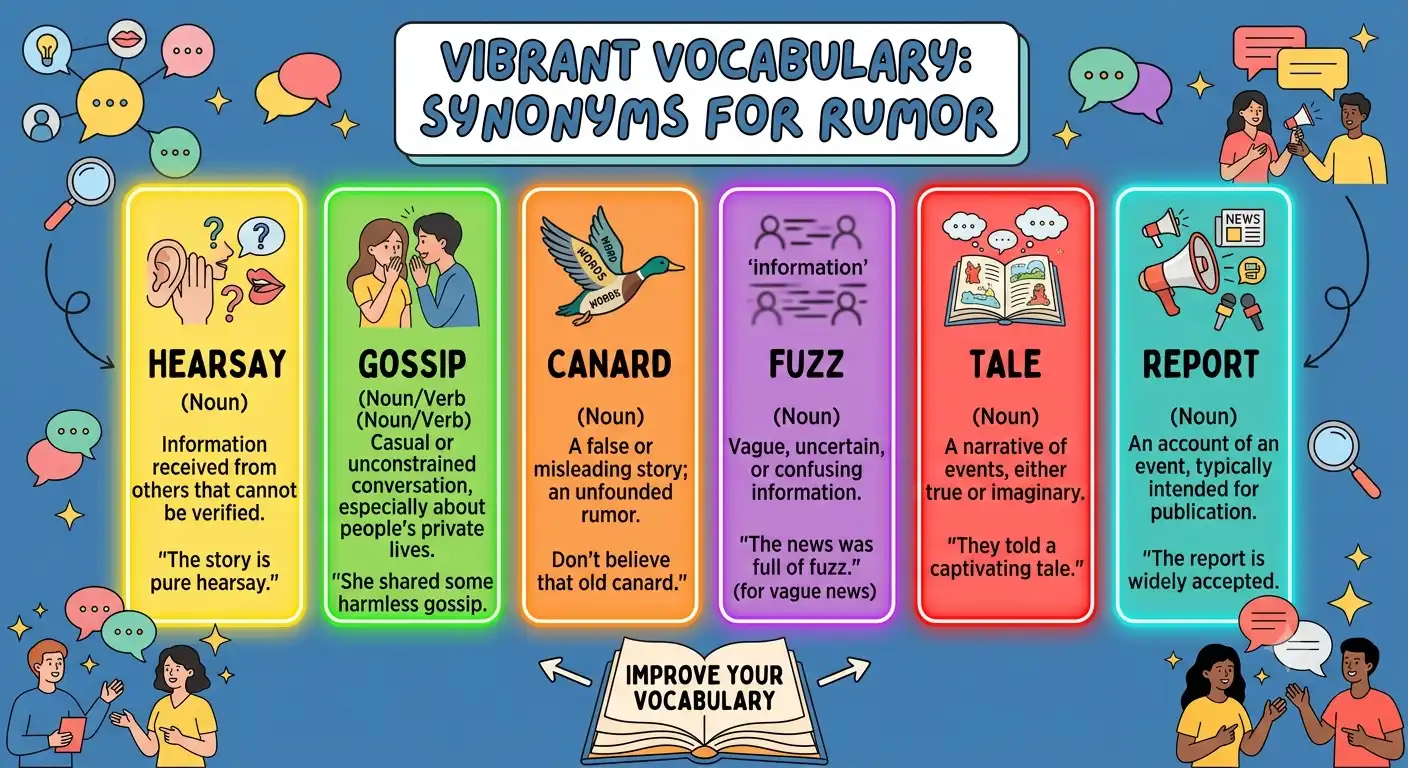
Learning effective synonyms for rumor allows you to describe unverified stories, office chatter, and widespread news with exact precision. When you master different synonyms for rumor, you upgrade your descriptive vocabulary and express complex social situations clearly. Exploring varied synonyms for rumor empowers writers, students, and speakers to choose the exact word for every tone.
Imagine walking into your office kitchen on a Monday morning and hearing two colleagues speaking in hushed tones about major company changes. Nobody has read an official announcement, yet everyone shares the same unconfirmed story. This everyday situation highlights how unverified information spreads quickly in human groups. A rumor is simply a story or statement that people pass around when they do not know for sure if it is true.
Understanding this word helps students write sharper essays, enables content writers and bloggers to craft engaging headlines, and gives daily English users better social vocabulary.
“A rumor goes in one ear and out many mouths.”
“Words spoken in secret often echo the loudest across a crowd.”
Linguistic Overview of “Rumor”
Connotative Meaning
The word rumor usually carries a neutral to slightly negative connotation. It implies uncertainty, potential misdirection, and informal communication channels. Depending on context, it can range from harmless curiosity to hurtful intrigue.
Etymology
- Origin: Derived from Middle English romour.
- Root: Traced back to Old French romor and Latin rumor, which means “noise,” “clamor,” or “common talk.”
- Evolution: The word originally referred to general loud noise before evolving into its modern meaning of unverified news passed by word of mouth.
Pronunciation (IPA)
- US:
/ˈruː.mɚ/ - UK:
/ˈruː.mə/
Syllables & Affixation
- Syllables: 2 (
ru·mor) - Base Word: Rumor
- Affixation Patterns:
- Noun/Verb: rumor
- Adjective: rumored
- Present Participle: rumoring
Comparison Table of Key Synonyms
| Keyword | Meaning | Usage Type | Context |
|---|---|---|---|
| Gossip | Casual talk about other people’s personal lives. | Casual | Social circles, friends, informal chat. |
| Hearsay | Information gathered from others rather than direct knowledge. | Professional / Formal | Legal, news, workplace discussions. |
| Scuttlebutt | Informal news or workplace gossip. | Casual / Professional | Workplace, breakrooms, offices. |
| Canard | An unfounded or deliberately misleading story. | Formal | Journalism, media, academic writing. |
| Grapevine | An informal network for spreading information. | Casual / Professional | Organizations, community groups. |
| Speculation | Forming opinions without firm evidence. | Professional / Formal | Finance, news, analytical essays. |
| Whisper | Quiet, secretive talk passed between people. | Emotional / Casual | Drama, literature, storytelling. |
50 Essential Synonyms for Rumor
1. Gossip
- Pronunciation: US
/ˈɡɑː.səp/| UK/ˈɡɒs.ɪp/ - Meaning: Casual talk about other people’s private lives.
- Examples:
- The office kitchen was full of late-night gossip.
- She refused to listen to harmful gossip about her friend.
2. Hearsay
- Pronunciation: US
/ˈhɪr.seɪ/| UK/ˈhɪə.seɪ/ - Meaning: News heard from others without real proof.
- Examples:
- The judge dismissed the statement because it was just hearsay.
- You cannot build a solid argument on mere hearsay.
3. Scuttlebutt
- Pronunciation: US
/ˈskʌt.əl.bʌt/| UK/ˈskʌt.əl.bʌt/ - Meaning: Informal workplace talk or current news.
- Examples:
- What is the latest scuttlebutt near the water cooler?
- The manager ignored the scuttlebutt about upcoming layoffs.
4. Grapevine
- Pronunciation: US
/ˈɡreɪp.vaɪn/| UK/ˈɡreɪp.vaɪn/ - Meaning: An unofficial path where news travels quietly.
- Examples:
- I heard through the grapevine that Mark got promoted.
- News travels fast on the school grapevine.
5. Canard
- Pronunciation: US
/kəˈnɑːrd/| UK/kæˈnɑːd/ - Meaning: A fake story designed to trick people.
- Examples:
- The news report proved that the story was an old canard.
- He published an article to defeat the silly canard.
6. Report
- Pronunciation: US
/rɪˈpɔːrt/| UK/rɪˈpɔːt/ - Meaning: An unconfirmed account of a recent event.
- Examples:
- Early reports say the store will close soon.
- We received a brief report about the traffic jam.
7. Talk
- Pronunciation: US
/tɑːk/| UK/tɔːk/ - Meaning: Common conversation circulating among a group.
- Examples:
- There is a lot of talk about a new park nearby.
- Her sudden decision became the main talk of the town.
8. Buzz
- Pronunciation: US
/bʌz/| UK/bʌz/ - Meaning: Excited or active background chatter about something.
- Examples:
- The new phone created a big buzz online.
- There is a subtle buzz about the team’s victory.
9. Whisper
- Pronunciation: US
/ˈwɪs.pɚ/| UK/ˈwɪs.pə/ - Meaning: Secretive talk shared softly among people.
- Examples:
- Whispers of a secret deal spread across the room.
- She heard quiet whispers regarding the sudden plan.
10. Story
- Pronunciation: US
/ˈstɔːr.i/| UK/ˈstɔː.ri/ - Meaning: A tale that may or may not be true.
- Examples:
- He told a wild story about finding lost gold.
- Do not believe every story you hear on the bus.
“Truth travels slowly, while a rumor flies across the world in seconds.”
11. Tale
- Pronunciation: US
/teɪl/| UK/teɪl/ - Meaning: An imaginative narrative passed along to others.
- Examples:
- The old man shared a fascinating tale of the sea.
- Her excuse turned out to be a made-up tale.
12. Chatter
- Pronunciation: US
/ˈtʃæt.ɚ/| UK/ˈtʃæt.ə/ - Meaning: Fast and informal continuous conversation.
- Examples:
- Constant chatter filled the busy coffee shop.
- Online chatter pointed toward a new movie release.
13. Speculation
- Pronunciation: US
/ˌspek.jəˈleɪ.ʃən/| UK/ˌspek.jəˈleɪ.ʃən/ - Meaning: Guesses made without clear facts.
- Examples:
- Market speculation caused stock prices to shift.
- Her leaves of absence led to widespread speculation.
14. Tattle
- Pronunciation: US
/ˈtæt.əl/| UK/ˈtæt.əl/ - Meaning: Petty or foolish casual talk.
- Examples:
- Ignore the childish tattle in the hallway.
- He disliked listening to daily playground tattle.
15. Insinuation
- Pronunciation: US
/ɪnˌsɪn.juˈeɪ.ʃən/| UK/ɪnˌsɪn.juˈeɪ.ʃən/ - Meaning: An unpleasant hint or indirect suggestion.
- Examples:
- She disliked his quiet insinuation about her work.
- His insinuation upset everyone at the dinner table.
16. Intimation
- Pronunciation: US
/ˌɪn.təˈmeɪ.ʃən/| UK/ˌɪn.tɪˈmeɪ.ʃən/ - Meaning: A subtle or indirect sign of news.
- Examples:
- We received an intimation of policy changes.
- Her smile gave an intimation of good news.
17. Slander
- Pronunciation: US
/ˈslæn.dɚ/| UK/ˈslɑːn.də/ - Meaning: False spoken words meant to damage a reputation.
- Examples:
- Spreading harmful slander can lead to legal trouble.
- He protected his name against wicked slander.
18. Libel
- Pronunciation: US
/ˈlaɪ.bəl/| UK/ˈlaɪ.bəl/ - Meaning: Published false statements that harm someone’s image.
- Examples:
- The paper faced a lawsuit for printing libel.
- She fought back against online libel.
19. Fabrication
- Pronunciation: US
/ˌfæb.rɪˈkeɪ.ʃən/| UK/ˌfæb.rɪˈkeɪ.ʃən/ - Meaning: An invented story made to deceive.
- Examples:
- His entire explanation was a total fabrication.
- Detectives proved the statement was a fabrication.
20. Hoax
- Pronunciation: US
/hoʊks/| UK/həʊks/ - Meaning: A trick played to make people believe a lie.
- Examples:
- The photo of the monster was just a clever hoax.
- Thousands fell for the internet hoax.
21. Falsehood
- Pronunciation: US
/ˈfɑːls.hʊd/| UK/ˈfɔːls.hʊd/ - Meaning: A statement that is not true.
- Examples:
- Telling a falsehood ruins mutual trust.
- The article was filled with obvious falsehoods.
22. Untruth
- Pronunciation: US
/ʌnˈtruːθ/| UK/ʌnˈtruːθ/ - Meaning: A factually incorrect assertion.
- Examples:
- She corrected the untruth during the meeting.
- Repeating an untruth damages credibility.
23. Dirt
- Pronunciation: US
/dɝːt/| UK/dɜːt/ - Meaning: Shocking or scandalous news about someone.
- Examples:
- They sat together to trade juicy dirt.
- The tabloid published personal dirt about stars.
24. Dish
- Pronunciation: US
/dɪʃ/| UK/dɪʃ/ - Meaning: Informal chatter or interesting personal stories.
- Examples:
- Come sit down and give me the latest dish.
- She spilled the dish about the party.
25. Prattle
- Pronunciation: US
/ˈpræt.əl/| UK/ˈpræt.əl/ - Meaning: Meaningless or simple ongoing talk.
- Examples:
- Idle prattle filled the room during lunch.
- He tuned out the endless prattle around him.
26. Leak
- Pronunciation: US
/liːk/| UK/liːk/ - Meaning: Secret information disclosed to the public.
- Examples:
- The government investigated the security leak.
- A sudden leak revealed the main plot details.
27. Noise
- Pronunciation: US
/nɔɪz/| UK/nɔɪz/ - Meaning: Public chatter that creates general distraction.
- Examples:
- Do not focus on background media noise.
- The sudden announcement caused a lot of noise.
28. Murmur
- Pronunciation: US
/ˈmɝː.mɚ/| UK/ˈmɜː.mə/ - Meaning: A low, quiet sound of continuous talk.
- Examples:
- A soft murmur of doubt filled the quiet hall.
- Murmurs of discontent spread through the crowd.
29. Tidbit
- Pronunciation: US
/ˈtɪd.bɪt/| UK/ˈtɪd.bɪt/ - Meaning: A small and interesting piece of news.
- Examples:
- She shared a fun tidbit about her trip.
- Every tidbit of news was eagerly received.
30. Invention
- Pronunciation: US
/ɪnˈven.ʃən/| UK/ɪnˈven.ʃən/ - Meaning: Something created completely by imagination.
- Examples:
- That wild story was a complete invention.
- His excuse was a pure literary invention.
31. Fiction
- Pronunciation: US
/ˈfɪk.ʃən/| UK/ˈfɪk.ʃən/ - Meaning: Something that is untrue or fabricated.
- Examples:
- The dramatic claims were pure fiction.
- Separating fact from fiction takes careful thought.
32. Yarns
- Pronunciation: US
/jɑːrnz/| UK/jɑːnz/ - Meaning: Long or exaggerated stories.
- Examples:
- Sailors love telling adventurous yarns.
- Grandfather spun entertaining yarns by the fire.
33. Spill
- Pronunciation: US
/spɪl/| UK/spɪl/ - Meaning: Information let out unexpectedly.
- Examples:
- She gave us a full spill of the events.
- His unexpected spill surprised all listeners.
34. Clamor
- Pronunciation: US
/ˈklæm.ɚ/| UK/ˈklæm.ə/ - Meaning: Loud and demanding public discussion.
- Examples:
- Public clamor led to immediate policy review.
- The sudden clamor died down by evening.
35. Supposition
- Pronunciation: US
/ˌsʌp.əˈzɪʃ.ən/| UK/ˌsʌp.əˈzɪʃ.ən/ - Meaning: An idea assumed to be true without proof.
- Examples:
- His theory rests on simple supposition.
- Clear evidence disproved their original supposition.
36. Conjecture
- Pronunciation: US
/kənˈdʒek.tʃɚ/| UK/kənˈdʒek.tʃə/ - Meaning: An opinion formed with incomplete facts.
- Examples:
- His conclusion was based on pure conjecture.
- Scientists avoid using unproven conjecture.
37. Allegation
- Pronunciation: US
/ˌæl.əˈɡeɪ.ʃən/| UK/ˌæl.ɪˈɡeɪ.ʃən/ - Meaning: A claim that someone did wrong, without proof yet.
- Examples:
- Police checked into the serious allegation.
- She denied every false allegation made.
38. Smear
- Pronunciation: US
/smɪr/| UK/smɪə/ - Meaning: An effort to damage someone’s reputation with lies.
- Examples:
- The campaign launched a nasty smear attack.
- He defended his record against the smear.
39. On-dit
- Pronunciation: US
/ˌɒnˈdiː/| UK/ˌɒnˈdiː/ - Meaning: A piece of flying rumor or common tale.
- Examples:
- Local society loved every stylish on-dit.
- The magazine published the latest on-dit.
40. Babel
- Pronunciation: US
/ˈbeɪ.bəl/| UK/ˈbeɪ.bəl/ - Meaning: A confused sound of many voices talking at once.
- Examples:
- A babel of voices greeted us at the entry.
- The market hall was full of noisy babel.
41. Jabber
- Pronunciation: US
/ˈdʒæb.ɚ/| UK/ˈdʒæb.ə/ - Meaning: Rapid, excited, or foolish talk.
- Examples:
- I could not understand their fast jabber.
- Loud jabber echoed down the hallway.
42. Gab
- Pronunciation: US
/ɡæb/| UK/ɡæb/ - Meaning: Easy, rapid conversational chatter.
- Examples:
- They enjoyed an afternoon of light gab.
- She has the gift of gab when telling stories.
43. Whiff
- Pronunciation: US
/wɪf/| UK/wɪf/ - Meaning: A faint trace or slight hint of news.
- Examples:
- We caught a whiff of upcoming changes.
- There was a whiff of mystery in the air.
44. Hint
- Pronunciation: US
/hɪnt/| UK/hɪnt/ - Meaning: An indirect suggestion or tiny clue.
- Examples:
- He dropped a helpful hint about the test.
- She gave no hint regarding her plans.
45. Idle Talk
- Pronunciation: US
/ˈaɪ.dəl tɑːk/| UK/ˈaɪ.dəl tɔːk/ - Meaning: Conversation that has no serious purpose or truth.
- Examples:
- Do not spend your time on idle talk.
- Wise people pay little mind to idle talk.
46. Myth
- Pronunciation: US
/mɪθ/| UK/mɪθ/ - Meaning: A widely held but false belief or story.
- Examples:
- The idea that carrots grant night vision is a myth.
- Teachers worked hard to bust the common myth.
47. Unconfirmed News
- Pronunciation: US
/ˌʌn.kənˈfɝːmd nuːz/| UK/ˌʌn.kənˈfɜːmd njuːz/ - Meaning: Information shared before facts are verified.
- Examples:
- Journalists avoid printing unconfirmed news.
- The team waited instead of acting on unconfirmed news.
48. Word of Mouth
- Pronunciation: US
/wɝːd əv maʊθ/| UK/wɜːd əv maʊθ/ - Meaning: Spoken communication passed naturally from person to person.
- Examples:
- The small restaurant grew popular through word of mouth.
- Word of mouth spread news of the event quickly.
49. Earworm Story
- Pronunciation: US
/ˈɪr.wɝːm ˈstɔːr.i/| UK/ˈɪə.wɜːm ˈstɔː.ri/ - Meaning: A persistent narrative that sticks in public memory.
- Examples:
- The catchy local legend became an earworm story.
- Everyone remembered that strange earworm story.
50. Buzzing
- Pronunciation: US
/ˈbʌz.ɪŋ/| UK/ˈbʌz.ɪŋ/ - Meaning: Continuous active chatter or news movement.
- Examples:
- The room was buzzing with excitement over the plan.
- Public buzzing increased right before the reveal.
Antonyms of Rumor
- Fact: Something known or proven to be true.
- Truth: The actual state of matter or reality.
- Certainty: A state of absolute freedom from doubt.
- Verification: Official evidence that proves truth.
- Confirmation: Formal approval or validation of news.
Prototype Meaning and Categorization
The prototype concept of a rumor centers on unverified social information. It functions as a informal communication mechanism within human networks.
                  [ UNVERIFIED INFORMATION ]
                              |
       +----------------------+----------------------+
       |                                             |
[ CASUAL SOCIAL ]                             [ FORMAL / MEDIA ]
 - Gossip                                      - Hearsay
 - Scuttlebutt                                 - Speculation
 - Grapevine                                   - Canard
 - Chatter                                     - Allegation
Frequently Asked Questions (FAQ)
1. What is the main difference between a rumor and gossip?
A rumor usually focuses on unverified facts or news events (e.g., company mergers or closures), whereas gossip focuses specifically on personal or private details about individuals.
2. Is hearsay the same as a rumor?
Hearsay is a specific legal and formal term describing secondhand testimony, whereas rumor is a general word for unconfirmed stories passed among people socially.
3. Can a rumor turn out to be true?
Yes. A rumor is defined by its lack of confirmation at the time of telling, not whether it is ultimately true or false.
4. What is a “canard” in English?
A canard is an old or deliberately unfounded story or rumor designed to mislead the public.
5. How can writers choose the right synonym for rumor?
Choose based on context: use scuttlebutt for workplace settings, hearsay for formal or legal contexts, gossip for social talk, and speculation for news or financial discussions.
Conclusion
Expanding your command of synonyms for rumor transforms how you express information, tell stories, and craft compelling arguments. Whether you write analytical essays, publish engaging blog posts, or speak in professional settings, choosing precise terms like scuttlebutt, hearsay, or canard adds clarity and nuance to your vocabulary.
When you replace repetitive words with targeted synonyms for rumor, your communication becomes sharp and dynamic. Try incorporating these newly learned words into your daily emails, academic papers, and casual discussions to build lasting confidence in your English skills.
“Language is the dress of thought; choose your words with care.”
“Precision in speech reflects clarity in mind.”

Thomas Walker is a professional English consultant and content strategist with over eleven years of experience working with technology companies, business writers, and content teams who need precise, modern vocabulary guidance (Biography).